
Language rules pose challenge for immigrants
Citizenship denied without proof
Advertisement
Read this article for free:
or
Already have an account? Log in here »
We need your support!
Local journalism needs your support!
As we navigate through unprecedented times, our journalists are working harder than ever to bring you the latest local updates to keep you safe and informed.
Now, more than ever, we need your support.
Starting at $15.99 plus taxes every four weeks you can access your Brandon Sun online and full access to all content as it appears on our website.
Subscribe Nowor call circulation directly at (204) 727-0527.
Your pledge helps to ensure we provide the news that matters most to your community!
To continue reading, please subscribe:
Add Brandon Sun access to your Free Press subscription for only an additional
$1 for the first 4 weeks*
- Enjoy unlimited reading on brandonsun.com
- Read the Brandon Sun E-Edition, our digital replica newspaper
*Your next Free Press subscription payment will increase by $1.00 and you will be charged $20.95 plus GST for four weeks. After four weeks, your payment will increase to $24.95 plus GST every four weeks.
Read unlimited articles for free today:
or
Already have an account? Log in here »
Hey there, time traveller!
This article was published 15/10/2012 (4985 days ago), so information in it may no longer be current.
Starting next month, if you want to be a citizen, you better talk like a Canadian.
For the first time in Canada’s history, people applying for citizenship will have to provide documented proof of their proficiency in either official language.
It’s good for the country, federal government spokespeople say, pointing to studies linking language ability to income levels.
But for a vulnerable minority, the new rules mean citizenship will be out of reach, say refugee advocates.
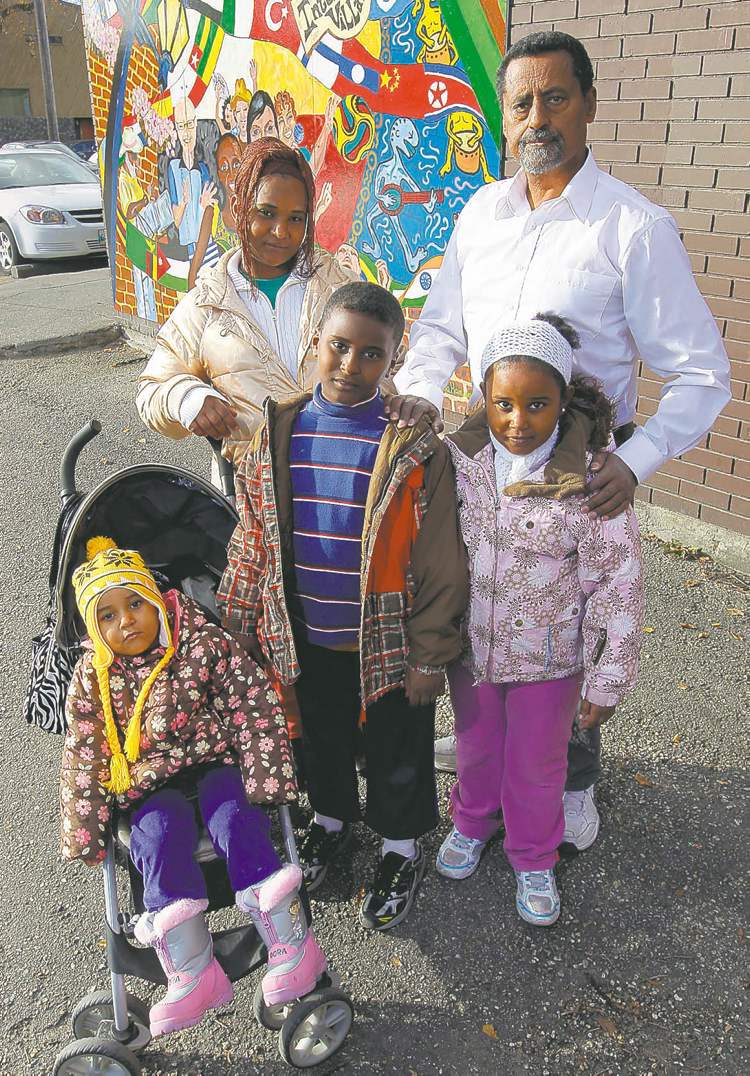
“It’s not fair,” said Ali Saeed, who has interpreted for people who took their citizenship test verbally administered by a citizenship court judge.
They’re not people who snuck into Canada illegally, said the human rights activist. They’re people who were forced to leave home, he said.
“Believe me, no one chooses to become a refugee,” said Saeed, who was tortured in Ethiopia before he came to Winnipeg as a political refugee 30 years ago. The refugees were approved by the United Nations and accepted by Canada, said the former refugee who is now a Winnipeg business owner.
“They’re paying taxes and respect Canadian rules and laws,” Saeed said.
But becoming a citizen is getting more difficult and costly for some, says the Canadian Council for Refugees.
Until Nov. 1, adults pay $200 each to apply for citizenship before taking the test. If they struggle, a citizenship judge can quiz them verbally, said Janet Dench, the council’s executive director.
After Nov. 1, applicants will have to provide proof of their language ability up front.
The government estimates 27 per cent of applicants will need to pay for testing because they lack documentary proof of their language competency, the council said in a news release.
Dench estimates it will cost each refugee about $250. Many newcomers to Canada already speak English or French but lack documented proof such as high school certificates, the council said. This is especially the case with refugees, who are often forced to travel without their personal documents or who may have learned languages informally, it said.
Other newcomers learn after arriving in Canada but not in a formal language training course, the council said. That includes resettled refugees who forgo language training in order to work to pay back their transportation loan from the government, it said.
Saeed worries the new language requirement will keep citizenship out of reach for some women.
Chilot Zegeye has three young children and, like many other stay-at-home moms, has fewer opportunities to learn English because she’s not mixing with English speakers at school or in the workplace, Saeed said.
“They’re in the home and have less contact with (fewer) people who are born here,” Saeed said.
Zegeye is the only person in her home without citizenship, he said.
“It’s very tough,” said Saeed, who took his citizenship test in 1987. “It was very easy,” he recalled.
“Now the test has gotten harder.”
He recalled interpreting the test for one woman who failed. One of the questions she couldn’t answer was about a pioneering women’s rights activist.
Feminism was a foreign concept to her and she had no answer, said Saeed.
She’s also taking care of her husband and children, who will have no problem with the test, he said. But citizenship is out of her reach, said Saeed. Without citizenship, she’ll never be secure, he added.
A spokeswoman for Citizenship and Immigration said they wouldn’t rule out foregoing the language requirement under special circumstances “on a case-by-case basis.”
carol.sanders@freepress.mb.ca
History
Updated on Monday, October 15, 2012 9:55 AM CDT: Typo fixed