
No mandate for student laptops: BSD
Advertisement
Read this article for free:
or
Already have an account? Log in here »
We need your support!
Local journalism needs your support!
As we navigate through unprecedented times, our journalists are working harder than ever to bring you the latest local updates to keep you safe and informed.
Now, more than ever, we need your support.
Starting at $15.99 plus taxes every four weeks you can access your Brandon Sun online and full access to all content as it appears on our website.
Subscribe Nowor call circulation directly at (204) 727-0527.
Your pledge helps to ensure we provide the news that matters most to your community!
To continue reading, please subscribe:
Add Brandon Sun access to your Free Press subscription for only an additional
$1 for the first 4 weeks*
- Enjoy unlimited reading on brandonsun.com
- Read the Brandon Sun E-Edition, our digital replica newspaper
*Your next Free Press subscription payment will increase by $1.00 and you will be charged $20.95 plus GST for four weeks. After four weeks, your payment will increase to $24.95 plus GST every four weeks.
Read unlimited articles for free today:
or
Already have an account? Log in here »
Hey there, time traveller!
This article was published 17/08/2012 (5044 days ago), so information in it may no longer be current.
The hand-crank pencil sharpener in the back of the classroom is quickly becoming an antique, as students lead the march of technology into everyday learning.
E-learning is no longer a method of the future; and last year a school in Winnipeg took the concept to the next level.
In a pilot project, Dakota Collegiate mandated that all Grade 9 students have a laptop or similar device for school. The pilot, aptly named the 21st Century Learning Project, was deemed such a success that this year all Grade 9 and 10 students will be included in furthering the mandate.
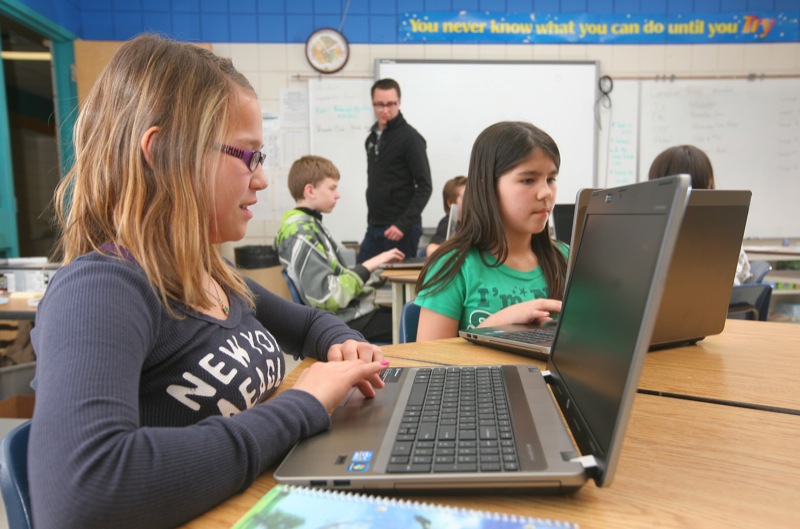
The program has caught the attention of school trustees and parents across the province and Brandon School Division Supt. Donna Michaels said the division is aware of the project, but has no plans of instituting a mandate that would require students to have a laptop in Brandon.
“We won’t mandate that a parent goes out and spends $300-400 on a net-book because that’s not fair,” Michaels said.
The school division has instead set a goal of having mobile computing devices in all Brandon school classrooms by 2014, according to Michaels, but access to the devices is a responsibility she believes is incumbent on the division to provide.
“There has to be accessibility and it’s up to division and districts to provide that,” Michaels said.
One of the biggest concerns for Michaels is providing an even playing field for all students in Brandon.
“There is an issue of equity,” she said, adding that the division encourages parents who want to purchase personal devices for their children, but that it is the division’s responsibility to ensure all students have equal access to the technology.
There’s also an issue of cost.
While the division continues to press the province for more funding ahead of a provincial mandate to limit Kindergarten to Grade 3 classrooms to 20 students by the end of the next four school years, there is a need for a significant investment in technology in the classroom, according to Michaels.
“It is an expensive proposition, but the question becomes: How do we make sure our students are equipped for learning and life in the 21st century where technology is ubiquitous?” Michaels asked. “It’s a matter of our priorities and how do we do it thoughtfully and with care so we are not just adding more burden to taxpayers.”
The province has also been monitoring the project at Dakota Collegiate, according to deputy education minister Gerald Farthing.
“It looks like it is going to be a part of the future of schooling and we need to have a good understanding of how it works and ensure that it is effective,” Farthing said.
But like Michaels, Farthing doesn’t expect the province to mandate personal devices in the classroom.
“I don’t see the province mandating it in the foreseeable future,” Farthing said. “If laptops work in the classroom, then that will be enough to get them in the classroom and people will want to have them.”
He said the province is looking at funding formulas to address the technology gap and ensure there is equity and accessability within the system.
The issue has also raised new questions as to what tools children use in the classroom that taxpayers be on the hook for.
Right now, the province provides an information technology grant that schools can apply for, but there are suggestions that a partnership between the province and industry should be struck to lessen the taxpayer’s burden.
While Farthing said the province would support private-public partnerships in the delivery of technology to students, he said the burden of proof lies with the companies.
“The onus should be on them to show us how their product contributes to learning,” Farthing said. “It’s not enough for the technology to simply bring more information to the kids, and it’s not enough for it to mean kids can communicate more, it has to mean that the kids are learning more.”
The new technologies will also force the need for further investment geared toward giving teachers time and tools to re-learn the technologies that are applicable to helping the delivery of curriculums to students.
Brandon University already offers technology courses for prospective teachers, according to Shelley Kokorudz, director of field experience for the university.
“Technology has changed so fast that part of the problem for fast integration and state-of-the-art equipment is that, in some cases there isn’t the infrastructure in place,” Kokorudz said. “In the next decade infrastructure upgrades are going to be a challenge and it’s costly. Each time a new technology is introduced, teachers have to keep up so they can show children how to use it responsibly.”
While the cost is steep, the benefit is enormous, Kokorudz said. The new technology not only engages children who are familiar with the devices, it also allows teachers to push the boundaries of teaching methods.
“The upside is that the creativity in the classroom has really grown because there is so much information on the Internet around teaching ideas and strategies,” Kokorudz said. “Teachers are doing a lot more collaborating.”
Over the past decade, the question of whether technology will influence schools in the classroom has been answered. The question now is, how to effectively use that technology? And although it will continue to play a larger role in students lives, Michaels said there is still no substitution for the teacher in the classroom.
“Teachers cannot be replaced by machines,” Michaels said. “That fundamental human relationship is critical to teaching and learning.”
» ctweed@brandonsun.com