Varying drought conditions plague Westman
Advertisement
Read this article for free:
or
Already have an account? Log in here »
We need your support!
Local journalism needs your support!
As we navigate through unprecedented times, our journalists are working harder than ever to bring you the latest local updates to keep you safe and informed.
Now, more than ever, we need your support.
Starting at $15.99 plus taxes every four weeks you can access your Brandon Sun online and full access to all content as it appears on our website.
Subscribe Nowor call circulation directly at (204) 727-0527.
Your pledge helps to ensure we provide the news that matters most to your community!
To continue reading, please subscribe:
Add Brandon Sun access to your Free Press subscription for only an additional
$1 for the first 4 weeks*
- Enjoy unlimited reading on brandonsun.com
- Read the Brandon Sun E-Edition, our digital replica newspaper
*Your next Free Press subscription payment will increase by $1.00 and you will be charged $20.95 plus GST for four weeks. After four weeks, your payment will increase to $24.95 plus GST every four weeks.
Read unlimited articles for free today:
or
Already have an account? Log in here »
Hey there, time traveller!
This article was published 22/06/2019 (2544 days ago), so information in it may no longer be current.
While Brandon has seen its fair share of rain this past week, many parts of Westman are experiencing drought conditions.
The Canadian Drought Monitor, an online drought map produced by the federal government, lists different parts of Westman as being either abnormally dry, in a moderate drought or in a severe drought. These conditions are assigned by comparing current weather conditions to historic conditions.
The area around Killarney is listed as abnormally dry — an event occurring once every three to five years. The bulk of Westman is listed as being in a moderate drought — an event that occurs every five to 10 years. A bubble containing Virden, Minnedosa and Neepawa at its extreme eastern edge is listed as a severe drought — an event occurring every 10 to 20 years.
Though conditions in Westman are dry, central Saskatchewan is drier, being listed on the Drought Monitor as undergoing a once-in-20-to-25 year drought.
“We go through cycles of wet and dry,” said Trevor Hadwen, an agriclimate specialist with Agriculture and Agri-Food Canada. “The last number of years have been dry, but before that we had quite a long period with excess moisture. You get used to that and adapt to those issues and then have to swing back to the other side of things.”
Years of dry weather have created a compounding problem as the moisture left over in the subsoil has been depleted by thirsty plants searching for moisture and then have not been replenished. Hadwen said Westman is running a moisture deficit of 200 millimetres.
Baljeet Singh, an agribusiness instructor at Assiniboine Community College, has advice for crop producers looking at adapting to drier conditions: try growing pulses and soybeans.
“The good thing with the pulses and soybeans is that they require less moisture, and they can tolerate more drought,” said Singh. “When we look at our canola prices and markets, it is a good opportunity for Manitoba farmers to diversify their cropping system.”
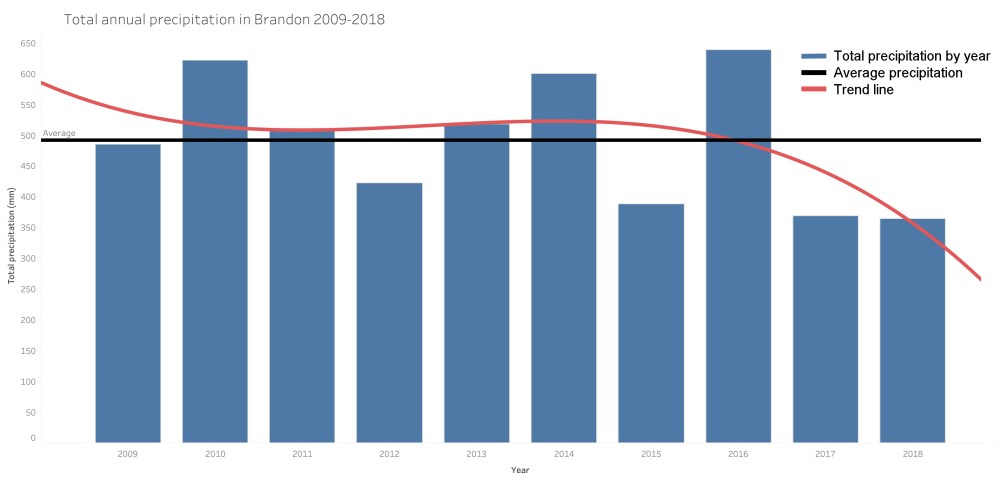
An analysis of historical data from Environment Canada’s weather station north of Brandon Municipal Airport done by The Sun shows that during the last 60 years, from 1959-2018, there has been on average 468.5 mm of precipitation. In the past five years, Brandon has had below-average annual precipitation levels three times, including 2017 and 2018.
The wettest year in that time was 1975, when 691.1 mm of precipitation fell on Brandon. The driest was 1966, where only 288.5 mm of precipitation fell.
Hadwen also outlined problems for livestock producers caused by these dry conditions, in that a lot of cattle ranchers have depleted their supply of feed over the past several years.
“They are relying heavily on getting some hay cut this spring and some feeds from pastures, but the production of pastures as well as hay yields haven’t been very productive this year due to the cool spring we had and then the dry, hot conditions we’ve had more recently,” he said.
“A lot of producers don’t have enough feed to bother cutting.”
Hadwen said producers are faced with multiple unappealing choices. They can let their livestock graze down their pastures far enough that they won’t be productive later in the year, move cattle to their hay lands and give up on their hay growth, buy feed from an external source, convert a field to grow feed or even reduce herd sizes.
According to Hadwen, the price of feed has doubled in some regions of Canada and the optimal time of year for feed growth has already passed by. The amount of water isn’t the only concern, either. Hadwen said some areas have seen increased levels of water salinity, making it unpotable.
Hadwen said that June and July are the most important months for crops to get healthy amounts of rain, so producers will need to see if Mother Nature can make up the difference.
According to the historical data, it has rained 39.5 mm this month as of June 20. On June 15, it rained 24.1 mm — the most precipitation in a single day this year. This recent rain has been helpful to agricultural producers, but it hasn’t been enough to make up for multiple years of drier-than-average conditions.
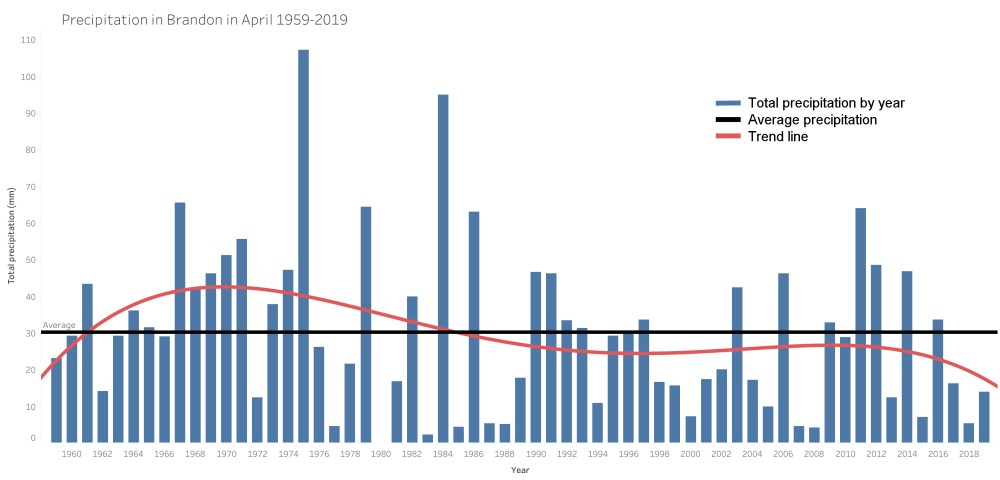
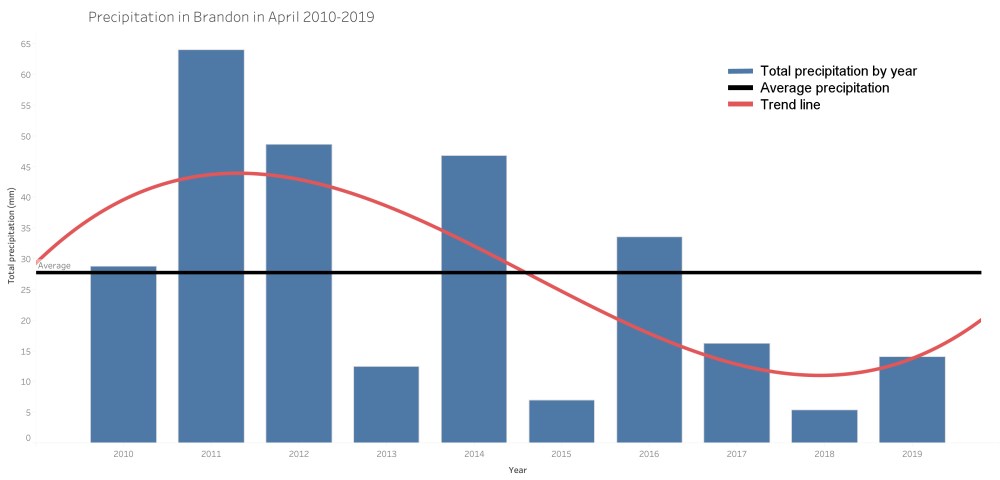
Much of this below-average precipitation has come in the early months of the growing season. Though precipitation rose to 14 mm in April 2019 from 5.4 mm in April 2018, the past three Aprils have all fallen short of the 60-year average of 30.2 mm. No April has been drier than in 1980, where only trace precipitation was detected.
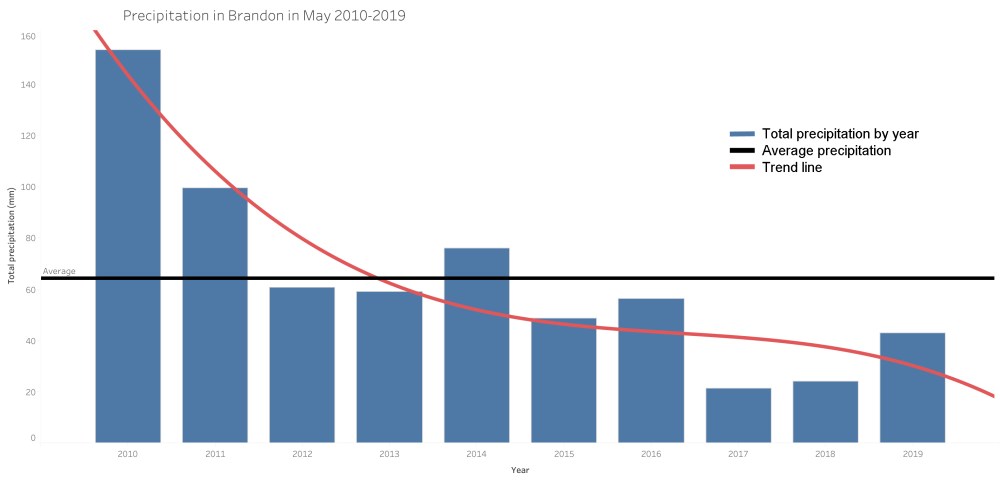
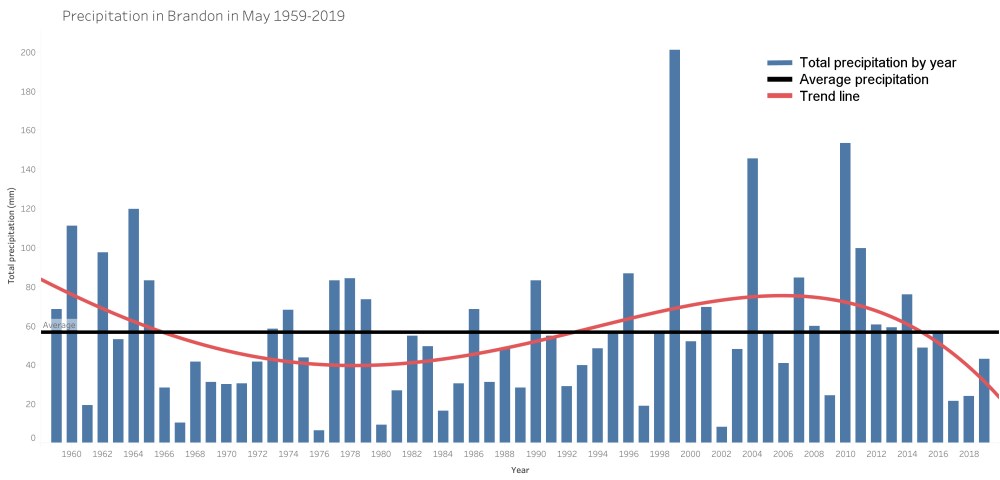
May 2019 also had more precipitation than its 2018 counterpart, climbing to 42.9 mm from 24 mm last year. However, the past three Mays have also fallen short of the 60-year average, 56.6 mm.
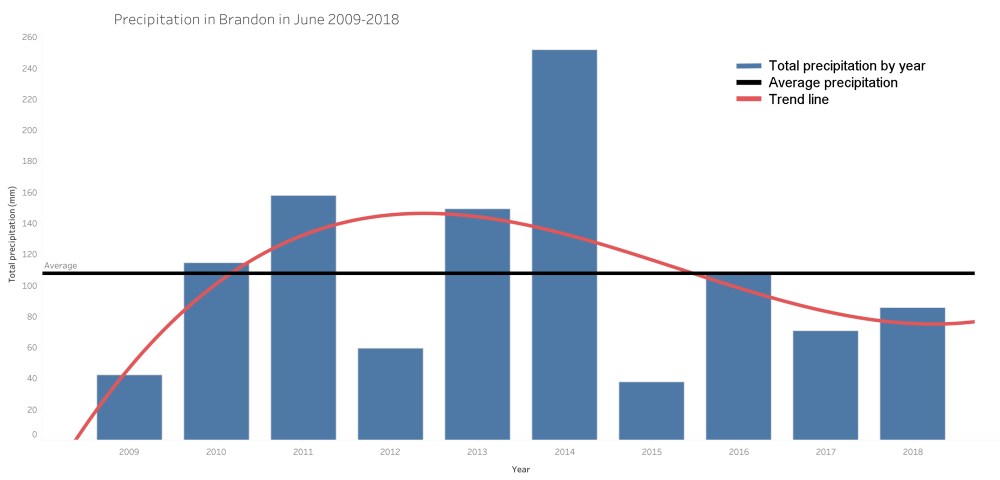
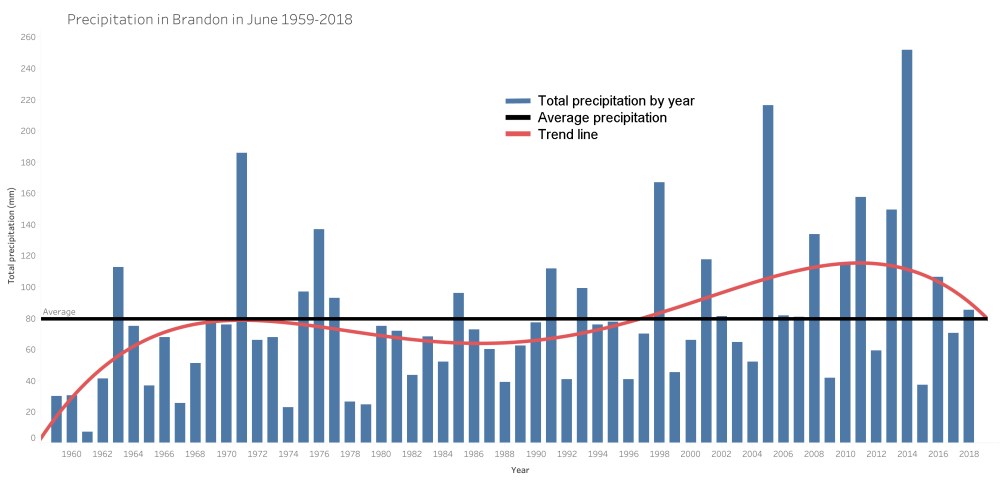
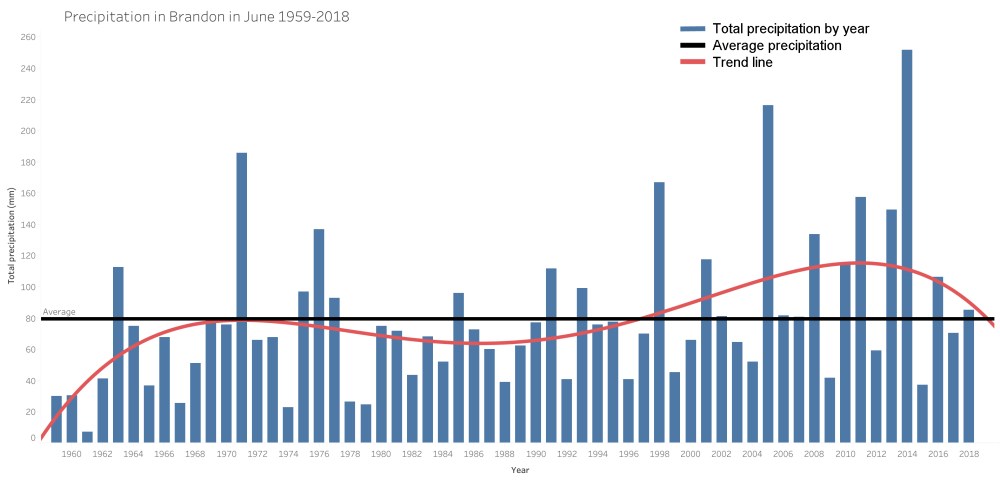
Recent Junes have been friendlier for crops. June 2014 saw 251.6 mm of rain, the highest single-year total in the last 60 years. Three out of the last five Junes have been above average in terms of rain, with 2017 a slightly lower 70.6 mm compared to the 60-year average of 79.4.
For producers, there was an early seeding of crops this year because of an early spring. Low levels of soil moisture impeded crop germination and emergence. Other crops came up early and were hit by a late frost.
Keystone Agricultural Producers president Bill Campbell said some crops were killed outright by the frost while other were made vulnerable by the cold to pests such as flea beetles and cutworms.
“There has been … significant reseeding and spraying for flea beetles and cutworms,” said Campbell. “Especially in the southwest part of the province. This (recent) rain will help for those that have reseeded. This will hopefully ensure that there’s good, even germination and get the crop growing.”
“There are people seeding again and dealing with delayed crop emergence,” said Hadwen. “Delayed crop emergence is going to possibly lead to reduced yields and possibly increase frost risk in the fall period.”
» cslark@brandonsun.com
» Twitter: @ColinSlark