
NATIONAL VIEWPOINT: Police militarization damaging public trust
Advertisement
Read this article for free:
or
Already have an account? Log in here »
We need your support!
Local journalism needs your support!
As we navigate through unprecedented times, our journalists are working harder than ever to bring you the latest local updates to keep you safe and informed.
Now, more than ever, we need your support.
Starting at $15.99 plus taxes every four weeks you can access your Brandon Sun online and full access to all content as it appears on our website.
Subscribe Nowor call circulation directly at (204) 727-0527.
Your pledge helps to ensure we provide the news that matters most to your community!
To continue reading, please subscribe:
Add Brandon Sun access to your Free Press subscription for only an additional
$1 for the first 4 weeks*
- Enjoy unlimited reading on brandonsun.com
- Read the Brandon Sun E-Edition, our digital replica newspaper
*Your next Free Press subscription payment will increase by $1.00 and you will be charged $20.95 plus GST for four weeks. After four weeks, your payment will increase to $24.95 plus GST every four weeks.
Read unlimited articles for free today:
or
Already have an account? Log in here »
Hey there, time traveller!
This article was published 06/06/2023 (1083 days ago), so information in it may no longer be current.
Ejaz Choudry, a 62-year-old Mississauga resident in the midst of a mental health crisis, was shot dead by Peel Regional Police’s Tactical and Rescue Unit in June 2020. Choudry’s death renewed public concern about police use of force and draws attention to the use of police tactical units to respond to incidents involving people in mental distress.
Interactions with tactical units can be among the most violent citizen-police encounters. These units rely on the use of military-like weapons, flashbangs, battering rams and a range of other specialized equipment. But the militarization of these police units is not a new phenomenon or trend. Canadian research has highlighted concerns about the increasing use of tactical units at incidents that are regarded as more common or routine.
In October 2022, the Toronto Police Service released a podcast episode about its tactical unit, the Emergency Task Force (ETF). A scene in the episode depicts two ETF officers brandishing and shooting assault rifles with a suppressor and wearing helmets reminiscent of those worn by military personnel.
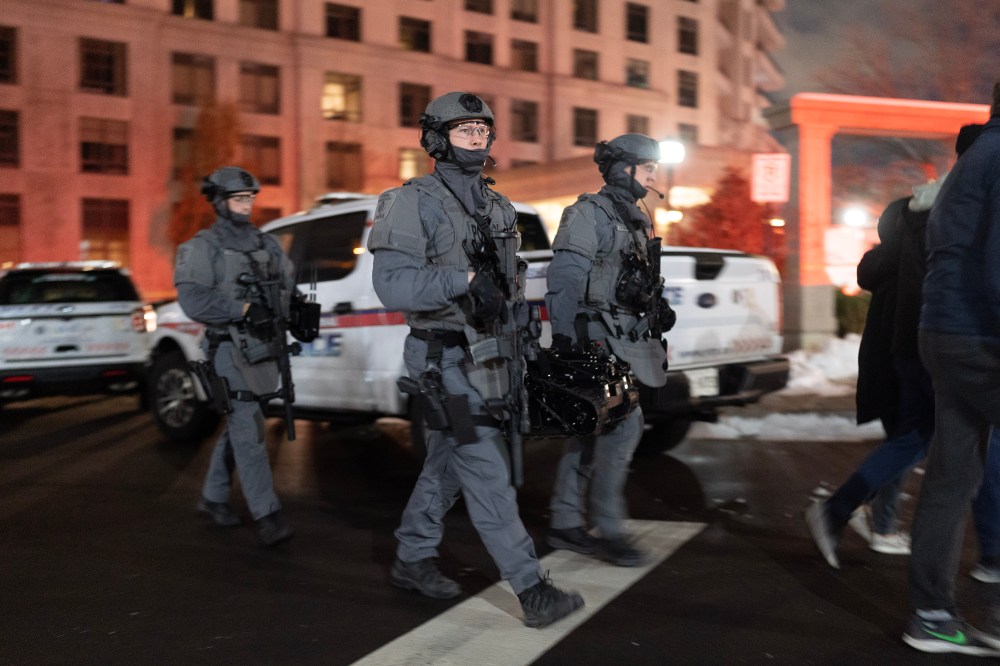
York Regional Police tactical officers respond to the scene of a shooting at a condo building in Vaughan, Ont., on Dec. 18, 2022. Tandeep Sidhu writes that one of the most troubling aspects of increased militarization is how police units are using military technology and tactics on civilians. (File)
Why are police, who are meant to ensure public safety, increasingly mirroring military units designed for warfare?
Mirroring military units
Most people would struggle to distinguish the Toronto Police’s ETF from a military unit. In my research, I aim to understand the lived experiences of individuals who encounter police tactical units. After seeing ETF officers equipped similarly to military units, I began investigating how police are becoming more militarized.
My research, currently under peer review, compared images of Toronto’s ETF to Canadian Armed Forces infantry and American and Canadian special forces units between 2008 and 2023. The research investigated whether police units adopted gear, like helmets, tactical pants and assault rifles, similar to those used by the military. The approach was premised on studying the similarities in equipment and weaponry between military special forces and police tactical units.
The findings show that, from 2016 onward, the Toronto Police’s ETF began to increasingly look more like military special forces units. This is concerning, as these specialized units are tasked with prosecuting wars and killing enemies, whereas the preservation of life is among the central aims of the police.
Tactics used on civilians
Among the most troubling aspects of increased militarization is how police units are using military technology and tactics on civilians. Police tactical units often engage in nighttime or early morning raids, times when it is common to find family members, including children, at home.
There are instances where police raid the wrong home or encounter individuals who are not involved in criminal activity. The trauma from these encounters cannot be understated. Many of the citizens I have interviewed in my research indicate experiencing nightmares, insomnia, having flashbacks and being in a state of constant hypervigilance.
By adopting military technology and tactics, police are treating our cities and communities like theatres of war, and treating civilians as the enemy. The implied message of such militarized equipment is that the civilian population is a threat, and war-like tactics are needed to respond to that threat.
Like other policing practices, the use of tactical units disproportionately affects racialized people, those living with mental illnesses and those in economically marginalized communities. The police-involved deaths of Choudry, Anthony Aust and Taresh Ramroop are reminders of the fatal consequences of militarized policing in Canada.
Tactical officers have also been deployed in response to Indigenous land rights movements. This demonstrates how police rely on heavily militarized responses in numerous contexts, not just criminal activity.
These practices contribute to the dehumanization and criminalization of racialized people and those living in poverty. They encourage an “us vs. them” mentality and ultimately undermine the potential for community-based models of policing.
Equipping police like military units that are tasked with fighting wars and killing enemies undermines the fundamental goal of policing: protecting people. It undermines public trust in the police and damages the very communities the police aim to serve.
» Tandeep Sidhu is a PhD candidate in sociology and legal studies at the University of Waterloo.
» This column was originally published at The Conversation Canada: theconversation.com/ca