
Hush, Shush, Swoosh — the sounds, or lack thereof, of winter
Advertisement
Read this article for free:
or
Already have an account? Log in here »
We need your support!
Local journalism needs your support!
As we navigate through unprecedented times, our journalists are working harder than ever to bring you the latest local updates to keep you safe and informed.
Now, more than ever, we need your support.
Starting at $15.99 plus taxes every four weeks you can access your Brandon Sun online and full access to all content as it appears on our website.
Subscribe Nowor call circulation directly at (204) 727-0527.
Your pledge helps to ensure we provide the news that matters most to your community!
To continue reading, please subscribe:
Add Brandon Sun access to your Free Press subscription for only an additional
$1 for the first 4 weeks*
*Your next subscription payment will increase by $1.00 and you will be charged $20.00 plus GST for four weeks. After four weeks, your payment will increase to $24.00 plus GST every four weeks.
Read unlimited articles for free today:
or
Already have an account? Log in here »
Hey there, time traveller!
This article was published 30/01/2025 (310 days ago), so information in it may no longer be current.
Now that we are, once again, in the heart of darkness … err I mean mid-winter, I am reminded of the seasonal sounds that occur around us. Or perhaps it’s the lack of sound, for winter is the season when a hush falls over the land. At least in rural Manitoba.
Occasionally, Rae and I have had the chance to travel outside Canada, often to places filled with people and their noises. Readers who have travelled to Mexico will understand what I mean. The sound of buses and trucks without mufflers, the crowing of roosters and barking of dogs, and the music from a hundred taxis and restaurants fills the air.
Upon returning home, the silence of our house can be deafening. I find my ears straining to pick up the smallest sound, attempting to reassure my brain that I haven’t been suddenly struck deaf.
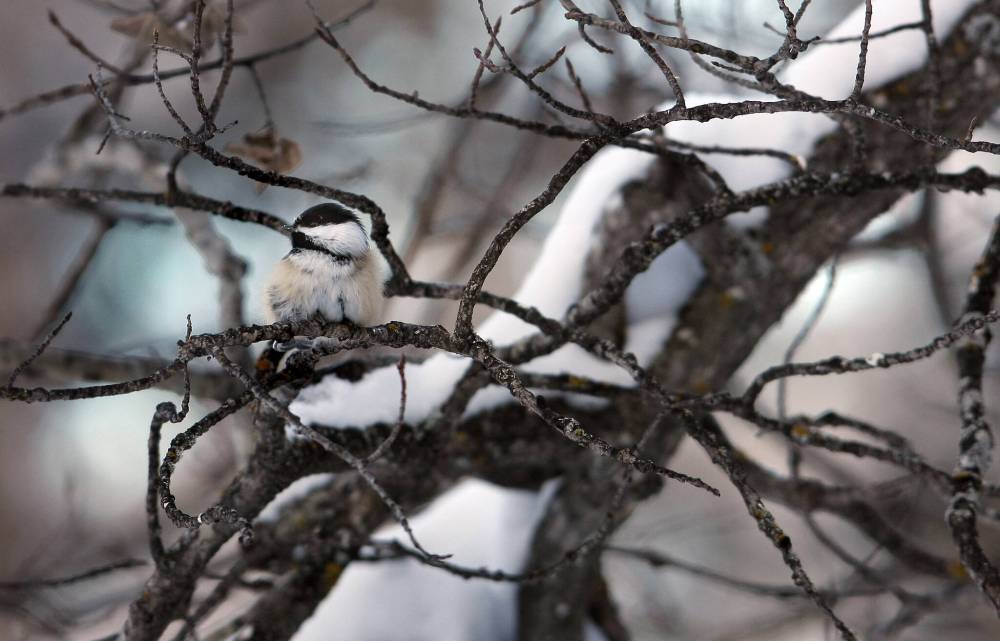
A popular winter resident, a black-capped chickadee sits perched on a branch in Riding Mountain National Park. Even the sound of chickadees chirping seems muted when the weather turns freezing, Ken Kingdon writes. (File)
The out-of-doors, similarly, can be filled with silence. On a calm day our winter world can be impressively, or perhaps oppressively, quiet. The snow dampens the sound and, given that most people are tucked up indoors during the winter, there are few sounds to break the silence.
This eerie muted world can take some getting used to and, as I say, it can feel slightly uncomfortable to be traipsing about without a single sound to be heard other than your boots squeaking in the snow.
When it gets very cold, the quiet deepens further. Even at a busy birdfeeder, most of the birds’ sounds are muffled as if their desire to stay warm trumps the urge to communicate. Or perhaps they are afraid that their calls will freeze in mid-air?
Chickadees quietly lisp their “dee dee” greeting, the woodpeckers tap at the trees with more restraint, and the flocks of evening grosbeaks are muted. Ravens, with their wide range of calls, seem to prefer the quiet as they fly over.
Inevitably, the cold weather breaks its hold, and when the temperatures warm, sounds suddenly abound. It’s as if the birds are saving up all their calls just to rejoice in the warming weather. So much so, that there are times when I just want to say shush.
This particularly applies to blue jays and red squirrels. Minding my own business when working outside, it isn’t unusual to be suddenly scolded by squirrels and irate jays. And they just won’t shut their yaps.
In rare fits of huffiness on my part, Rae has looked out the window on more than one occasion just in time to witness me throwing snowballs at the irritating local red squirrels. This rarely causes these beasts to shush. In fact, it seems to encourage them to make more noise, with their squeaking, hissing, and angry stomping of little feet high up in a tree, well beyond any throw I can muster with my aging spaghetti arms.
If you think I’m just being a crank, you’re probably right. In my defence, though, these noisiest of animals seem to always make their presence known just as I am trying to hear the soft calls of a kinglet or brown creeper, or zero in on the soft tip-tap of a black-backed woodpecker.
Silence isn’t always golden, of course. I have written in the past on how I use the strident calls of blue jays to home in on sleeping owls or roving weasels as they are mobbed by the angry birds. I guess what I am really asking is for a little restraint.
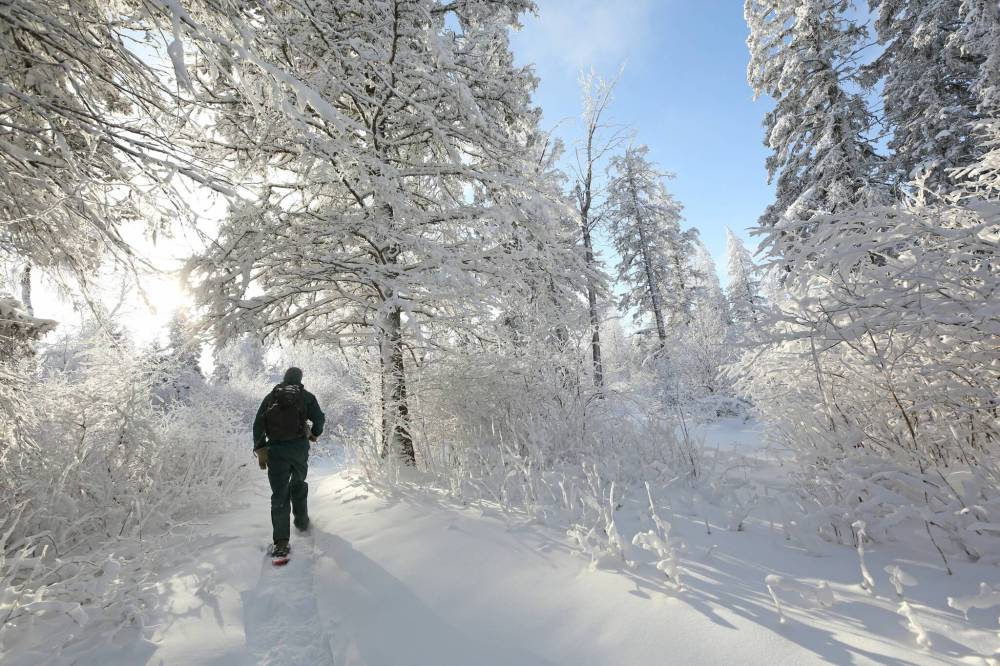
A winter wonderland greets Parks Canada resource conservation officer Tim Town as he follows the snow-covered Bead Lakes Trail during the 2022 Christmas Bird Count in Riding Mountain National Park. (File)
And finally, swoosh. Rae and I are enthusiastic snowshoers and cross-country skiers. As activities, they get us out in even the coldest weather, when silence reigns supreme. Sliding or tromping along the trails allows us to enjoy the quiet, when often the only sound is the clink of ski poles, the crunch of snowshoes, or the creaking of trees in the wind.
Occasionally, when it is snowing, the winter silence is even deeper. It is at these times, when slipping along a darkening forest trail at the end of the day, that I recite the Robert Frost poem “Stopping by Woods on a Snowy Evening” to myself. Its rhymes and rhythm lend themselves perfectly with gliding skis or the steps of a snowshoe-bound moccasin.
Inevitably, even at the quietest times, the silence is broken by the distant whine of a snowmobile or the crackling hiss of a jet flying high overhead, which serve to remind me that I have a warm house to return to … and maybe I’ll turn up the tunes while we make supper.
Thanks to Adrien Clement for sending me a text about crows and robins in Dauphin, and for the questions from David Gamey about wild turkeys. I enjoy hearing from readers, and while I don’t always have the answers to your questions (more like rarely), it’s fun to take a dive down a rabbit hole, so to speak, in the search for information.
» Ken Kingdon lives in the heart of the Riding Mountain Biosphere Reserve. Send him a text at 204-848-5020 if you have stories to share.