
BU prof studies policing in the social media age
Advertisement
Read this article for free:
or
Already have an account? Log in here »
We need your support!
Local journalism needs your support!
As we navigate through unprecedented times, our journalists are working harder than ever to bring you the latest local updates to keep you safe and informed.
Now, more than ever, we need your support.
Starting at $15.99 plus taxes every four weeks you can access your Brandon Sun online and full access to all content as it appears on our website.
Subscribe Nowor call circulation directly at (204) 727-0527.
Your pledge helps to ensure we provide the news that matters most to your community!
To continue reading, please subscribe:
Add Brandon Sun access to your Free Press subscription for only an additional
$1 for the first 4 weeks*
- Enjoy unlimited reading on brandonsun.com
- Read the Brandon Sun E-Edition, our digital replica newspaper
*Your next Free Press subscription payment will increase by $1.00 and you will be charged $20.95 plus GST for four weeks. After four weeks, your payment will increase to $24.95 plus GST every four weeks.
Read unlimited articles for free today:
or
Already have an account? Log in here »
Hey there, time traveller!
This article was published 03/05/2016 (3673 days ago), so information in it may no longer be current.
A professor at Brandon University is helping the nation’s police services figure out how, and how not, to “get personal” online.
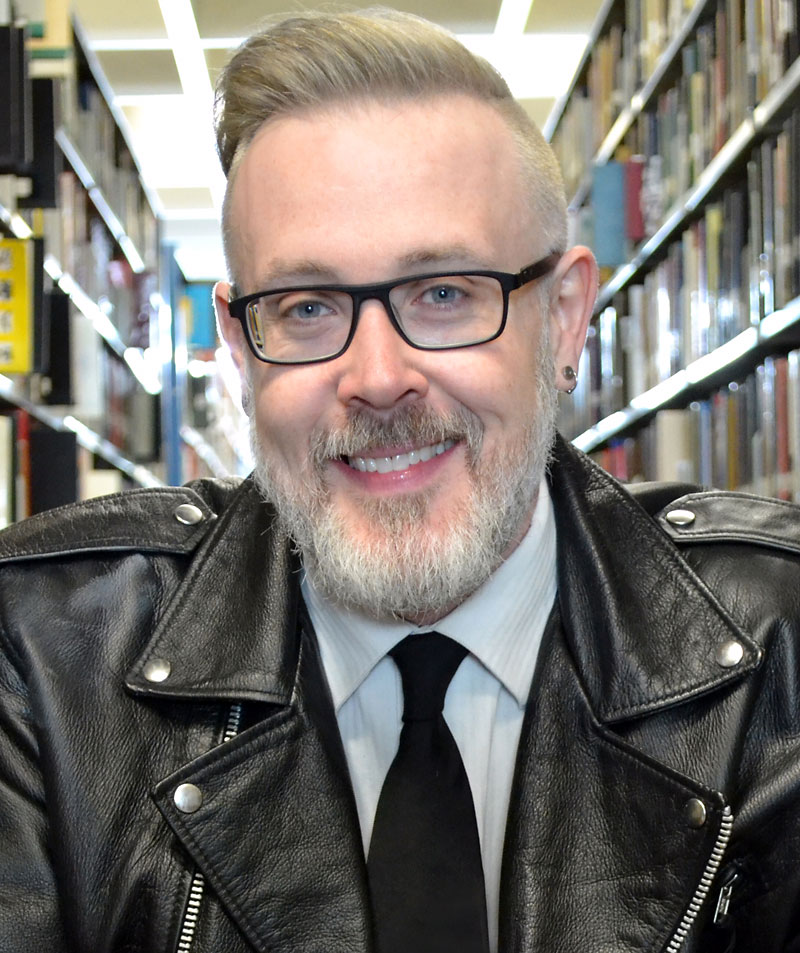
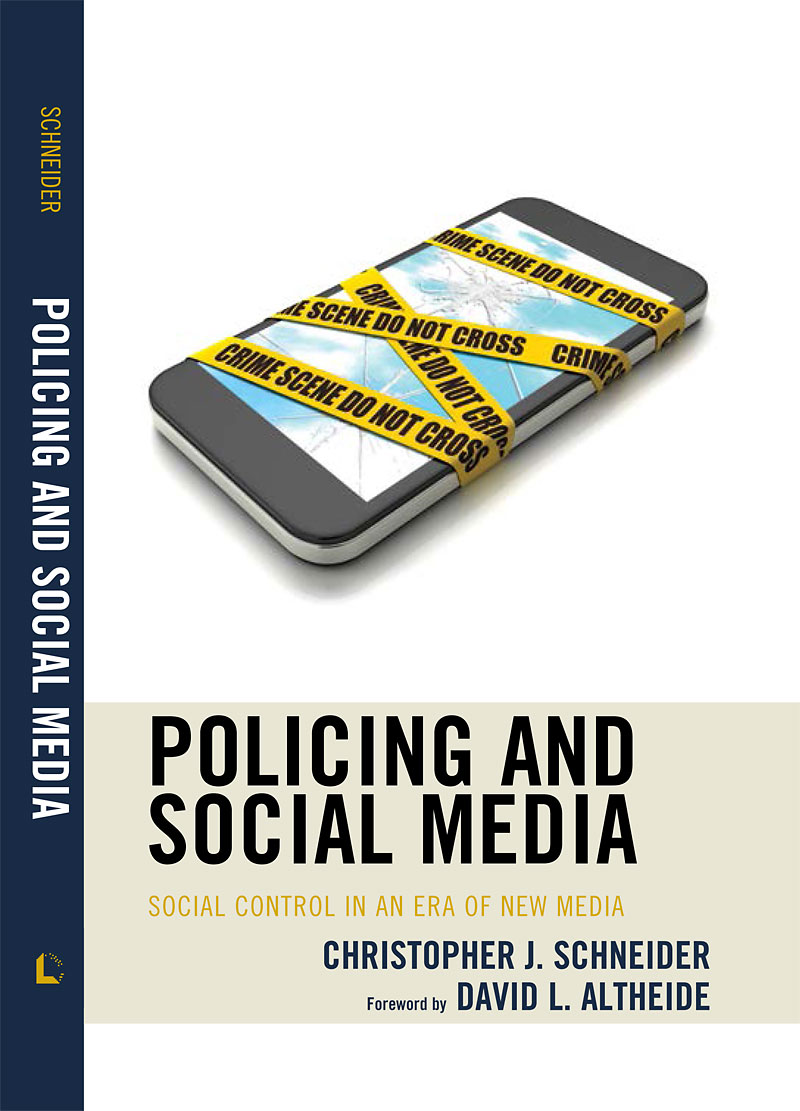
Christopher Schneider, an associate professor in BU’s sociology department recently published “Policing and Social Media: Social Control in an Era of New Media,” which he believes is one of the first academic looks at how the authorities are reacting to the changing media landscape to keep up their public image.
“As best as I can tell this is the first book of its kind that looks at an empirical analysis of policing and social media and looks at the ways in which police incorporate social media platforms,” said Schneider.
“Policing and Social Media” delves into three main case studies: the Vancouver Police Department’s online investigations relating to the 2011 Stanley Cup riots, the Toronto Police Service’s innovative social media work and then the role of YouTube in the fallout of the shooting of a citizen by TPS officer James Forcillo.
Schneider pointed to “COPS,” a long-running TV show heavily directed and edited by law enforcement, to explain what’s changed for police across North America.
“I look at the ways in which now police are operating on Facebook, Twitter, YouTube, Instagram and other social media platforms – not only for the purposes of crime and crime control, but also the ways in which police present themselves as the good guys, as crime fighters: putting out a positive, favourable impression of the police organization or apparatus.”
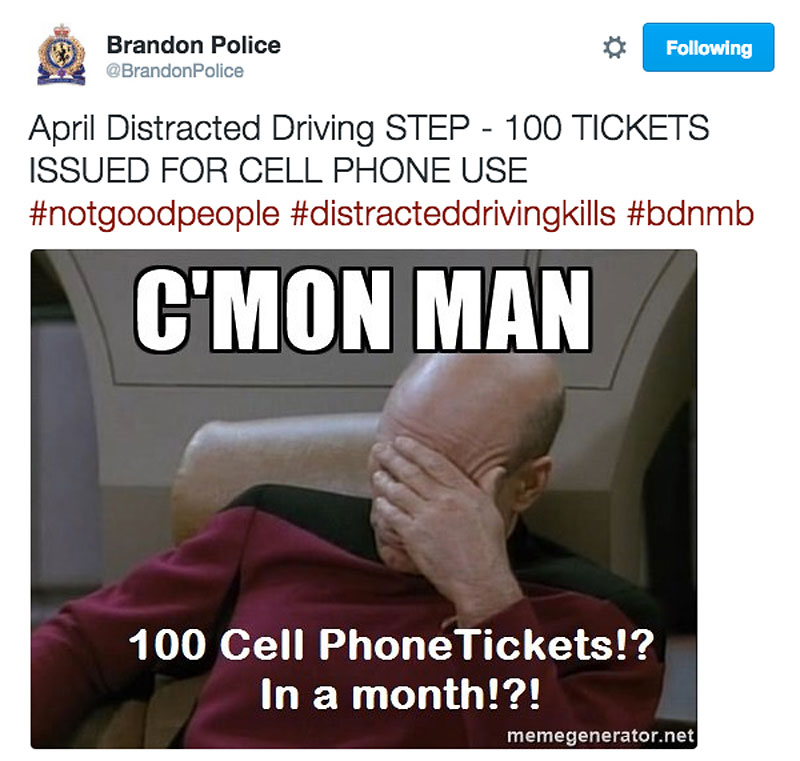
In a tweet directed at Brandonites on Monday, the Brandon Police Service paired the release of underwhelming distracted driving statistics with a meme of “Star Trek” character Captain Picard burying his face into his hand, as if to scold drivers.
Schneider said that what the BPS does online is comparable to similar forces across Canada.
“They have a Twitter account, there’s a little bit of humour there but it’s mostly crime updates — which is pretty consistent with other police services that are on social media throughout the country,” he said.
The idea, Schneider argues, is to help personalize those in uniform.
“Police organizations or officers tweeting on behalf of organizations are starting to tweet things about humour, or liking certain hockey teams or being grumpy or getting their oil changed — just really inconsequential, mundane things that have nothing to do with police work whatsoever.”
Schneider explores whether that conflicts with the concept of “impersonal policing,” the “bedrock or core of all legitimate policing,” according to Schneider.
“On one hand, that’s probably a good thing but on the other hand what we don’t know about is: Is this going to personalize police too much and is that going to upset the balance of this ‘impersonal policing?’”
Schneider has talked to local police brass, including BPS Chief Ian Grant, about the department’s online presence.
“Many police officers, according to (Grant) and other people I’ve talked to, they’re afraid. This is these guys’ career, this is how they feed their family. Now they are supposed to be on Twitter and what if something they say gets taken out of context or appears six months later?”
Schneider hopes to take a slightly different tack with his next project, and turn his attention to how the TPS and VPD use social networks to aid internal police work.
“If an officer gets a notification of somebody who is a wanted criminal … do they then take out their cellphones and look up their Facebook pages? How are police gathering information online and how does it work its way into courtrooms? All of these things we know little about,” Schneider said.
“Police are a pretty guarded institution, so they are careful about any criticism, but they want to get a handle on what it is that’s going on and how they can best represent their institution.”
» tbateman@brandonsun.com
» Twitter: @tombatemann