
Sun Interview Shines On … Robert Richardson
Advertisement
Read this article for free:
or
Already have an account? Log in here »
We need your support!
Local journalism needs your support!
As we navigate through unprecedented times, our journalists are working harder than ever to bring you the latest local updates to keep you safe and informed.
Now, more than ever, we need your support.
Starting at $15.99 plus taxes every four weeks you can access your Brandon Sun online and full access to all content as it appears on our website.
Subscribe Nowor call circulation directly at (204) 727-0527.
Your pledge helps to ensure we provide the news that matters most to your community!
To continue reading, please subscribe:
Add Brandon Sun access to your Free Press subscription for only an additional
$1 for the first 4 weeks*
- Enjoy unlimited reading on brandonsun.com
- Read the Brandon Sun E-Edition, our digital replica newspaper
*Your next Free Press subscription payment will increase by $1.00 and you will be charged $20.95 plus GST for four weeks. After four weeks, your payment will increase to $24.95 plus GST every four weeks.
Read unlimited articles for free today:
or
Already have an account? Log in here »
Hey there, time traveller!
This article was published 02/09/2016 (3551 days ago), so information in it may no longer be current.
Born in Ontario and raised in Brandon after his parents, Robert and Sylvia, came to teach at Brandon University’s acclaimed School of Music, Robert Richardson Jr. was raised surrounded by music. His father taught piano, his mother voice, and his brother Mark earns his living playing guitar and rock music. But Richardson, a violinist and violist, is a devotee of, and an acknowledged expert in, the Suzuki Method, an approach that emphasizes teaching musical appreciation and ability to very young children, with the added features of parental participation, loving encouragement and constant repetition. The director of the Suzuki program at BU in the 1990s, the now-51-year-old Richardson still teaches in the program here, but he’s involved in the Suzuki Association of the Americas as one of the co-ordinators for that organization’s biennial conferences. In addition, he’s taught violin and teaches viola to university-age students at the music school, and travels extensively as a teacher, clinician and conductor across Canada, the United States and Europe. And just for fun, he plays fiddle in a local folk band as well.
I’d suggest it would have been hard in the household you grew up in NOT to have become a musician!
Well, it’s a perfect example of environment that creates your future. Because I remember sleeping underneath the grand piano while my parents were practising. And I also learned about teaching, too, because they were constantly talking about teaching, and students, and ways to get through to them, and what they were working on. I also remember the records — when someone like Dr. (Lawrence) Jones would get a record, he’d have it in his family for a couple of weeks and then we would maybe get it, or the Ehneses.
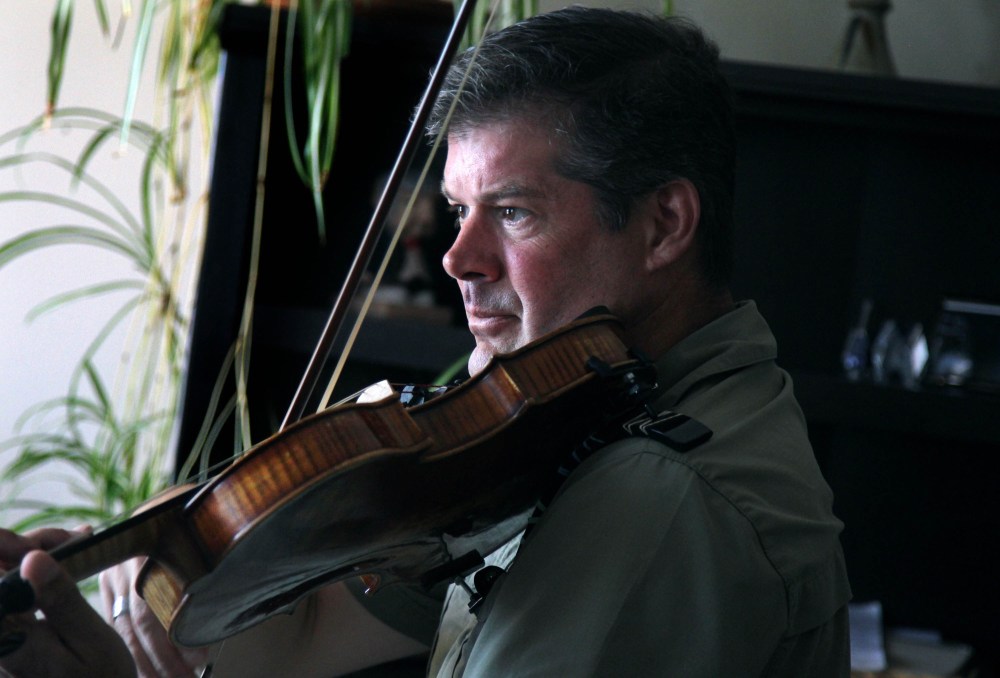
And I remember being part of the School of Music — essentially being raised there as a kid. Marg Ricoine would catch me eating the sugar cubes in the faculty lounge. She was amazing! She IS amazing!
I often wonder about kids like you, because it’s almost like you didn’t have a choice. I mean, your parents would have supported you if you’d wanted to do something else, but it seems like from birth — likely before birth — that music was your life.
My first official music teacher was Edna Knock. And I spent years in her Orff program. And I did no music lessons until I was 10. That’s when I found my first violin, at my grandma’s house. Of course, a 10-year-old boy, you tell him not to go to the attic, and of course I went. And after being scared and freaked out, I found this weird shaped-box, and it was a violin case, and that’s when I started. So I started when I was old.
Well, hardly old. But I get what you mean — old in terms of when most kids start studying music. But what was it about the violin that spoke to you?
I really don’t remember why I liked it. I think I like the social aspect of playing chamber music and orchestra.
So your specialty now, if I can call it that, is Suzuki. Did you study it when you were younger?
No, I didn’t. I studied with Alec White and Joy Crawford and eventually went to Francis Chaplin and then started playing with the Brandon University Orchestra.
What was it, then, that drew you to Suzuki? Was it a particular enjoyment of working with kids? Or had the teaching influence from your parents rubbed off? Because you have a really wonderful combination of performance and teaching as a lot of the profs at the School of Music do now. But it wasn’t always that way.
It wasn’t always, no. I remember being 17 and I remember Francis Chapman telling me I was going to teach kids on Saturday who came from Dauphin because they’d just lost their school program. And I saw their technique books and it was just really boring music. So I went to the library to try to find something different, and I came across the Suzuki literature. I liked it for the bow arm development. And the rhythm. I had no idea about parental involvement, listening, systematic structure, so I used those in my first year and it wasn’t until years later, when I moved away for a short time, that I got training.
But now the Suzuki program thrives at Brandon University.
I think there’s good teamwork. Michelle Bouchard has been the director for the last 10 years. I think during the ’90s, when I was directing, I took it one direction, and I think Michelle has taken it in another direction.
What is it about Suzuki that differentiates it from other programs that are out there?
I think with the Suzuki philosophy, I’m a strong believer that every child CAN. We’re dealing with children who are three and four years old. In the old days, there used to be three- and four-year-old beginners, but not so many and not all of them would succeed. Now, it’s just understood that you would play the violin really well. There’s not even a question anymore. It’s based on environment.
Which is collegial and all-encompassing and supportive …
Yeah — nurturing. And there’s more music — like the way I grew up. We try to make sure there’s beautiful music happening in the children’s homes all the time, and make sure they’re listening to their recordings.
And it’s parental involvement that ensures that happens.
Exactly. You don’t get berated for mistakes. The parents provide a nurturing environment. And there’s a strong sense of community among the families, more and more about parenting than it is about music. And the success is not just about music — it’s about being successful people. The more I teach, the more I realize that it’s less to do with violin and more about character development. And when I look at the graduates from the program, whether they’re musicians or not, they’re pretty amazing people.
About how many in a class?
It’s group classes and it’s private lessons — a combination of the two. I have a dream of creating something for those people who maybe don’t have as much money. Because if you have a three-year-old beginner, you’re spending about $1,300 or $1,400 a year for weekly half-hour lessons. And so I have a dream about trying something in a more group-style of learning for less than half that amount to reach more people. There are many reasons for that — financial, just to help people.
And then also, there’s a lack of fiddlers in our community. We’re losing our tradition. Participation in all the fiddle competitions is down dramatically. And there’s not enough people learning our culture — our musical culture, our background in fiddling. So I’ve talked to a couple of the fiddlers, trying to find a space — we’re trying to find a place — so in the future, I hope to create some place that we can retain our fiddling culture and then offer maybe violin lessons, group-class style, at least to begin. I’m not sure how to get it organized yet. But I’ll figure it out.
Is it fun to work with kids who are really young? I mean, I can’t imagine the patience it must take. Because you’re getting them pre-kindergarten, even. Is it their youthful fascination, and your ability to mould them and instil passion that thrills you? Or just their unabashed interest in things? What is it about that age group?
They’re interested. And they’re interested in so many different things. And I don’t think I have patience. I think I have an unconditional belief in their success.
I don’t believe in failure. I know, in time, that they will succeed in whatever it is. Everyone has ability, and it’s just a refinement of their own ability. It’s like how we write English. Some people are really brilliant at it, some people aren’t. But we’re still able to communicate.
You’ve been teaching for decades. Everywhere!
I love it. I like being silly. I love playing. I love music. And I love kids. They’re honest. They see everything. They challenge you. They want to be loved. They want to be guided. They want to be respected and I think just because they’re small doesn’t mean you can’t respect them. I think I have a sense of play, and that’s why I’m successful in teaching. And the silliness — that’s what gets them. Music is fun and when they realize they can do it really well, no matter what level it is, they recognize when they do it well. And I will never let them get away with just being average. You have to try and always push the limit. But I think they respond to it. Everyone wants to be good at something or recognized.
Do a lot of students quit along the way?
You know, I used to be able to say that I had no attrition rate. But times have changed. People want their children to do everything. But in some cases, there’s no work ethic. The kids want to be recognized for something but not do it. What they want is this big show without working hard. They want fame.
And then I think parents are just busy driving their kids everywhere when they need to be just home. I mean, just be home! Choose one activity — do one activity, and stay at home with your family. Do violin but then don’t add piano and then band and then choir. Be a dancer, but then don’t add football and soccer and everything else. Choose something or a couple of things, just not 18 things. Choose something and do it to a high level of proficiency. Then you actually get the benefits of whatever music study is: refinement or respect or dedication, determination, perseverance. You only get those by doing something at a high level in whatever discipline it is. But not so many things.
One of the major reasons Suzuki is so successful is because parents are supportive and participatory, right?
Yes. I think that’s why anything is successful. And all you have to do is make sure a parent plays a little bit of violin and then they have a new appreciation for what their child is doing. So the parents of my students play violin. And they have to play. And when I first get them — the parents — and they’re not understanding what’s going on, I get them to play it. And all of a sudden they realize, ‘Oh yeah — this is really hard.’ And then there’s a greater appreciation for what the child is doing.
What’s the motivation for a lot of parents wanting their children to study violin in the first place? You’d think piano or guitar or drums might be more to many people’s liking.
Sometimes it’s a family tradition — they used to have a relative who played. But it’s also brain development, all these special characteristics, appreciation for music, and every year, I try and remind parents that that’s why we’re here. It’s not to create a musician, because if you want to have money, you don’t want to be a musician! Let’s get real! You want your children to make money so they can leave the nest. But I like to remind them that when somebody becomes really good at something, there’s actually an appreciation of the art form — an appreciation of self-discipline and self-discovery.
And it doesn’t have to be a career for everybody. It can be just a wonderful passion or hobby or sideline or something like that.
Absolutely!
You’re also renowned for your abilities in teaching and playing. And you’ve gone to the States and Europe and all over Canada doing workshops. In what are supposed to be your off months, you’re busier than ever, I think. Do you ever get tired of it? Do you ever go for a while without picking up your violin?
I haven’t touched my violin in a week-and-a-half right now! (laughs) And I’m avoiding the viola playing right now. Playing with the Manitoba Chamber Orchestra has brought my playing level up dramatically. So that’s been a big deal. And it gives me street cred. The old man can still play and I think that’s important, especially when I’m involved more and more at the university level.
So you teach at all levels then. From beginners to students aspiring to be professionals. That’s amazing!
I’m very lucky. When I travel-teach, I’m either hired as an advanced violinist or advanced violist or early specialist — like being with the beginners. Or sometimes I go as a conductor, sometimes as a chamber music coach, sometimes as the parent guider. When I travel, especially repeatedly, I helped develop programs and give insight. So Whitehorse, for example — I’ve been going up there for years — even in years when there was no teacher. So I’d go up three times a year and teach all these students. Now they have three young teachers up there. And so I’ve been able to help them build their independence in their music community. And one of those young teachers is joining our Suzuki faculty team here this year. But I remember teaching her back in Book One in Whitehorse when there was no teacher.
What keeps you at it?
I love it. I get to travel, play music, teach kids, eat great food, meet great people, see the world. I’m very lucky. And I live in Brandon, which is a nice, small city. I like Brandon a lot. It’s a good size — a great size. I can bike around. I haven’t had a car since ’89. It’s a wonderful community.