
Federal budget is passed to prevent unwanted election
Advertisement
Read this article for free:
or
Already have an account? Log in here »
We need your support!
Local journalism needs your support!
As we navigate through unprecedented times, our journalists are working harder than ever to bring you the latest local updates to keep you safe and informed.
Now, more than ever, we need your support.
Starting at $15.99 plus taxes every four weeks you can access your Brandon Sun online and full access to all content as it appears on our website.
Subscribe Nowor call circulation directly at (204) 727-0527.
Your pledge helps to ensure we provide the news that matters most to your community!
To continue reading, please subscribe:
Add Brandon Sun access to your Free Press subscription for only an additional
$1 for the first 4 weeks*
*Your next subscription payment will increase by $1.00 and you will be charged $20.00 plus GST for four weeks. After four weeks, your payment will increase to $24.00 plus GST every four weeks.
Read unlimited articles for free today:
or
Already have an account? Log in here »
As confidence votes go, this one didn’t inspire a whole lot of confidence.
The manner in which Prime Minister Mark Carney’s first federal budget was passed in the House of Commons — by a razor-thin margin — could hardly be heralded as a political victory. At very best, it might be described as a defeat avoided.
Nevertheless, while nothing in politics is ever written in stone, passage of the budget was the likely outcome, given the fact that none of the major parties was in a position to fight yet another federal election this year — financially or otherwise.
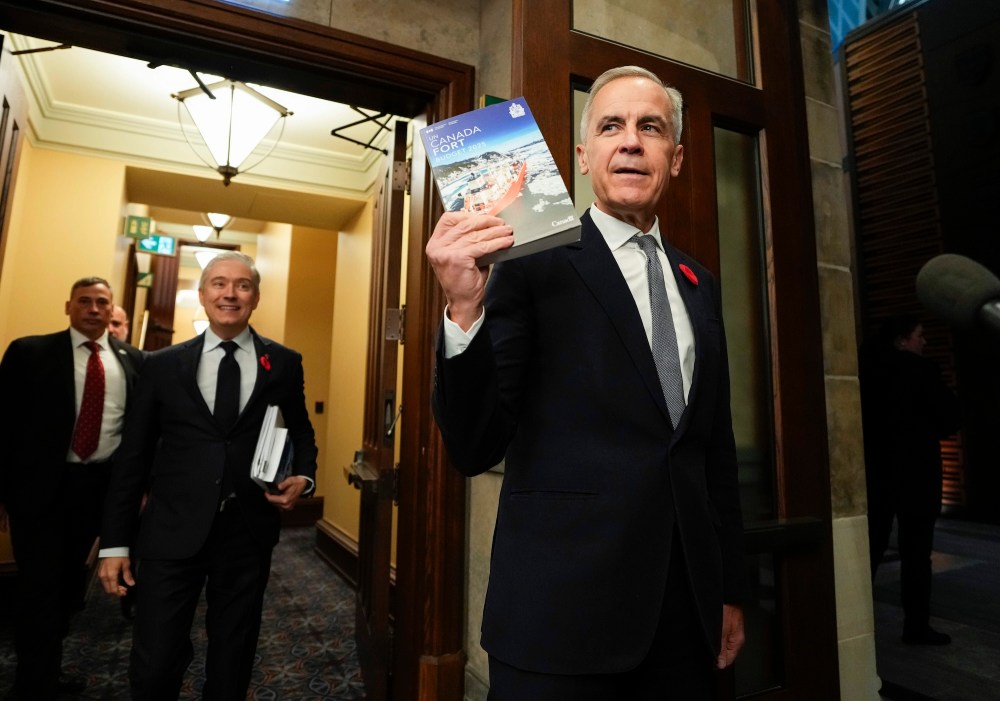
The final tally of Monday’s vote was 170-168; passage of the budget was actually made possible by the fact four MPs — two Conservative and two NDP — did not vote. The strategy of the opposition parties was clear: they did not support the Liberal budget, but were unwilling to express their dissatisfaction in a way that would trigger a federal election scarcely six months after the last one.
By having a couple of their members conveniently abstain from voting, each could demonstrate a modicum of disdain for the document without having to face accountability for being the party that brought the government down.
Realistically, a federal election in the run-up to the holiday season is something the Conservatives and New Democrats want even less than the minority-ruling Liberals do.
The NDP is in complete disarray, having been reduced to a meagre seven seats in the last election and left leaderless and essentially penniless in the process. Going back to the polls now would very likely put the party’s very existence in peril.
The Conservatives, under unrepentantly combative Leader Pierre Poilievre, also have all kinds of reasons for not wanting to face voters at the moment. After riding high in the polls for a couple of years, the last federal election was theirs to win or lose — and lose it they did, rather spectacularly.
That loss was thanks in large part to Poilievre’s inability to pivot from the Trump-lite persona he had so determinedly crafted and clung to prior to the post-inauguration wave of anti-Canadian tariffs and taunts that made the U.S. president (and anyone who seeks to emulate him) persona non grata on this side of the border.
With his leadership style clearly causing friction within the party — the past few weeks have seen one MP cross the floor to the Liberals and another announce he will not seek re-election — Poilievre is in no position to fight a federal election. Chances are he’ll have more than enough of a tussle on his hands when he faces a Conservative leadership review in January.
So while the vote on the federal budget was close, it’s fair to say the Liberals were never really in danger of being defeated on this confidence matter.
Everyone involved had too much to lose.
Going forward, however, Carney will necessarily have been reminded of the tenuous nature of his minority government’s situation. Without anything in the way of a formal — or even informal — co-operation agreement with one or more of the opposition parties, he will have to treat every major legislative endeavour as one that might cause his parliamentary downfall.
As for the budget itself, Carney described it as both “transformational” and “a generational investment” in Canada’s economy, injecting $140 billion in new spending over the next five years, including a $50-billion infrastructure fund, $13 billion for the Build Canada Homes strategy and $30 billion earmarked for defence and security aimed at meeting Canada’s NATO commitments.
How these big-picture initiatives will affect average Canadians remains to be seen; what seems certain in the medium term is that they won’t be required to make their feelings known at the ballot box.
And according to a poll by EKOS, a rather sizable majority of Canadians will be just fine with that outcome. The poll, released earlier this month, suggested that just 27 per cent of Canadians wanted federal opposition parties to vote against the federal government as a means to trigger a fall election.
More to the point, at least half of those polled — a majority of NDP voters and 11 per cent of Conservative supporters — said they would be less likely to support a party that brought down the government.
Carney’s biggest asset, in terms his government’s stability, is the opposition parties’ shared understanding that forcing a federal election anytime soon would do them much more harm than good.
» Winnipeg Free Press and The Brandon Sun