
BU prof helps make key biodiversity finding
Advertisement
Read this article for free:
or
Already have an account? Log in here »
We need your support!
Local journalism needs your support!
As we navigate through unprecedented times, our journalists are working harder than ever to bring you the latest local updates to keep you safe and informed.
Now, more than ever, we need your support.
Starting at $15.99 plus taxes every four weeks you can access your Brandon Sun online and full access to all content as it appears on our website.
Subscribe Nowor call circulation directly at (204) 727-0527.
Your pledge helps to ensure we provide the news that matters most to your community!
To continue reading, please subscribe:
Add Brandon Sun access to your Free Press subscription for only an additional
$1 for the first 4 weeks*
*Your next subscription payment will increase by $1.00 and you will be charged $20.00 plus GST for four weeks. After four weeks, your payment will increase to $24.00 plus GST every four weeks.
Read unlimited articles for free today:
or
Already have an account? Log in here »
Hey there, time traveller!
This article was published 21/07/2010 (5626 days ago), so information in it may no longer be current.
A new study shows that life in the tropics prefers constant temperatures, not just hotter ones. And a Brandon University professor co-authored it.
Dr. David Greenwood, coordinator of BU’s Environmental Science program, helped figure out that the tropics owe their biodiversity to consistent year-round temperatures, not higher temperatures or more sunlight as previously thought. The findings were presented this week in the journal Paleobiology.
Greenwood worked on the study with researchers from Harvard University and Simon Fraser University.
"Anyone who has been to Mexico or Costa Rica is struck by the profusion of different kinds of animals and plants they find in a forest or while snorkeling," he says. "As you head further north, fewer and fewer species are found in the forests and in the sea. This has been known a long time (since at least Charles Darwin’s day), but an explanation for why this should be so across the whole world has been unclear."
Previous theories for tropical biodiversity have focused on the greater heat and light found closer to the equator. Also to a lesser extent on the low seasonality of the tropics, where average temperature in the hottest and coolest months may vary by only a few degrees.
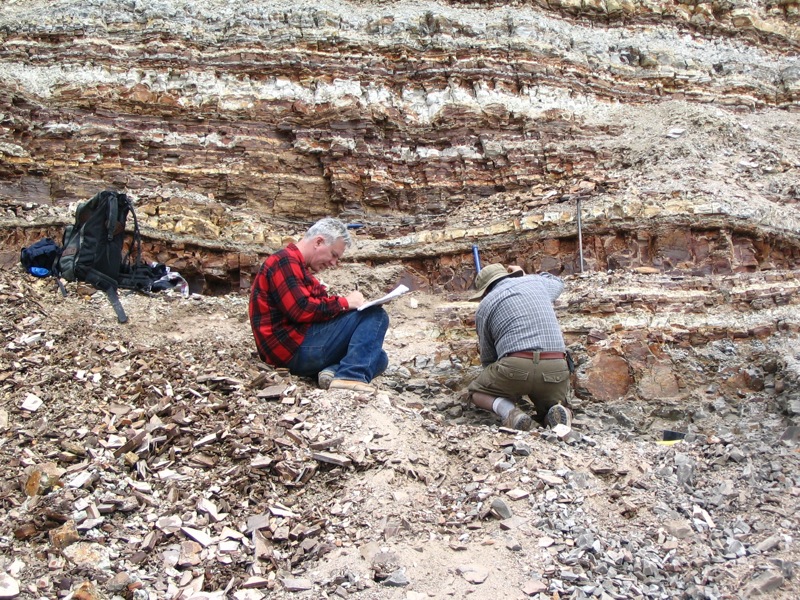
This time, though, researchers conducted a survey of insect diversity at different latitudes and at different points in the planet’s history. They studied a fossil site near Kelowna in British Columbia and found that the forest that grew around a lake there in the Eocene (51 million years ago) was as diverse as modern-day Costa Rica, despite having an annual average temperature similar to Vancouver.
At that time, the entire Earth had consistent year-round temperatures, much like the modern tropics do. The new study suggests that the modern world is likely less diverse than it was in the Eocene because today most of the world has strong seasonal swings in temperature.
"Our results point at the lack of seasonality as being one of the main drivers for the diversity of life in the tropics. In the geological past, even the Prairies had mild winters where freezing never occurred, allowing more species to occur in any given patch of forest than does today. Under a milder climate many more organisms could over-winter," Greenwood says.
"Our results suggest that a world with less seasonality, such as may exist under future climate change, may promote higher diversity of plants and animals outside of the tropics."
Greenwood’s co-authors on the Paleobiology paper are Dr. Bruce Archibald, a research associate at Simon Fraser University and the Royal British Columbia Museum, Dr. Brian Farrell, professor of biology at Harvard University, and Dr. William H. Bossert of Harvard’s School of Engineering and Applied Sciences. The work was funded by the Natural Sciences and Engineering Research Council of Canada, Harvard’s Department of Organismic and Evolutionary Biology and Museum of Comparative Zoology, and the Maurice Pechet Foundation.
More information is also provided on the Harvard University website (http://news.harvard.edu/gazette/story/2010/07/constant-temps-key-to-tropical-biodiversity/).
A copy of their paper can be found on Greenwood’s website (http://www2.brandonu.ca/academic/environmental/greenwood%20publications.htm).