
Arctic ice makes alarming retreat in May
Advertisement
Read this article for free:
or
Already have an account? Log in here »
We need your support!
Local journalism needs your support!
As we navigate through unprecedented times, our journalists are working harder than ever to bring you the latest local updates to keep you safe and informed.
Now, more than ever, we need your support.
Starting at $15.99 plus taxes every four weeks you can access your Brandon Sun online and full access to all content as it appears on our website.
Subscribe Nowor call circulation directly at (204) 727-0527.
Your pledge helps to ensure we provide the news that matters most to your community!
To continue reading, please subscribe:
Add Brandon Sun access to your Free Press subscription for only an additional
$1 for the first 4 weeks*
*Your next subscription payment will increase by $1.00 and you will be charged $20.00 plus GST for four weeks. After four weeks, your payment will increase to $24.00 plus GST every four weeks.
Read unlimited articles for free today:
or
Already have an account? Log in here »
Hey there, time traveller!
This article was published 14/06/2010 (5731 days ago), so information in it may no longer be current.
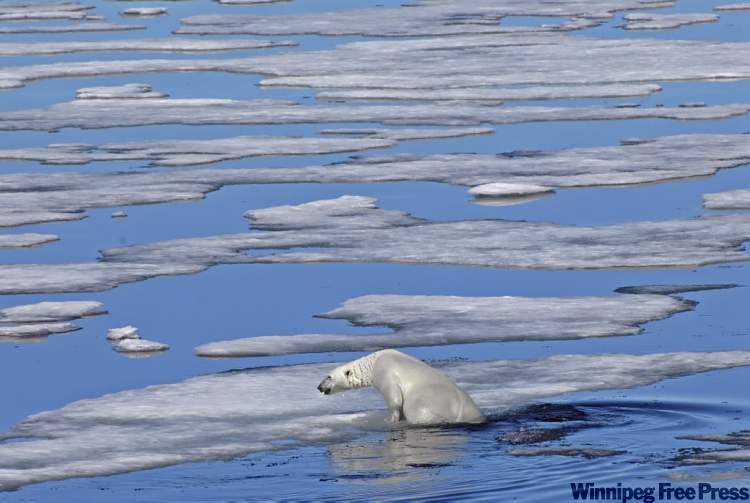
Arctic Ocean ice cover retreated faster last month than in any previous May since satellite monitoring began more than 30 years ago, the latest sign the polar region could be headed for another record-setting meltdown by summer’s end.
The U.S. National Snow and Ice Data Center had already warned earlier this spring that low ice volume — the result of repeated losses of thick, multi-year ice over the past decade — meant this past winter’s ice-extent recovery was superficial, due mainly to a fragile fringe of new ice that would be vulnerable to rapid deterioration once warmer temperatures set in.
And, driven by unusually hot weather in recent weeks above the Arctic Circle, the polar ice is disappearing at an unprecedented rate, reducing overall ice extent to less than that recorded in May 2007 — the year when a record-setting retreat by mid-September alarmed climatologists and northern governments.
The centre reported that across much of the Arctic, temperatures were two to five degrees Celsius above average last month.
The centre pegged the retreat at an average of 68,000 square kilometres a day, noting that "this rate of loss is the highest for the month of May during the satellite record."
The report also highlighted recent research indicating that, along with reduced ice extent — now reliably measured by the U.S. centre through satellite tracking — harder-to-measure ice volume also appears to be on a steady decline as mature ice that had previously survived many summers is now disappearing.
In November, University of Manitoba polar scientist David Barber also raised concerns about the increasingly "rotten" state of the Arctic’s oldest ice and predicted ice-free summers could become the norm far sooner than 2030, as some experts have forecast.
— Canwest News Service
Leaders pressure Harper on climate
OTTAWA — It was described by Prime Minister Stephen Harper as a "sideshow," but international leaders are mounting pressure on the Canadian government to include climate change as a major issue on the agenda at upcoming G8 and G20 economic summits in Huntsville, Ont., and Toronto.
"We are actively consulting our guests to prepare the agenda," Harper said last week in the House of Commons.
"Obviously, a lot of subjects will be discussed, including some issues surrounding climate change. At the same time, the G20 isn’t expected to replace the United Nations (global-warming) negotiating process."
In recent weeks, international leaders from the European Union, Mexico, the United Nations, along with Nobel Peace Prize laureates have all come forward, urging Harper to allow the summits to consider the climate-change issues as part of their discussions on achieving a sustainable economy.
— Canwest News Service