
Argentine bear may join Churchill orphan at city zoo
Advertisement
Read this article for free:
or
Already have an account? Log in here »
We need your support!
Local journalism needs your support!
As we navigate through unprecedented times, our journalists are working harder than ever to bring you the latest local updates to keep you safe and informed.
Now, more than ever, we need your support.
Starting at $15.99 plus taxes every four weeks you can access your Brandon Sun online and full access to all content as it appears on our website.
Subscribe Nowor call circulation directly at (204) 727-0527.
Your pledge helps to ensure we provide the news that matters most to your community!
To continue reading, please subscribe:
Add Brandon Sun access to your Free Press subscription for only an additional
$1 for the first 4 weeks*
- Enjoy unlimited reading on brandonsun.com
- Read the Brandon Sun E-Edition, our digital replica newspaper
*Your next Free Press subscription payment will increase by $1.00 and you will be charged $20.95 plus GST for four weeks. After four weeks, your payment will increase to $24.95 plus GST every four weeks.
Read unlimited articles for free today:
or
Already have an account? Log in here »
Hey there, time traveller!
This article was published 30/10/2013 (4641 days ago), so information in it may no longer be current.
Assiniboine Park Zoo could get a pinch of Latin-American spice.
The International Polar Bear Conservation Centre is exploring the possibility of giving Arturo, a polar bear from Mendoza, Argentina, a new home at the zoo.
The 28-year-old male polar bear has been living in isolation at the Mendoza Zoo for the past 20 years and could be coming to Winnipeg if he’s deemed fit enough to travel. Zoo directors are scheduled to fly to Argentina on Sunday and discuss the transfer of Arturo, as well as offering suggestions to Mendoza staff on how to activate a new vision for their existing zoo model.
Don Peterkin, the chief operations officer at the Assiniboine Park Conservancy, puts the chances of Arturo moving to Manitoba at “well over 50 per cent” and said there has been a lot of internal debate on bringing the older bear into the fold and what value it could have for the IPBCC.
At the end of the day, it comes down to this for Peterkin: If you’re going to talk the talk and open up an international centre for the preservation of polar bears, you need to walk the walk.
“We can’t just take the easy ones,” he said Tuesday. “It’s easy to get a bear from Churchill and bring it back in a day. If we’re serious about doing what’s right for polar bears, then we should help bring this animal into better surroundings.”
If the move gets the green light, Peterkin said the transfer process could take months. Arturo needs to pass the various medical checks to be deemed a suitable candidate, and if or when that happens, he won’t be transported until April or May of next year.
There are challenges with taking Arturo in, though. As an older bear that has been in a small enclosure most of his life, he would have to be introduced to larger spaces and the freedoms of that environment. Peterkin anticipates there will be some behavioural issues and a long adjustment period in his new surroundings.
“He’s probably not a candidate to mix with other bears, because the rest of the bear population are younger and they’re going to be more active,” he said. “They’re going to behave more like bears. He may live out his life as a solitary animal on display.”
Those wondering about Arturo’s age and life expectancy should note Debby, the female polar bear who called Assiniboine Park Zoo home, lived until she was 42. She was euthanized in November 2008.
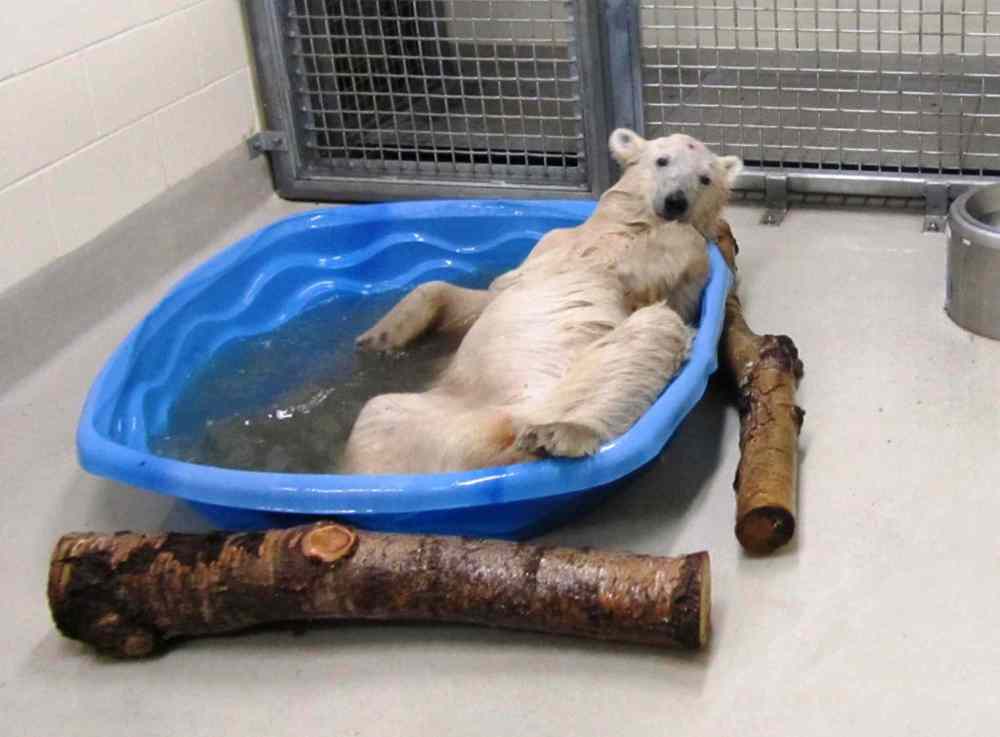
Meanwhile, the zoo added a third polar bear — and second this month — to its resident list when it brought in an 11-month-old orphaned female cub to the centre Monday night. The cub was discovered near the Churchill airport last week, and after Manitoba conservation officials monitored the animal over a few days to make sure it was an orphan, the province took it into custody. An extensive search of the area turned up no female polar bear, leading officials to make the call to the IPBCC.
‘It’s pretty much an established fact that cubs of that age are unable to survive on their own without their mother.
It would have perished’
— Jim Duncan, wildlife branch director at Manitoba Conservation, on the as-yet-unnamed orphan polar bear cub from Churchill
Jim Duncan, director of the wildlife branch at Manitoba Conservation, said the orphaned cub was discovered as an example of the polar bear alert program, an initiative designed to keep both the polar bear population and the northern Manitoba communities safe.
Duncan said the female cub would have had little chance surviving on its own and would have experienced a long and painful death, as it would be unable to hunt and nourish itself while alone in the wild. Polar bear cubs typically remain with their mothers for two years.
“It’s pretty much an established fact that cubs of that age are unable to survive on their own without their mother,” he said. “It would have perished. Without the (IPBCC), the options are fairly limited.”
In the past, and as recently as 2009, Duncan pointed out the province has tried pairing an orphaned cup with a new mother — a polar bear adoption, of sorts — but those attempts were unsuccessful.
As for the health of the yet-to-be-named cub (no timetable has been set on when an official handle will be given), zoo officials were pleased with her condition. Dr. Chris Enright, the head of veterinary services at the zoo, said while the cub is a little thin and malnourished, it was nothing to be overly concerned about.
A more pressing issue is the condition of her teeth. The orphaned bear has a few broken and infected teeth, Enright said, and will be getting a visit from the veterinary dentist soon.
Dr. Brian Joseph, director of zoological operations, travelled with Enright to bring the cub to Winnipeg Monday night, and was thrilled with the way the latest resident of the soon-to-be-completed Journey to Churchill exhibit was adjusting to her new surroundings. “We have full confidence that she’s going to adapt very quickly to the situation,” he said.
The plan is to introduce the female cub to the two existing male polar bears already on site. That could come as early as Christmas, once the automatic 30-day quarantine is complete, Joseph figures, adding his initial intention is the lone female be a part of a breeding program down the road.
We can’t just take the easy ones. If we’re serious about doing what’s right for polar bears, then we should help bring this animal into better surroundings’
— Don Peterkin, chief operations officer at the Assiniboine Park Conservancy, on the polar bear he hopes will arrive shortly from Argentina
That’s obviously a ways off, though. The first two polar bear inhabitants at IPBCC, Hudson, a 257-kilogram male and an unnamed 128-kg specimen — who was brought in from Churchill earlier this month — are much larger than the 38-kg female cub, so the integration process will be carefully monitored.
Initial observations of how the bears are reacting to the presence of each other in the same building (the three are in separate enclosures currently) are positive, zoo officials say.
The IPBCC and the Journey to Churchill exhibit are expected to open in summer of 2014.
adam.wazny@freepress.mb.ca
History
Updated on Wednesday, October 30, 2013 6:41 AM CDT: Replaces photo