
Climatologist believes sky’s the limit for atlas
Advertisement
Read this article for free:
or
Already have an account? Log in here »
We need your support!
Local journalism needs your support!
As we navigate through unprecedented times, our journalists are working harder than ever to bring you the latest local updates to keep you safe and informed.
Now, more than ever, we need your support.
Starting at $15.99 plus taxes every four weeks you can access your Brandon Sun online and full access to all content as it appears on our website.
Subscribe Nowor call circulation directly at (204) 727-0527.
Your pledge helps to ensure we provide the news that matters most to your community!
To continue reading, please subscribe:
Add Brandon Sun access to your Free Press subscription for only an additional
$1 for the first 4 weeks*
- Enjoy unlimited reading on brandonsun.com
- Read the Brandon Sun E-Edition, our digital replica newspaper
*Your next Free Press subscription payment will increase by $1.00 and you will be charged $20.95 plus GST for four weeks. After four weeks, your payment will increase to $24.95 plus GST every four weeks.
Read unlimited articles for free today:
or
Already have an account? Log in here »
Hey there, time traveller!
This article was published 22/01/2015 (4323 days ago), so information in it may no longer be current.
What will Manitoba’s climate be like in 30 years?
University of Winnipeg climatologist Danny Blair wants everyone to have that information through an easy-to-read mapping database called the Climate Atlas of Manitoba.
Blair discussed the idea during a seminar presentation at Manitoba Ag Days at the Keystone Centre Wednesday.
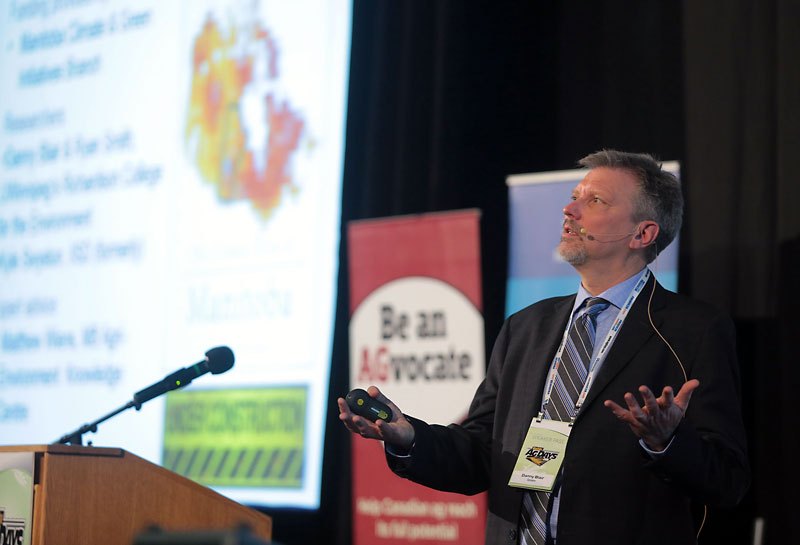
The fledgling project has received modest funding from the Manitoba climate and green initiatives branch, which has helped Blair hire a researcher to pull the terabytes of “enormous and really complex” data.
“It’s about time we produced our own, locally grown climate data,” he said to the audience Wednesday. “What’s it going to be like in Russell? What’s it going to be like in Carman? We need to know.”
Blair received a $14,000 grant, though it hasn’t been renewed — and he’s looking for funding.
“They (the governments) need to invest in producing these tools so you can see for yourselves what’s coming to change your perspective,” he said.
The plan isn’t without its challenges — chief of which being the quality of Manitoba-specific data available. Climate stations in Manitoba aren’t evenly distributed throughout the province, for one.
The atlas, a computer program that has already been created, can map extreme hot and cold days, frost-free days, and frost risk.
And Blair wants to see such user-friendly maps used for mapping forest fire risk and runs of days without precipitation and cold and hot stretches.
“(Farmers) should have what the science says about temperature … in 20, 30, 40 years.”
Last winter may be regarded as the coldest in recent memory, Blair said, but worldwide, it was one of the warmest on record, going back to 1880.
“You cannot look out your window and expect to see the world climate. What you see is your weather,” Blair said.
Global warming will bring higher heat, a longer growing season and increased risk, he said
The current rate of warming in Manitoba is about 10 C per century, and we’re “cancelling the next Ice Age.”
With worst-case-scenario data, in 30 years, Manitoba will have 30 days per year above 30 C — more than double the number of those days now. That heat will be good for crops such as corn, but it brings with it immense risk for crop-damaging droughts.
“The really big changes have been in northern Canada, but that’s coming our way,” Blair said.
Meanwhile, during Blair’s presentation, Manitoba Agriculture, Food and Rural Development Minister Ron Kostyshyn announced a task force to evaluate existing programs and policies used to help farmers recover from climate-related catastrophes such as flooding.
“Manitoba’s farmers have told us existing agricultural programs can’t adequately address these climate-related challenges, especially as they become more common,” Kostyshyn stated in the release.
“We are following through on our commitment to review existing programs and consider options that will be more predictable, comprehensive and sustainable for farmers and governments. I look forward to hearing from Manitobans as part of the task force’s work on this important issue.”
The group will be chaired by Arborg-area farmer Bill Uruski and includes five other members representing the Manitoba Agricultural Services Corporation, farmers and other experts.
“Living in the Interlake, we have also experienced many of the same challenges that farmers living in other parts of the province have faced in recent years,” Uruski said.
“It’s certainly timely to undertake a review of all available business risk-management tools, while seeking input and advice from farmers, insurance policyholders and other stakeholders.”
Public consultations are expected to begin this spring and a final report with recommendations to government will be submitted by the end of the year, the minister said.
» gbruce@brandonsun.com
» Twitter: @grjbruce