
Easing the transition
Advertisement
Read this article for free:
or
Already have an account? Log in here »
We need your support!
Local journalism needs your support!
As we navigate through unprecedented times, our journalists are working harder than ever to bring you the latest local updates to keep you safe and informed.
Now, more than ever, we need your support.
Starting at $15.99 plus taxes every four weeks you can access your Brandon Sun online and full access to all content as it appears on our website.
Subscribe Nowor call circulation directly at (204) 727-0527.
Your pledge helps to ensure we provide the news that matters most to your community!
To continue reading, please subscribe:
Add Brandon Sun access to your Free Press subscription for only an additional
$1 for the first 4 weeks*
- Enjoy unlimited reading on brandonsun.com
- Read the Brandon Sun E-Edition, our digital replica newspaper
*Your next Free Press subscription payment will increase by $1.00 and you will be charged $20.95 plus GST for four weeks. After four weeks, your payment will increase to $24.95 plus GST every four weeks.
Read unlimited articles for free today:
or
Already have an account? Log in here »
Hey there, time traveller!
This article was published 11/07/2015 (4067 days ago), so information in it may no longer be current.
New research led by the Rural Development Institute at Brandon University revealed a perception from settlement service providers that it is “somewhat difficult” for newcomers to settle in Brandon due to the acceptance of locals, housing and language difficulties.
The study, which was funded by Citizenship and Immigration Canada, examined 29 rural areas and centres in Western Canada identifying opportunities for improved services to better serve newcomers.
Four of the six communities that were studied in Manitoba were in Westman, including Brandon, Dauphin, Neepawa and Virden.
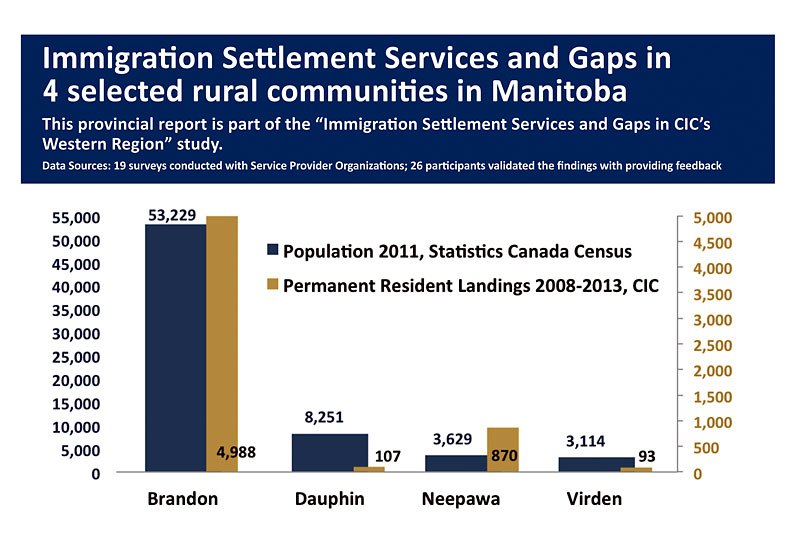
In Brandon, nine per cent of the population are newcomers who arrived between 2001 and 2009 with the largest proportion of immigrants coming from Central America and employed by Maple Leaf Foods or in another capacity in the hog industry.
Westman Immigrant Services was one of the providers surveyed for the study. WIS is unique as it offers a type of “one-stop shopping” when it comes to settlement services.
WIS executive director Richard Bruce said he takes issue with the statement that locals aren’t accepting of immigrants.
“I have not been any place where I have heard anyone talk ill of immigrants,” Bruce said.
While there have been some examples of ethnocentrism in traditional and social media, Bruce said, “When people say that newcomers shouldn’t be here, they need to ask the person that said that where their grandparents came from?”
In reality, unless you’re First Nation, everyone in Brandon is the descendent of immigrants.
Bruce points to the Lieutenant Governor’s Winter Festival as an example of inclusion in Brandon. The festival, which showcases approximately a dozen cultures in the community, is hugely successful.
Housing is a major hurdle, Bruce said, for everyone.
“The reality in Brandon is that it’s difficult for anybody to find housing,” he said. “It’s a tight market and it’s compounded because when newcomers come here most often they don’t have a lot of money and they don’t make large amounts of money to start with so they have to find some place that they can afford to live.”
The immigrant profile has transformed recently as the federal government cracked down on immigrants who aren’t proficient in one of the country’s two official languages.
“Our client base is changing a little bit, there is higher levels of English now and the government demands higher levels of English,” Bruce said.
The size of the community, for a variety of reasons, is one of the major contributors to how easy it is to settle, according to BU research assistant Eleni Galatsanou, who worked on the study.
“If you go to a large centre you will find people from your own country and maybe it will be easier to adjust and when you need services you will go to them to ask,” Galatsanou said. “It’s not always like that in the rural communities which is a challenge.”
Brandon offers 22 of 26 of the key services identified for settlement.
The services are administered by a variety of organizations, including faith groups, schools, health-care providers and businesses.
The four services not offered in Brandon are recognition of foreign credentials, investment opportunities, business mentorship and services specifically for seniors.
Brandon service providers are engaged and in partnership with other community organizations, however, at times the challenges specifically deal with infrastructure rather than service outreach.
“A lot of these communities don’t have the infrastructure to support the amount of immigrants they area receiving,” Galatsanou said. “CIC funds the service for newcomers but because there are no available houses in the community, the service cannot be taken on by the newcomers.”
Language training is another major obstacle in Brandon. Diminished English skills affect employment opportunities.
Most newcomers find it “somewhat easy” to find work in Brandon, though usually low-skill work.
Galatsanou said service providers want to create stronger partnerships with the business community. A theme that was echoed by Bruce at WIS, who said the organization has trouble matching employees with employers.
Brandon Chamber of Commerce president Jordan Ludwig said currently the chamber doesn’t have any outreach or mentorship programs designed specifically for newcomers or any other sector of the population.
The chamber has been approached by Manitoba Entrepreneurship, Training and Trade and Canadian Youth Business about establishing mentorship programming, but the organization hasn’t found someone to champion it in the community, according to Ludwig.
Another difficulty is the size of businesses in the community, which typically still see owners integral to the success of the company.
“There are a lot of owner-operator type businesses in Brandon so a lot of it is resources and a lot of those businesses are thriving because the owner is still involved, take them out of the day-to-day operations and put them in a training situation and all of sudden the business might not run the way it should,” Ludwig said.
Businesses have worked hard to cater to newcomers. Several sales companies now employ senior staff members who speak Spanish, new restaurants and grocery stores have popped up and existing stores have brought in stock from some of the more common countries where immigrants have came from.
Lack of child care, transportation difficulties and the fact not all newcomers are eligible for services are further barriers.
Neepawa has grown 10 per cent between 2006 and 2011, according to Statistics Canada, with many newcomers moving for employment at HyLife Foods, a pork processing plant.
The majority of providers in Neepawa felt it was “somewhat easy” for newcomers to settle in the community while one participant felt is was “somewhat difficult.”
The reasons cited for the difficultly were housing, doctor shortages, a harsh climate, adjusting to small-town life, language and that settlement is often difficult on spouses who are not employed.
In contrast, a strong volunteer and ethno-cultural groups, such as the Filipino community, are reasons it is easy to settle in Neepawa.
Many Neepawa newcomers find themselves underemployed in the service industry, while there are many nurses who have been unable to get jobs in the area because their foreign credentials are not recognized.
Virden and Dauphin have experienced more tempered growth when compared to Brandon and Neepawa.
Child care, mental health services and social supports were three areas that need to expand in both communities.
In Dauphin, transportation and daycare are identified as roadblocks.
In Virden, the report said some residents’ preconceived notions about newcomers make it difficult to settle.
Virden Mayor Jeff McConnell conceded there are some people that the wrong attitude about immigration, but it comes from a very small minority.
“For the most part people are accepting and accommodating to people who are immigrants to our community,” McConnell said. “I’m seeing a lot of acceptance. And a lot of employers who are filling positions by virtue of immigration are very accepting because it’s helping them to continue deliver the services they want to provide … They’re part of our community and it’s a non-issue.”
Virden has found success retaining immigrants from the Philippines, according to McConnell.
“A lot of that started by bringing nurses into our region,” he said. “Since then we’ve had a number of Filipinos that have come to work in all sorts of other businesses in our community.”
The community also has a number of temporary foreign workers, particularly in the service industry. And one of the biggest gaps is the difference in services offered to permanent residents versus temporary workers.
“Technically the immigration settlement services officer is not supposed to work on behalf of temporary foreign workers,” McConnell said. “Those individuals who moved into our community for up to two years are not able to take advantage of programs or people that might be able to help them be more comfortable in our communities. And I think that’s a real problem.”
Temporary workers, similar to students and visitors, have never qualified for CIC settlement services, which are designated for people who come to live permanently in Canada.
Some provinces offer unique services to temporary workers, according to Immigration Research West director Lori Wilkinson, who worked on the RDI report.
Wilkinson said Manitoba is a leader in immigration policy with immigrants rating the province No. 1 in Western Canada when it comes to the feeling that they belong and how happy they are.
Other jurisdictions look to the province for best practices, she said.
“The Province of Manitoba really focused on bringing newcomers in permanently instead of some of the provinces that focused on other groups of people, such as Alberta which focused on secondary migration into the province,” Wilkinson said.
» ctweed@brandonsun.com
» Twitter: @CharlesTweed