
Primary classroom cap to cost $105M
Advertisement
Read this article for free:
or
Already have an account? Log in here »
We need your support!
Local journalism needs your support!
As we navigate through unprecedented times, our journalists are working harder than ever to bring you the latest local updates to keep you safe and informed.
Now, more than ever, we need your support.
Starting at $15.99 plus taxes every four weeks you can access your Brandon Sun online and full access to all content as it appears on our website.
Subscribe Nowor call circulation directly at (204) 727-0527.
Your pledge helps to ensure we provide the news that matters most to your community!
To continue reading, please subscribe:
Add Brandon Sun access to your Free Press subscription for only an additional
$1 for the first 4 weeks*
- Enjoy unlimited reading on brandonsun.com
- Read the Brandon Sun E-Edition, our digital replica newspaper
*Your next Free Press subscription payment will increase by $1.00 and you will be charged $20.95 plus GST for four weeks. After four weeks, your payment will increase to $24.95 plus GST every four weeks.
Read unlimited articles for free today:
or
Already have an account? Log in here »
Hey there, time traveller!
This article was published 27/10/2011 (5436 days ago), so information in it may no longer be current.
THE people designing uniform report cards are obviously exceeding expectations and working well with others — they’ve now been assigned the job of capping class sizes.
Education Minister Nancy Allan announced Wednesday she’s given the job of figuring out how to cap kindergarten to Grade 3 classes at 20 students to the committee designing parent-friendly, easy-to-understand report cards.
Implementation of the capped classes is to be complete within five years, cost $20 million for annual additional teachers’ salaries and $85 million for classroom space.
Beyond that, everything is vague about how and when the government will implement the cap on class size.
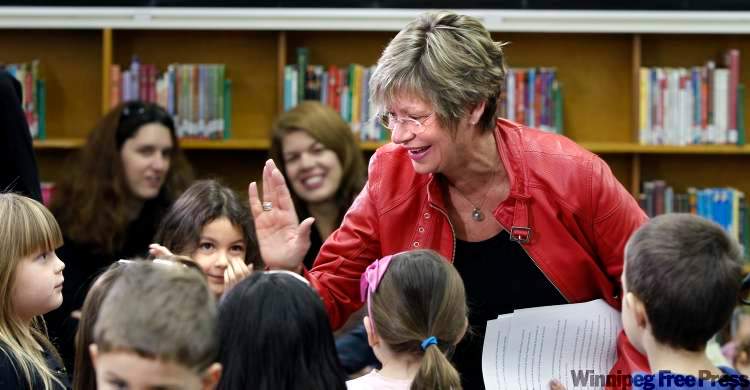
Speaking at Glenwood School in St. Vital in front of a Grade 1 class, Allan said only Ontario and British Columbia have also taken this step to “make a strong learning environment, where students will get the individual attention they need.”
The committee consists of bureaucrats, teachers, superintendents, trustees and parents.
“It is a huge undertaking,” Allan said. “We’d like to start it in 2012-13 with the first couple of classes.”
The committee will figure out how the province will “roll out” the cap, Allan said.
She would not say whether the cap would start with kindergarten and add a grade each year. Nor would she speculate whether some schools would need portables, or if crowded schools might have to shift an older grade to another school to free up space.
The process will take five years, Allan said repeatedly.
“It will give us time to iron out some of those details.”
There will be challenges, such as the anomaly of a school with only 21 kids in a grade, she said.
The $20 million should be enough for teachers, Allan said.
“It’s not an exact science. We’ve done a ballpark; we think it’s 250 (additional) teachers. There are lots of teachers looking for jobs,” she said.
Come September, the education department website will track K-3 class sizes school by school, class by class.
No one disputes whether small class sizes benefit kids, Manitoba Teachers Society president Paul Olson said.
“This is great news. It has tremendous potential for getting kids ready,” Olson said.
Seven Oaks superintendent Brian O’Leary, president of the Manitoba Association of School Superintendents, said some divisions are already close to the target.
“Our average class size, K-8, is 22,” O’Leary said.
In Seven Oaks, completing the construction of a new school in Amber Trails will likely be the key to capping class sizes at 20, he said.
He predicted there will be more need for classrooms with more than one grade to achieve the province’s goals.
“If everyone wants it to work, it’s workable,” said Seine River trustee Robert Rivard, president of the Manitoba School Boards Association.
“Our biggest concern would be if it’s a hard cap, if you have to have 20 in the class” even if there are only 21 or 22 students in a grade.
nick.martin@freepress.mb.ca