
Shaken to the core… subjects
Manitoba kids lag behind nationally in math, science, reading
Advertisement
Read this article for free:
or
Already have an account? Log in here »
We need your support!
Local journalism needs your support!
As we navigate through unprecedented times, our journalists are working harder than ever to bring you the latest local updates to keep you safe and informed.
Now, more than ever, we need your support.
Starting at $15.99 plus taxes every four weeks you can access your Brandon Sun online and full access to all content as it appears on our website.
Subscribe Nowor call circulation directly at (204) 727-0527.
Your pledge helps to ensure we provide the news that matters most to your community!
To continue reading, please subscribe:
Add Brandon Sun access to your Free Press subscription for only an additional
$1 for the first 4 weeks*
- Enjoy unlimited reading on brandonsun.com
- Read the Brandon Sun E-Edition, our digital replica newspaper
*Your next Free Press subscription payment will increase by $1.00 and you will be charged $20.95 plus GST for four weeks. After four weeks, your payment will increase to $24.95 plus GST every four weeks.
Read unlimited articles for free today:
or
Already have an account? Log in here »
Hey there, time traveller!
This article was published 29/11/2011 (5443 days ago), so information in it may no longer be current.
Brace yourselves, Manitoba parents — when it comes to core subjects, your kids aren’t doing that well in school compared to other Canadian students.
Manitoba’s students scored abysmally in national testing in math, science and reading conducted by the 10 provincial and Yukon territorial ministers of education.
Our students were significantly below the national average in all categories and beat out only Prince Edward Island in math and topped only Yukon in science and reading.
The Council of Ministers of Education Canada (CMEC) conducted the Pan-Canadian Assessment Program (PCAP) tests among Grade 8 students in the spring of 2010. The tests conducted every three years highlight one of the three subjects — math this time around.
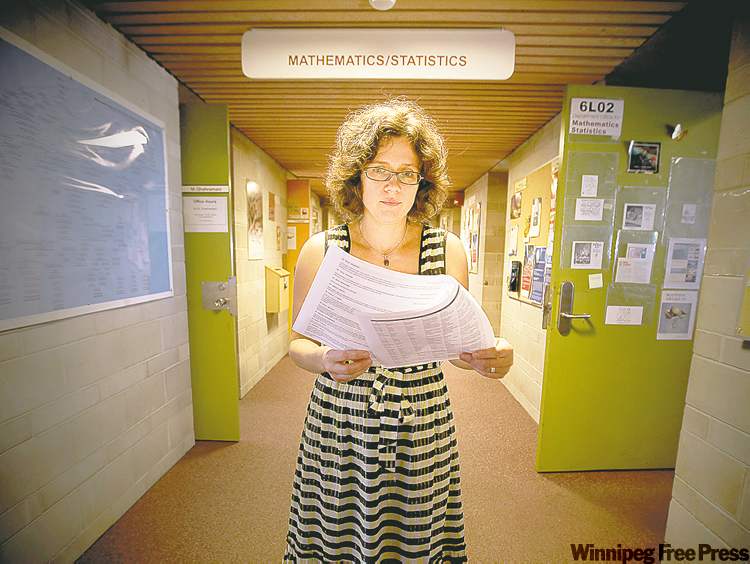
University of Winnipeg math Prof. Anna Stokke says Manitobans should be concerned our kids did so poorly in the testing.
“It’s completely unacceptable — parents and residents should be completely outraged by this. There should be a public outcry — we’re not living in the Third World,” Stokke said.
“There are huge issues with the curriculum. It’s the foundations that are really being neglected,” said Stokke.
Stokke speaks for a group of math professors who made headlines earlier this fall when they charged that some university education students often didn’t get a high-level math education when they were in high school, and aren’t sufficiently trained to teach math to kids. Education faculties will accept students who completed only consumer math in high school.
Stokke said Manitoba children — unlike those in some other parts of Canada — don’t get the basic algorithms for arithmetic, an old-fashioned grounding in addition, subtraction, multiplication and division.
“Not enough is being expected of children. They (schools) seem to be against any kind of practise,” Stokke said.
Education Minister Nancy Allan was not thrilled with the test scores. After receiving them last week, she called in teachers, trustees and provincial bureaucrats to talk about what could be done.
“Manitoba did not do well. This is unacceptable. I’m very concerned about this,” Allan said Monday.
Allan said Manitoba needs to look at our curriculum, at teachers’ professional development and at the education and training that teachers receive.
“This is really all about teacher contact and zeroing in on the kids that are struggling,” Allan said.
Manitoba Teachers’ Society president Paul Olson cautioned against panic.
“The sky is not falling. There are five provinces within a percentage point of each other,” he said.
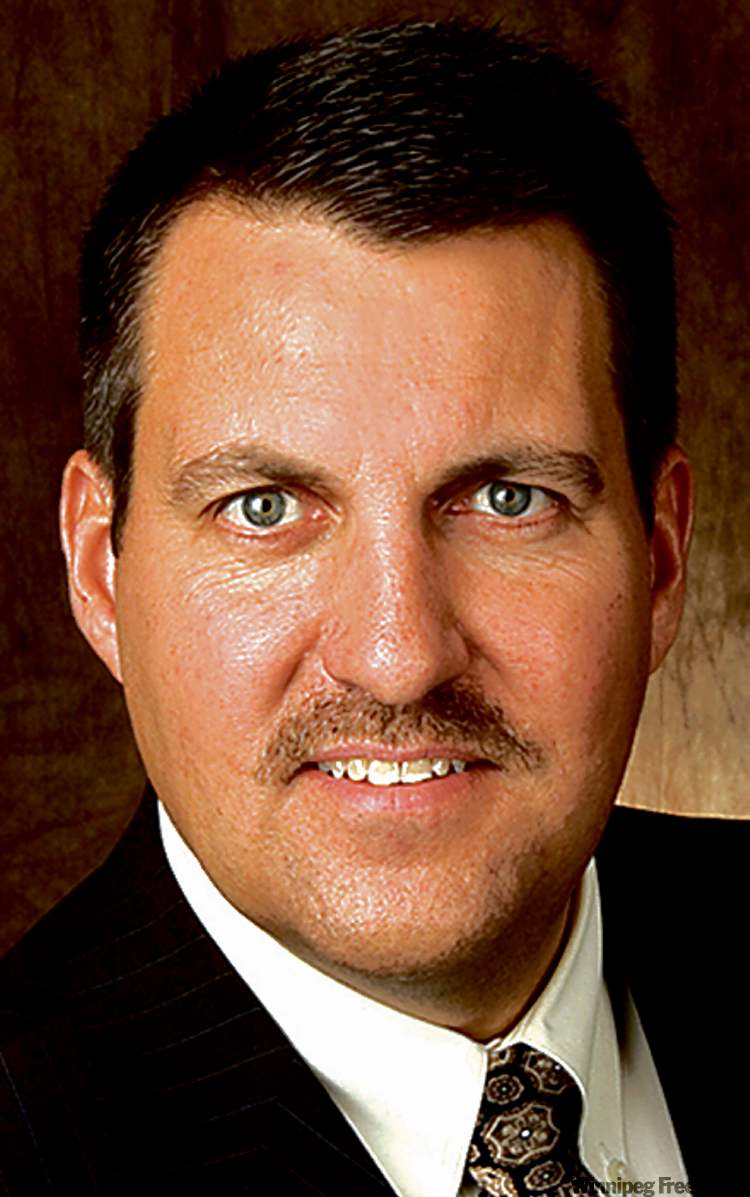
“Since the 2007 national report, Manitoba students improved; they just didn’t improve as fast as other jurisdictions.”
In fact, math scores ranged from 460 for P.E.I. to 515 for Quebec. Ontario was at 507, Alberta 495, B.C. 481, New Brunswick 478, Saskatchewan and Nova Scotia 474, Newfoundland and Labrador 472, and Yukon one point ahead of Manitoba at 469. Reading and science had similar spreads.
Olson said some provinces such as Ontario are experienced in positive moves that Manitoba is just making, such as capping class sizes for young kids, focusing on early childhood education and boosting stay-in-school programs.
Tory education critic Cliff Cullen (Spruce Woods) didn’t blame everything on the NDP. He said Manitoba students have posted low testing results for years.
“It’s pretty clear there’s not one easy answer to this. It begs the question, ‘What is the government going to do?'” he said.
Cullen said Manitoba needs to look at what other provinces are doing, examine the curriculum and determine whether our kids are getting the basics.
“You have to look in the mirror and say, ‘What are we doing wrong?'” said Cullen.
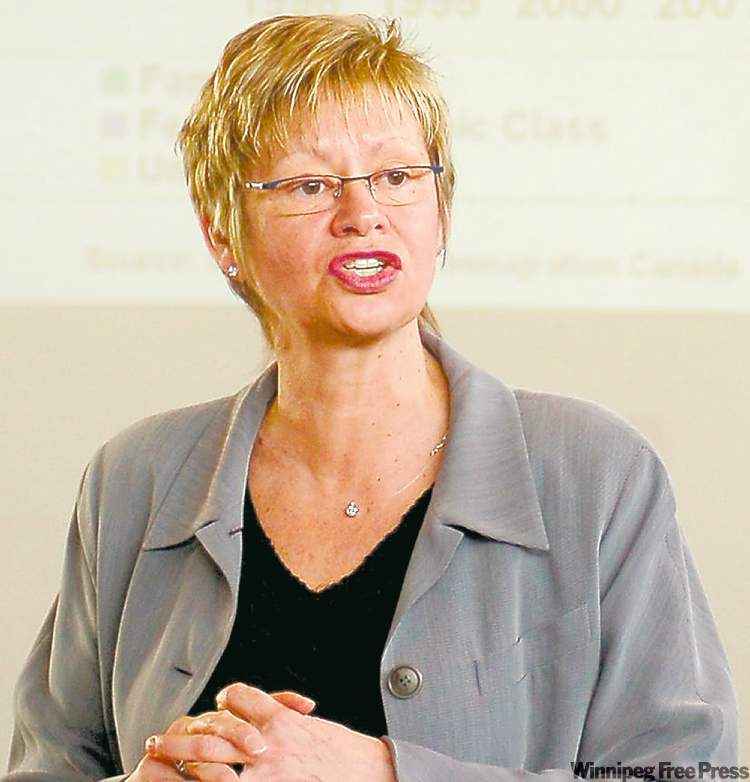
Manitoba School Boards Association executive director Caroline Duhamel said students need foundation skills in every subject.
“We’ll have to look at those jurisdictions that are more successful… and see what they’re doing differently,” Duhamel said.
nick.martin@freepress.mb.ca
Breaking down
the numbers
The Pan-Canadian Assessment Program released Monday by the Council of Ministers of Education, Canada, was bad news for Manitoba.
With the national average set as a benchmark of 500, Manitoba kids scored 468 in overall math, 486 in science and 478 in reading.
CMEC conducts the testing every three years, highlighting one subject in each round — the ministers did their in-depth analysis of the data on math in the 2010 testing.
While the gap against the national average remained about the same, French-speaking Manitoba students did better in math than anglophones. The English national standard was 495 — our students achieved 467; the national francophone standard was 515, while our students hit 480.
Canadian boys performed slightly better than girls in math. Nationally, boys scored 504 (Manitoba boys 470); nationally, girls scored 499 (Manitoba girls 468).
The ministers broke math performance down into four levels. Regardless of language or gender, Manitoba students were above the national percentages in the two lowest categories, below in the two highest categories.
Digging even deeper into the data, CMEC found Manitoba students were considerably weaker in geometry and measurement than in other areas of math.
Nationally, only math students in Ontario and Quebec exceeded the national average. In science, only Ontario and Alberta were above, and in reading, only Alberta and Ontario.
Similar testing by the Organization for Economic Co-operation and Development (OECD) conducted every three years among 15-year-olds in industrialized nations has shown Manitoba leaning towards the lower third in Canada, but still scoring above many developed countries.
The entire report can be found at http://www.cmec.ca/Publications/Lists/Publications/Attachments/270/pcap2010.pdf