
Truckers not on board with biodiesel increase
Province planning diesel-blend hike
Advertisement
Read this article for free:
or
Already have an account? Log in here »
We need your support!
Local journalism needs your support!
As we navigate through unprecedented times, our journalists are working harder than ever to bring you the latest local updates to keep you safe and informed.
Now, more than ever, we need your support.
Starting at $15.99 plus taxes every four weeks you can access your Brandon Sun online and full access to all content as it appears on our website.
Subscribe Nowor call circulation directly at (204) 727-0527.
Your pledge helps to ensure we provide the news that matters most to your community!
To continue reading, please subscribe:
Add Brandon Sun access to your Free Press subscription for only an additional
$1 for the first 4 weeks*
- Enjoy unlimited reading on brandonsun.com
- Read the Brandon Sun E-Edition, our digital replica newspaper
*Your next Free Press subscription payment will increase by $1.00 and you will be charged $20.95 plus GST for four weeks. After four weeks, your payment will increase to $24.95 plus GST every four weeks.
Read unlimited articles for free today:
or
Already have an account? Log in here »
Hey there, time traveller!
This article was published 25/07/2012 (5137 days ago), so information in it may no longer be current.
MANITOBA’S trucking industry is far from pumped over the possibility the province may increase the biodiesel mandate to five per cent.
Since early 2010, all diesel fuel sold in Manitoba must have an average two per cent blend of biodiesel.
The province is at the early stages of considering an increase to that level, something a provincial official said was always part of the plan.
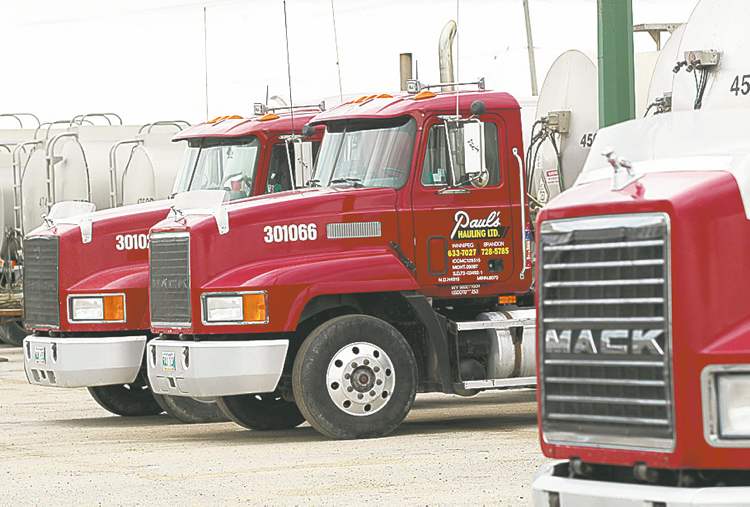
According to the provincial government calculations, a five per cent biodiesel mandate in Manitoba will reduce greenhouse gas (GHG) emissions by 56,000 tonnes annually, the equivalent of taking 11,200 cars off the road.
But truckers are concerned an increase to the blend might start gumming up engines because biodiesel has been known to get cloudy and gel at very low temperatures.
As it is, since biodiesel does not perform well in cold weather, to achieve a two per cent average the fuel companies deliver a blend closer to five per cent in the summer months and much less than two per cent in winter.
Bob Dolyniuk, executive director of the Manitoba Trucking Association, said increasing the mandate to five per cent would mean a blend closer to 10 per cent would be sold in the summer.
“The problem with that,” Dolyniuk said, “is that the diesel engine manufacturers, with the exception of Volvo, will not accept biodiesel over five per cent in their engines.”
An official with Manitoba Innovation, Energy and Mines (MIEM) said there are no imminent plans to increase the mandate to five per cent. But he said a consultation is likely to start this fall to get a reading from stakeholders.
“We have not set any specific dates,” said Bob Brennand, a business development project manager for transportation fuels with MIEM. “Engine warranty is a big factor and we appreciate the trucking industry’s concerns.”
Other advocates for more biodiesel use are not so conciliatory to the truckers’ concerns.
Scott Thurlow, president of the Canadian Renewable Fuels Association, said he does not have all of the information about engine warranty requirements.
But he pointed out British Columbia has already increased its average mandate to four per cent.
“The trucking industry has put up a barrier every time anyone has made a move on the mandate,” Thurlow said. “There really is no demonstrated evidence there is anything to be worried about. If there are warranty concerns, they need to be brought up with the original equipment manufacturers.”
Dolyniuk said there are plenty of instances where trucks won’t start in the cold and need to be brought inside to let the fuel warm up. Although there’s no unequivocal evidence such instances can be blamed exclusively on biodiesel affecting the operation, there is plenty of anecdotal concern.
“We are not opposed to alternative fuels as an industry,” Dolyniuk said. “My board is in support, but there’s certain criteria that have to be met.”
That criteria include: that it is equally or more efficient that diesel; the same price or better than diesel; does not affect operability or the warranty of the equipment; and demonstrates positive environmental impact.
The trucking industry argues it should not have to pay the price for economic development incentives to produce biodiesel, noting there are no similar incentives available for truckers.
martin.cash@freepress.mb.ca