
Gone Gardenin’ – Try your hand at making gorgeous Christmas wreath
Advertisement
Read this article for free:
or
Already have an account? Log in here »
We need your support!
Local journalism needs your support!
As we navigate through unprecedented times, our journalists are working harder than ever to bring you the latest local updates to keep you safe and informed.
Now, more than ever, we need your support.
Starting at $15.99 plus taxes every four weeks you can access your Brandon Sun online and full access to all content as it appears on our website.
Subscribe Nowor call circulation directly at (204) 727-0527.
Your pledge helps to ensure we provide the news that matters most to your community!
To continue reading, please subscribe:
Add Brandon Sun access to your Free Press subscription for only an additional
$1 for the first 4 weeks*
- Enjoy unlimited reading on brandonsun.com
- Read the Brandon Sun E-Edition, our digital replica newspaper
*Your next Free Press subscription payment will increase by $1.00 and you will be charged $20.95 plus GST for four weeks. After four weeks, your payment will increase to $24.95 plus GST every four weeks.
Read unlimited articles for free today:
or
Already have an account? Log in here »
Hey there, time traveller!
This article was published 15/12/2011 (5428 days ago), so information in it may no longer be current.
I am greatly attracted to natural Christmas wreaths; there is just something about holiday wreaths that draws me to them during the festive season.
There are innumerable wreaths available for sale at garden centres and some retail shops, but of course I do prefer to make my own from materials from my garden or retrieved from the local compost site.
The process of making a simple natural wreath is not difficult. All you need is some kind of circular form, which will be sturdy enough to support the finished wreath, to act as the base for the wreath — I use a few willow branches wound together and wired into a circular form.
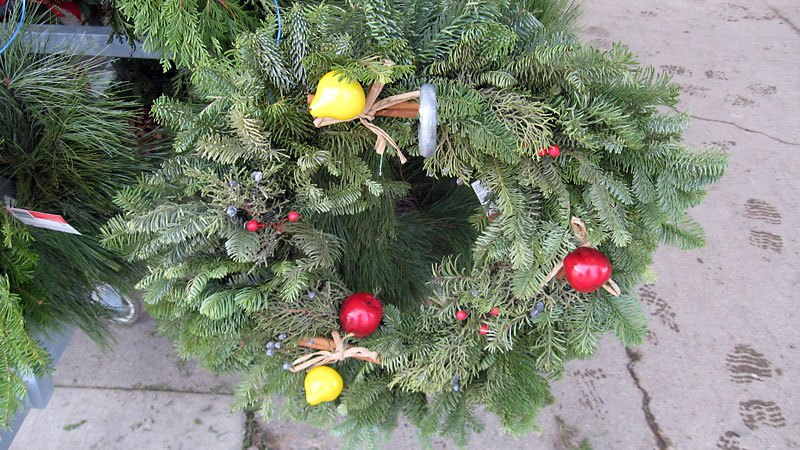
Usually I use evergreen branches to create the wreath. The butt end of the first branch is shoved into the form and the branch is then secured to the form, then the next one is placed so that its top overlaps the butt end of the first one to hide the bottom on the branch and so on.
As the branches are secured with wire to the form — all pointed in the same direction — the unsightly base of each branch is hidden by the next one that is put in place. Using lots of branches placed close together will create a lovely, full wreath.
Wreaths of just one type of evergreen are attractive or a more interesting wreath can be made by using a variety of evergreen types. I like spruce, pine, and cedar — each has its own texture and colour — and if I happen to get hold of a few blue spruce branches, they are used as colourful accents.
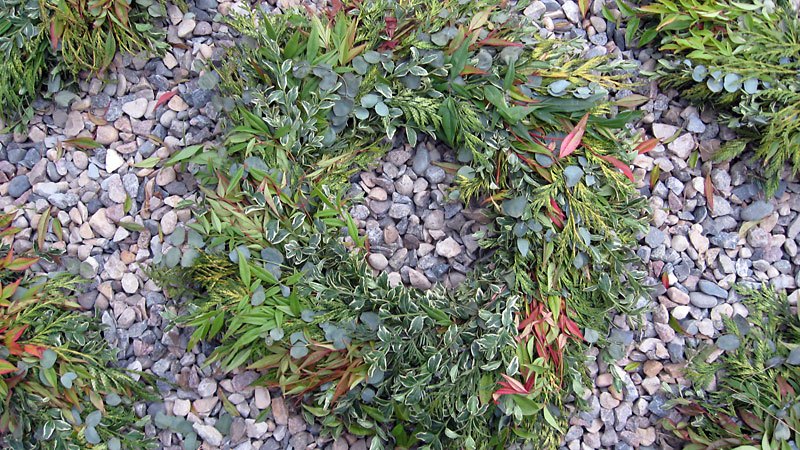
For the last couple of years, I have noticed that garden centres are offering wreaths made from broadleaf evergreens. These wreaths have an entirely different appearance than the typical evergreen wreath.
Some of them have quite a number of different types of branches, some with burgundy leaves, others with green leaves, and a few even have dark brown or tan leaves. I have even seen some of these wreaths with lovely silvery-leaf accents.
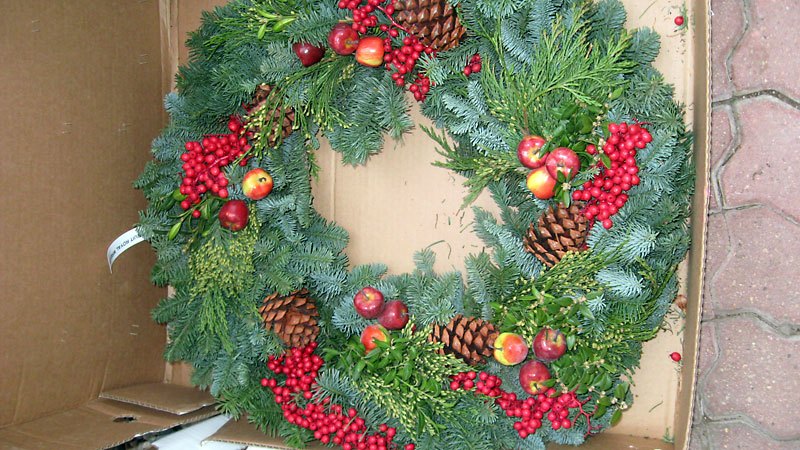
Although you can certainly purchase a wreath that has already been assembled, several outlets also offer for sale bunches of foliage perfectly suited for wreath making. As well, I am sure you could get some suitable foliage from a florist shop if you cannot find it elsewhere.
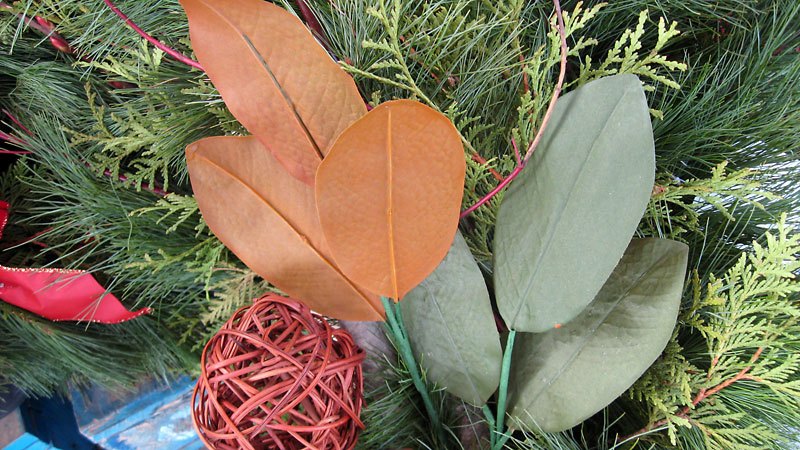
Some shops this year are offering bunches of magnolia leaves and I am quite intrigued by them since we have seen magnolias blooming in the south during some of our winter holidays. The magnolia leaves are green on the top and a lovely tan colour on their undersides, which can create some interesting points of colour in a wreath.
I have noticed that the broadleaf evergreen foliage used in wreaths and offered for sale for making wreaths all has one thing in common — it is very leathery.
The leaves are tough, leathery and usually quite pliable so they are well suited to creating wreaths for two reasons: they will be long lasting and they are not brittle, so they will not shatter or crack during the wreath making process.
If you choose to use a broadleaf evergreen wreath, you still might use a few things from your own garden to add to it. Use berries from your mountain ash or cranberry trees to create colour; sturdy seed heads such as those of echinacea and perennial grasses can be worked into the design as well.
If you are going to finish the wreath off with a bow, you might consider buying some raffia and making a bow from it; this will ensure that the entire wreath is made of natural materials.
Cones from your garden can be added to the wreath as well.
Broadleaf evergreen wreaths will have a shorter shelf life than those made from coniferous evergreen branches.
However, it is always interesting to try something different and creating a Christmas wreath from materials that you have not used before will provide an interesting activity during the holiday season.
Albert Parsons is a consultant for garden design and landscaping who lives in Minnedosa.
» communitynews@brandonsun.com