
The Blair Hitch Project
Advertisement
Read this article for free:
or
Already have an account? Log in here »
We need your support!
Local journalism needs your support!
As we navigate through unprecedented times, our journalists are working harder than ever to bring you the latest local updates to keep you safe and informed.
Now, more than ever, we need your support.
Starting at $15.99 plus taxes every four weeks you can access your Brandon Sun online and full access to all content as it appears on our website.
Subscribe Nowor call circulation directly at (204) 727-0527.
Your pledge helps to ensure we provide the news that matters most to your community!
To continue reading, please subscribe:
Add Brandon Sun access to your Free Press subscription for only an additional
$1 for the first 4 weeks*
- Enjoy unlimited reading on brandonsun.com
- Read the Brandon Sun E-Edition, our digital replica newspaper
*Your next Free Press subscription payment will increase by $1.00 and you will be charged $20.95 plus GST for four weeks. After four weeks, your payment will increase to $24.95 plus GST every four weeks.
Read unlimited articles for free today:
or
Already have an account? Log in here »
Hey there, time traveller!
This article was published 04/12/2010 (5798 days ago), so information in it may no longer be current.
In case you missed it, atheist Christopher Hitchens and former British prime minister Tony Blair went head to head in Toronto last Friday to debate whether religion is a force for good in the world. Hitchens was adjudged the comfortable winner, by a margin of two to one.
Formerly second fiddle to leading atheist Richard Dawkins, Hitchens has become first violin recently for his book "God is Not Great: How Religion Poisons Everything" and for photos of him in the final stages of esophageal cancer, yet asserting his health won’t be affected by people praying either for his healing or his death.
That is the literal truth, even if his book isn’t, but I must state my bias. It is not to claim that Blair was the real winner, as we might say about Jesus on Good Friday, but to say that all debates about religion are a waste of breath. If they don’t end in a nil-nil draw, then one side cheated. Intelligent pundits on both sides of the faith debate agree on that. Just repeating loudly that science has disproved religion, or that atheism is a mark of moral depravity, doesn’t make either statement true. Trying to influence the jury by eye-rolling and making faces to discredit defence witnesses is not allowed in a proper court.
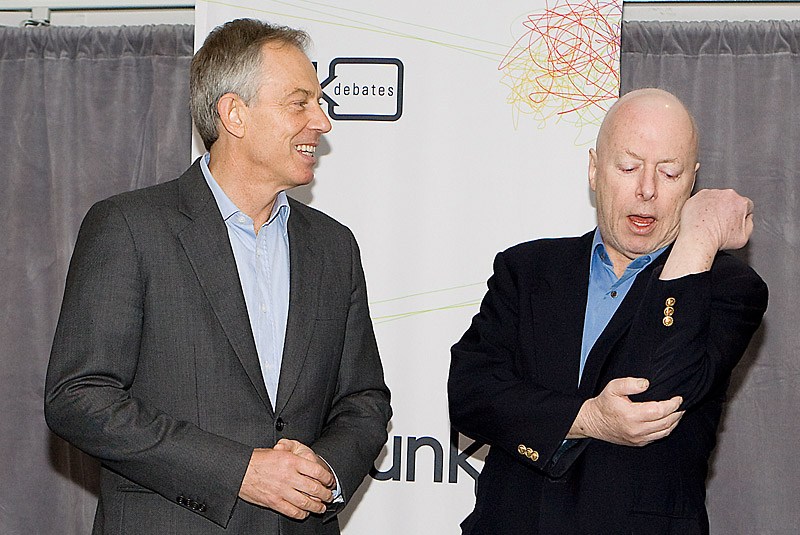
Some, like Stephen Jay Gould, say that science and religion are chalk and cheese — NOMA (non-overlapping magisteria), so debate is fruitless. Like most, I see them as POMA (partial ditto, e.g. the mind/brain relationship). So debate is useful, provided one views the topic as a Malayan jungle clearing — an area being constantly choked by the creeping undergrowth of quotations out of context and unfounded assertions, needing constant attention to keep it clear of illogical trains of thought and the comparing of apples with oranges — in particular, setting rationalism (modern science) against superstition (out of date religion).
Only when all wrong thinking is hacked away, and every rational argument neutralized by an equally rational counter argument, can a verdict be reached. Either — for religion or for atheism — will then be a step of pure faith.
The favourite ploy of pitting Stephen Hawking against the latest utterances of a semi-educated church pastor (modern science against old-fashioned religion), as Hitchens did when he talked of "books of legend and myth, man-made and primitive," will always make science appear the winner. And what better opponent than one whose denomination has only just "forgiven" Galileo! Poor Tony Blair is neither a scientist nor a theologian — just a famous churchgoer. Hitchens is a theological lightweight, too. If, instead, he had taken on any of Keith Ward, Alister McGrath, Paul Davies, Stephen Dick, Francis Collins, Owen Gingerich, John Polkinghorne, the Roman Catholic Michael Heller or Arthur Peacocke when he was alive (Google them), he would have been thoroughly routed by these theologians (most of them ordained scientists) who are as perfectly at ease with quantum mechanics as they are with biblical theology.
Yet none of those would dream of claiming proof for God, because they know it’s all so undisprovable that any debate like the Hitchens/Blair one could never be more meaningful than a Fox News documentary. This case to be heard only in the High Court, please, not some local kangaroo court.
It’s true that old-fashioned beliefs are still with us. They rely on an exaggerated theism which, crudely speaking, holds that God is "a" being, therefore separate from the universe he created, who is all-loving but inexplicably sends tornadoes and earthquakes, and is all-powerful yet only answers prayers to bring about good if it suits him.
This extreme version of theism is no longer held by any theologians of repute. Local church leaders may still pay lip service to it, possibly because they can’t afford to buy books of modern theology, more likely for fear of losing half their flock. Hitchens’ description of old-style theism — "a celestial dictatorship, a kind of divine North Korea" — is painfully accurate, though, and rightly drew laughter.
Today, God is seen as a limitless ocean, in which we are sponges — God being all round us and inside us, through and through, not as an interfering and rather grumpy outsider. Creation is seen as creativity — an eternal now — not something "he" got out of bed one morning and did, 6,000 or even 13 billion years ago.
In the same way, prayers to alter the course of nature — the kind that Hitchens spurns — embarrassed thinking Christians long before the enlightenment of the 18th century. When Dr. Benson did his experiment in 2006 (funded to the tune of $2.4 million by the Templeton Foundation), which involved praying for 1,802 patients in Boston hospitals, the inconclusive results didn’t surprise Christian theologians at all. (If anything, those who were being prayed for recovered slightly less quickly than those who weren’t.)
Telepathy, influence, will power and thought transference between humans — what computerists would call peer-to-peer networking — is one thing. That wife we heard about last weekend, dying six hours after hearing that her husband had been killed in a car accident, is a sad example of that. But satellite prayer — beaming a request up to some server-side deity, so that it can be triaged and redirected down onto Christopher Hitchens’ esophagus, has long been disowned as wishful thinking, even if saying so empties churches. Prayer is wholesome and rightly changes the prayer, the person who prays, causing him to revise his love/hate/fear/hope list, but not the prayee. So new evidence has emerged; order a retrial.
Neither does "religion starts all wars" stand up to close scrutiny. Those who say this would readily agree that the Koran nowhere commands the killing of all Americans; it is only a perversion of Islam that urges Muslims to join a jihad against the West. Yet the same are reluctant to admit that the New Testament itself does not promote crusades or killing, and that those who do are only exploiters. Terrorism is just that, whatever it attaches itself to. Case dismissed.
More cogent was Hitchens’ charge that religion promotes a distorted picture of the world — fanaticism was his word. He quoted Cardinal Newman: "The Catholic church holds it better for the sun and moon to drop from heaven, for the earth to fail and for all the many millions on it to die in extremist agony than one soul … should tell one wilful untruth or should steal one farthing without excuse." He uses that as evidence of Christianity’s "fantasy of purity," of a humankind "created sick, and commanded to be well." If he accuses the church of inducing guilt and fear, then he has a point. But it’s a device every organization and demagogue (Glenn Beck et al.) has been guilty of, not just religious ones, to keep followers on message. To promote the "noble savage" theory, though — the idea that if all this nasty religion hadn’t messed up our heads, we would have no shame or guilt feelings — is not one any anthropologist would take seriously. In general, religion has tried to make sense of things; it hasn’t caused them. So stop that line of argument, please, prosecuting counsel.
Hitchens correctly pointed to current instances of bad religion: associating sex with guilt and shame, terrifying children (and some parents) with images of hell and eternal punishment, assigning second-class status to women and denying the fact of evolution — "in the face of all the evidence." But when newspapers splash these, are they presented as things we ignore at our peril, like evidence of global warming, or do they only make headlines because they are held up as absurd relics of out-of-date thinking? Setting up religion as a straw man, as if all believers are like that Florida pastor Terry Jones who wanted to burn Korans, only takes in the gullible. The curious thing is those same people have an uncritical faith in science which is not held by scientists themselves. Full disclosure on that, please. You must share your findings with the defence.
Blair’s defence must also be discounted, factual though it was: "Almost half the health care in Africa is delivered by faith-based organizations … one-quarter of worldwide HIV/AIDS care provided by Catholic organizations … fantastic work of Muslims and Jewish relief organizations … in Canada, thousands of religious organizations care for the mentally ill, disabled, disadvantaged and destitute … in Toronto, a shelter run by covenant house, a Christian charity for homeless youth."
Only this week, American atheist Susan Jacoby admitted that churchgoers give more to charities than secularists — 25 per cent more to religious and even 15 per cent more to secular causes. They also feature substantially more in the help industry generally. But there’s no knowing whether generous-spirited folk are naturally attracted to church or whether church makes them generous-spirited. It’s a seductive but unprovable argument. Disregard it, jury.
Nor can we allow any of those jeers about "forcing religion down our throats." Not even Rush Limbaugh can ever force anything down anyone’s throat. Plea disallowed.
In the case of Modern Knowledge vs. Modern Beliefs, the correct outcome must always be "no verdict," because of a hung jury split straight down the middle.
If you still want to go to appeal, you weren’t really listening to the arguments.
» Rev. Michael Skliros is a retired Anglican priest in Brandon.
» Comments or criticisms on all aspects of contemporary religious faith and practice are welcome and should be emailed to: life@brandonsun.com.