
Many Westman EMS stations fail to meet response-time benchmarks
Advertisement
Read this article for free:
or
Already have an account? Log in here »
We need your support!
Local journalism needs your support!
As we navigate through unprecedented times, our journalists are working harder than ever to bring you the latest local updates to keep you safe and informed.
Now, more than ever, we need your support.
Starting at $15.99 plus taxes every four weeks you can access your Brandon Sun online and full access to all content as it appears on our website.
Subscribe Nowor call circulation directly at (204) 727-0527.
Your pledge helps to ensure we provide the news that matters most to your community!
To continue reading, please subscribe:
Add Brandon Sun access to your Free Press subscription for only an additional
$1 for the first 4 weeks*
*Your next subscription payment will increase by $1.00 and you will be charged $20.00 plus GST for four weeks. After four weeks, your payment will increase to $24.00 plus GST every four weeks.
Read unlimited articles for free today:
or
Already have an account? Log in here »
Hey there, time traveller!
This article was published 21/02/2015 (4071 days ago), so information in it may no longer be current.
More than 40 per cent of Westman’s rural ambulances don’t meet provincial response-time benchmarks when going to an emergency.
Of the 28 rural Westman emergency medical services (EMS) stations, 12 didn’t meet a provincial guideline that provides a 30-minute window from the time the call comes in to the time the ambulance reaches the patient, according to information obtained through a Freedom of Information and Protection of Privacy Act request made to Manitoba Health by the Brandon Sun.
The wait times were tabulated for EMS stations during a one-year period ending March 2014, and represent an average time of the monthly 90th percentile figures — the time by which 90 per cent of patients are picked up.
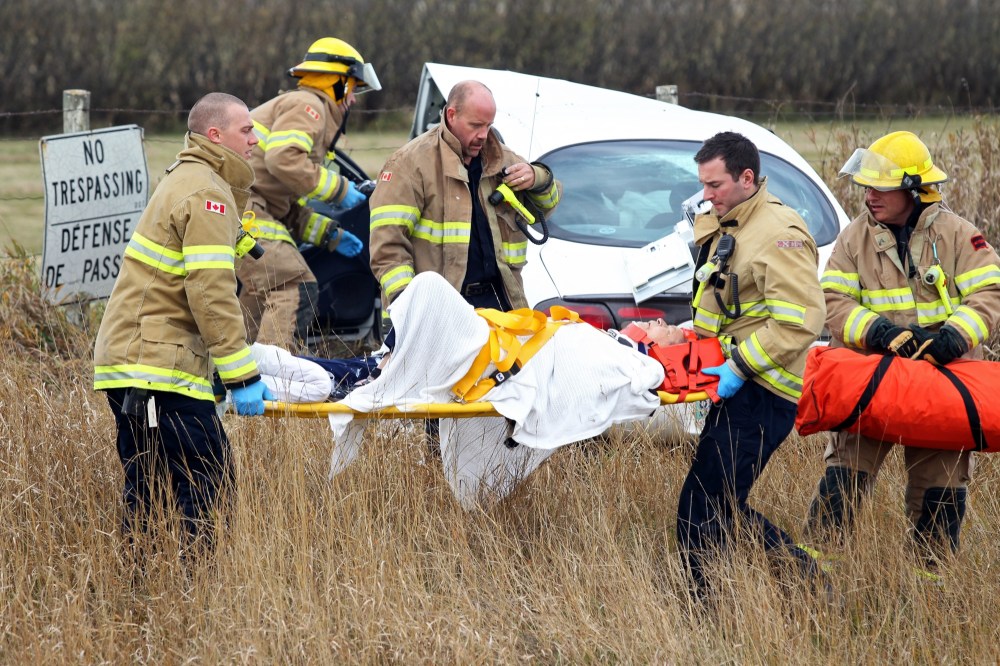
Prairie Mountain Health regional manager Neil Gamey doesn’t agree with how the numbers are aggregated.

Gamey pointed out that it’s not an accurate representation of all of the stations’ numbers. For example, one really high call could skew the numbers up during a slow month or conversely a lot of high calls during one month would be underrepresented for the station throughout the entire year.
However, the numbers might be worse when individual months — which are void any averaging — are examined.
Only two of the 28 stations —Souris and Minnedosa — had month-by-month wait times under the provincial threshold for the entire year.
In Deloraine, only twice did the ambulance get to 90 per cent of patients in under 30 minutes.
In August 2013, 90 per cent of patients waited almost 57 minutes for ambulance service, while in January 2014, the wait was up to one hour and six minutes.
While the numbers are credited to the Deloraine station, it is patients in surrounding areas who are often suffering the most, as the Deloraine stats become inflated when other stations are shuttered, increasing its service area.
“Deloraine stats will look horrible if the stations around them go down for any reason,” Gamey said. “It doesn’t reflect a change to the people in the Deloraine area.”
But that only highlights another problem — that the health region has difficulty staffing stations, forcing administration to close them, subsequently driving up wait times at neighbouring stations.
“We are in serious staffing issues in the southwest,” Gamey said. “We’re not happy with those numbers. With Deloraine, we’re really struggling to recruit and it’s difficult to keep the stations open that we have — and not from lack of trying or lack of willingness to hire … It’s hard to recruit into rural areas.
“We want to see all the stations in service all the time, and when they are not in service, it’s because of staffing.”
In the 2012-13 period, Hamiota’s average numbers were terrible as ambulances got to 90 per cent of patients in about 47 minutes or less. In the most recent period, Hamiota dropped to less than 36 minutes, but that’s more a product of the Birtle station being in service more.

“The last time (these results) came out, it was Hamiota residents that were upset and the people that should have been upset were in Birtle, because Birtle was out of service,” Gamey said.
Gerry Delorme, executive director of health emergency management with Manitoba Health, is charged with implementing recommendations from a large-scale review of the EMS system filed with the province in March 2013.
Delorme said Prairie Mountain Health has EMS challenges for many reasons, including its geographical size.
“It’s bigger than some European countries.”
Weather, call volume and the number of ambulances rolling also plays a role.
“The worst part about EMS is sometimes all the days line up — we have bad weather, you’re in a far place, plus we’re responding to multiple calls,” he said.
At the moment, Delorme is designing a provincial model that will reduce ambulance wait times and increase the quality of care received when ambulance attendants reach a patient’s door. That model is based on suggestions from the review, which pointed to closing 18 EMS stations across Manitoba, with 11 of those closures coming in PMH.
Delorme said he’s strictly looking at the science, leaving politics out of his decisions. His goal is to provide faster and better care and that might require closing some facilities and strategically placing primary-care paramedics in the area.
“My business is cruel and harsh,” Delorme said. “It is response times in minutes and seconds. I’m going to put forward the best model and brief (the government and stakeholders) on the best model on how we can improve services for Manitobans.”
Many municipal leaders are concerned higher standards for ambulance attendants will only make recruiting more difficult.
But Delorme argues moving the positions away from on-call employees to dedicated, professional paramedics will provide more incentive for people to fill the positions.
“When you can offer people a good career with good pay in the community they love, they are likely to stay there,” Delorme said.
In-house paramedics are typically on the road in under 90 seconds, according to Delorme, a number that balloons when communities rely on on-call staff, who often have to leave their jobs to go to the garage, change, and then leave the station.
In some cases, there are times the first attendant gets to the station almost immediately, but has to wait on a second ambulance attendant, meaning the ambulance is idling, ready to go but can’t, adding valuable minutes to the “chute time.”
“Ambulances could be further away but will get there quicker because of the lower chute time versus a casual model where it’s not uncommon that a chute time is up in five- to nine-minute range,” Delorme said.
In Brandon, where ambulances are staffed by full-time paramedics from the city’s fire halls, chute and response times are lower.
The new fire hall, located beside Andrews Field near the Daly overpass, has a yearly 90th percentile average time of just over 12 minutes. The hall doesn’t have a single month that is under the provincial guideline for urban centres of nine minutes.
Firehall No. 2, located near the Keystone Centre, gets to patients in under 10 minutes. In August and September 2013, the ambulance reached patients below the provincial threshold.
Gamey said location and traffic lights are reasons No. 2 hall is two minutes faster on average to patients than No. 1 hall.
» ctweed@brandonsun.com
» Twitter: @CharlesTweed