
First flood forecast favourable
Advertisement
Read this article for free:
or
Already have an account? Log in here »
We need your support!
Local journalism needs your support!
As we navigate through unprecedented times, our journalists are working harder than ever to bring you the latest local updates to keep you safe and informed.
Now, more than ever, we need your support.
Starting at $15.99 plus taxes every four weeks you can access your Brandon Sun online and full access to all content as it appears on our website.
Subscribe Nowor call circulation directly at (204) 727-0527.
Your pledge helps to ensure we provide the news that matters most to your community!
To continue reading, please subscribe:
Add Brandon Sun access to your Free Press subscription for only an additional
$1 for the first 4 weeks*
- Enjoy unlimited reading on brandonsun.com
- Read the Brandon Sun E-Edition, our digital replica newspaper
*Your next Free Press subscription payment will increase by $1.00 and you will be charged $20.95 plus GST for four weeks. After four weeks, your payment will increase to $24.95 plus GST every four weeks.
Read unlimited articles for free today:
or
Already have an account? Log in here »
Hey there, time traveller!
This article was published 01/03/2016 (3811 days ago), so information in it may no longer be current.
Below-average snow cover and mild winter temperatures have led to a favourable spring flood forecast for most of the province.
The flood risk in Brandon on the upper Assiniboine River has been identified as “below normal to normal,” according to Steve Topping, executive director of hydrologic forecasting andwater management with Manitoba Infrastructure and Transportation.
“It’s a lot less snow this year,” he said. “And because of the milder temperatures, we’ve seen a melting of the snowpack, and we’ve seen the frost depths less than normal.”
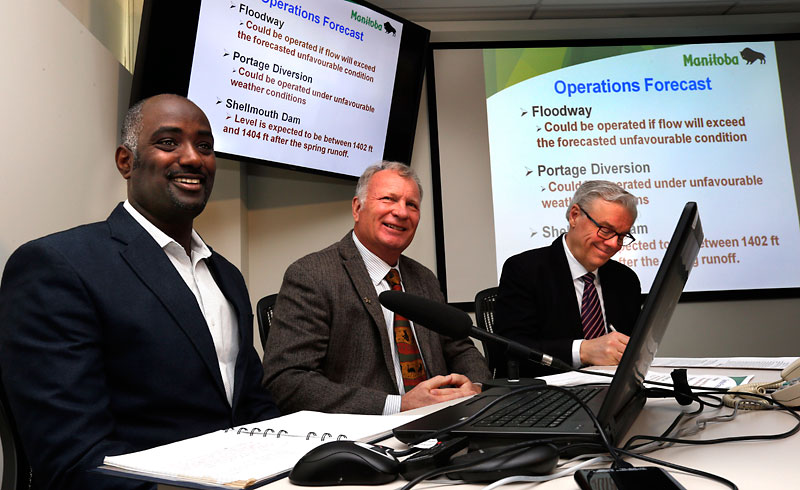
Generally below-normal frost depth means that the soil can absorb more melting water and potentially decrease the amount of overland flooding. Above-normal frost depth can contribute to increased runoff.
In the Qu’Appelle and Souris river basins, the flood potential is also “normal to below normal.”
Topping stressed that the overall flood risk could change, depending on weather conditions.
“You always have to be cautious,” he said. “In 1997, we had a huge snow fall event in April. In 2014, we had late spring rain, so it’s these outlier events that can put us into unfavourable conditions.”
The other potential concern is an early melt, followed by a freeze-up. Topping said this could have an impact on culverts.
“That often requires us to get the steamers out to thaw culverts,” he said.
The province will release another flood outlook in March, which Topping says will give Manitobans a better picture of what to expect.
The potential for localized flooding due to ice jams is also low, thanks to ice thickness being less than the province has seen in the past.
“Major ice jams are difficult to predict as to location and magnitude, and cannot be ruled out,” the flood outlook states. “On most major rivers, ice thickness is normal to below normal for this time of the year due to above-normal temperatures and lower-than-normal snow cover to provide insulation and prevent freezing.”
While the flood risk remains low, the province continues to prepare for any spring flooding that might arise. Flood-fighting equipment includes six sandbag-making machines, nearly 20,000 super sandbags, 2.2 million regular sandbags, 32.5 kilometres of Hesco cage barriers, 69 km of water-filled barriers and 61 heavy-duty steamers, among others.
In Brandon, work continues to fortify dikes and increase flood mitigation efforts.
Patrick Pulak, the city’s director of engineering services and water resources, said the flood forecast is good news, but if there were to be a spring flood, “we’re ready.”
“The 2014 flood is the flood of record, and we’re (protected to) two feet higher than that,” Pulak said.
The $27-million project to improve the city’s dike system is a partnership among the city, the province and the federal government. Pulak said work on the north side of the river is essentially complete.
“The last thing they’re doing … is putting in these big slide gates that’ll allow us to close off the storm sewers so we don’t have that issue backing up like we did in years past,” Pulak said.
The south dike project will be going out to tender within the next week or so, and will include everything from 26th Street to Fifth Street North.
“We’ve got some areas where the slope isn’t quite ideal, we’re just … augmenting what we’ve already got there,” Pulak said.
It will still be a few years before the entire project is complete, as one major component — the new lift station — still needs to be done, as well as work around Kasiurak Bay and 17th Street East.
“I think the biggest thing for us is now having completed Kirkcaldy (Drive) with all the storm sewer outfalls,” Pulak said. “We’ve gotten rid of those. We’re in a much better spot.”
» jaustin@brandonsun.com
» Twitter: @jillianaustin