
Hog producers upbeat about future
Advertisement
Read this article for free:
or
Already have an account? Log in here »
We need your support!
Local journalism needs your support!
As we navigate through unprecedented times, our journalists are working harder than ever to bring you the latest local updates to keep you safe and informed.
Now, more than ever, we need your support.
Starting at $15.99 plus taxes every four weeks you can access your Brandon Sun online and full access to all content as it appears on our website.
Subscribe Nowor call circulation directly at (204) 727-0527.
Your pledge helps to ensure we provide the news that matters most to your community!
To continue reading, please subscribe:
Add Brandon Sun access to your Free Press subscription for only an additional
$1 for the first 4 weeks*
- Enjoy unlimited reading on brandonsun.com
- Read the Brandon Sun E-Edition, our digital replica newspaper
*Your next Free Press subscription payment will increase by $1.00 and you will be charged $20.95 plus GST for four weeks. After four weeks, your payment will increase to $24.95 plus GST every four weeks.
Read unlimited articles for free today:
or
Already have an account? Log in here »
Hey there, time traveller!
This article was published 26/09/2015 (4038 days ago), so information in it may no longer be current.
For the first time since 2011, Manitoba hog producers have reason to be optimistic about the future of their industry in the province.
Earlier this year, the Manitoba government introduced a new special pilot project that will finally lift the moratorium on the construction and expansion of hog barns in the province.
The Pig Production Special Pilot Project Evaluation Protocol will allow construction to resume under several new conditions, according to Mike Teillet, sustainable development manager for Manitoba Pork.
One of the key conditions is a significant reduction in soil phosphorous limits where hog manure is spread. Previously, regulations allowed for 180 parts per million (ppm) of phosphorous to build up in soil while the new protocol will slash that by 200 per cent to just 60 ppm.
Secondly, any spreading of fertilizer will have to be incorporated into the soil within 48 hours or directly injected, a practice most producers have already adopted as a way to reduce runoff.
While several requirements were tightened under the new protocol, there was one major win for producers looking to build or expand.
Gone is the requirement that any new construction require an anaerobic digester, something producers long argued was too expensive and not practical due to cold Manitoba winters. In its place, hog farmers will now be able to use a dual- or multi-cell lagoon system that uses gravity to separate liquid from sludge — not dissimilar from the ones employed by many municipalities.
There are some geographical stipulations on the new protocol, according to Teillet. Producers east of the Red River will only be able to expand existing hog barns, while producers to the west will be able to expand and build new barns. In the RMs of Hanover and La Broquerie, where hog barns are some of the most densely populated in the province, no construction of any kind is allowed.
“I can’t say we’re thrilled with this,” Teillet said. “It’s not perfect, but under the circumstances, it’s as good as was expected.”
Manitoba Pork is fielding one to two calls per week from producers interested in learning about expansion, according to Teillet. He expects the first applications to come in before the end of the year, with construction starting next spring.
With relatively strong prices over the last two years, Teillet is hoping producers take advantage of the pilot project so that more hogs can be added to the supply chain.
“We would hope to build enough capacity and fill the shortage in the next five years,” he said.
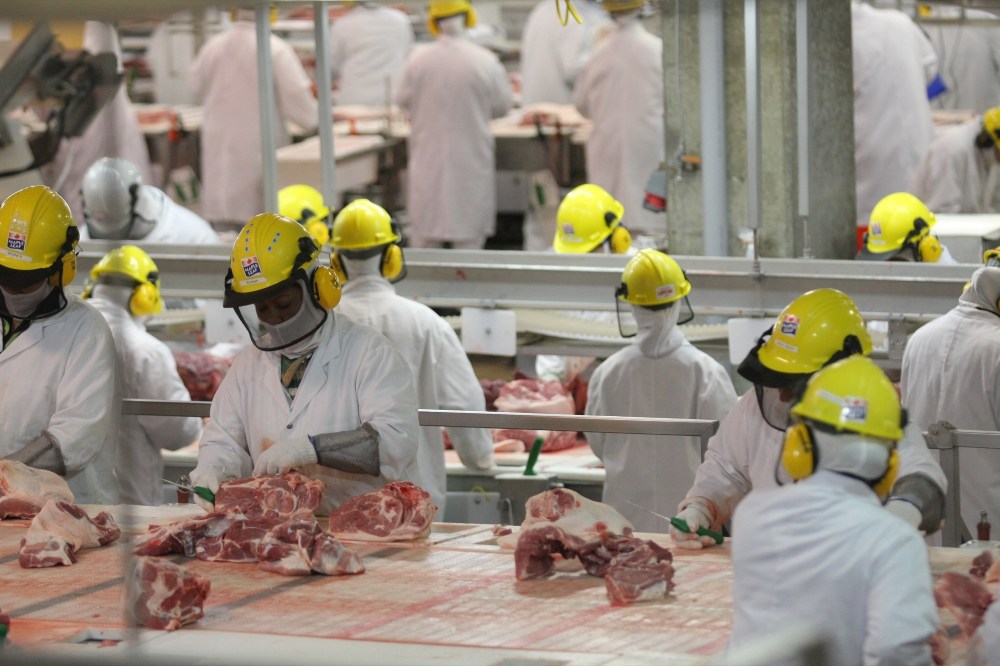
In Brandon, Maple Leaf has the capacity to process 90,000 hogs every five days, but is currently running at approximately 70,000 to 75,000 hogs, according to plant manager Morgan Curran-Blaney.
Maple Leaf has tailored its second shift to match the reduction in volume, but it comes at a financial cost to the company and its employees.
At peak capacity, the facility would need 2,250 employees, but only employs 1,850 at the moment. The hope is the new protocol could provide an influx of hogs and a subsequent ramp-up of production, fuelling jobs at the plant.
Additionally, many of the hogs that are being supplied to Maple Leaf come from barns that were built in the late 1990s or early 2000s. The hog industry’s infrastructure is aging in Manitoba and needs to be addressed if the plant is to remain viable in the long term.
“We’re in favour of responsibly expanding hog production,” Curran-Blaney said. “You need to be able to continue to invest in order to have a sustainable industry and an industry that doesn’t invest ends up running those risks of stagnation.”
At Neepawa, HyLife Foods executive vice-president Claude Vielfaure said the plant is working at capacity, but would have the ability to add about 15 per cent more production with some investment.
“It’s positive as far as the government finding a way of doing something with a pilot project,” Vielfaure said. “I think our industry was slowly dying and was going to whittle away because if you can’t replace your assets, then you become non-viable and it would have cost thousands of jobs and lots of money to the economy. This gives us a ray of light to do something and start to replace assets that we need to be viable as an industry.”
In 2006, the NDP government banned hog barn construction in 35 RMs in the province. Then in 2011, the government implemented what amounted to a moratorium on new hog barns anywhere in the province under the Save Lake Winnipeg Act. The act resulted in a gradual decline in hog production and shortages at the processing level.
Agriculture Minister Ron Kostyshyn said pork makes up 44 per cent of the food-processing sector, the single largest contributor in the sector.
While the industry is important, the government won’t jeopardize clean water in the province for the expansion of one more hog, he said.
“There are rules and regulations that have been tested and scientifically researched, and as long as we stay within the rules and regulations, there’s an opportunity of a partnership in continued growth in the industry.”
Kostyshyn said he didn’t have enough information to know if the protocol would be revoked at some point in the future.
The province intends to study the two- and multi-cell lagoon system over the next two years to examine its effectiveness compared to anaerobic digesters.
Country of Origin Labelling and changes federally to the Temporary Foreign Workers Program are additional reasons the hog industry has shrunk in the province over the last number of years, according to Kostyshyn.
» ctweed@brandonsun.com
» Twitter: @CharlesTweed