
Travelin’ Westman — ‘A night you’ll never forget’
Hockey player, firefighter recall leap day collapse at Austin arena
Advertisement
Read this article for free:
or
Already have an account? Log in here »
We need your support!
Local journalism needs your support!
As we navigate through unprecedented times, our journalists are working harder than ever to bring you the latest local updates to keep you safe and informed.
Now, more than ever, we need your support.
Starting at $15.99 plus taxes every four weeks you can access your Brandon Sun online and full access to all content as it appears on our website.
Subscribe Nowor call circulation directly at (204) 727-0527.
Your pledge helps to ensure we provide the news that matters most to your community!
To continue reading, please subscribe:
Add Brandon Sun access to your Free Press subscription for only an additional
$1 for the first 4 weeks*
*Your next subscription payment will increase by $1.00 and you will be charged $20.00 plus GST for four weeks. After four weeks, your payment will increase to $24.00 plus GST every four weeks.
Read unlimited articles for free today:
or
Already have an account? Log in here »
Hey there, time traveller!
This article was published 12/03/2016 (3690 days ago), so information in it may no longer be current.
Kevin Henry doesn’t mind that Feb. 29 only comes around once every four years.
Henry, who is indelibly linked to the day, wasn’t born on the leap day. Nor was he married or had a child on the day. Instead, it was four years ago on Feb. 29 that the then 45-year-old died.
“That day just doesn’t want to stick,” Henry said when asked what he remembers about the day his heart stopped for several minutes.
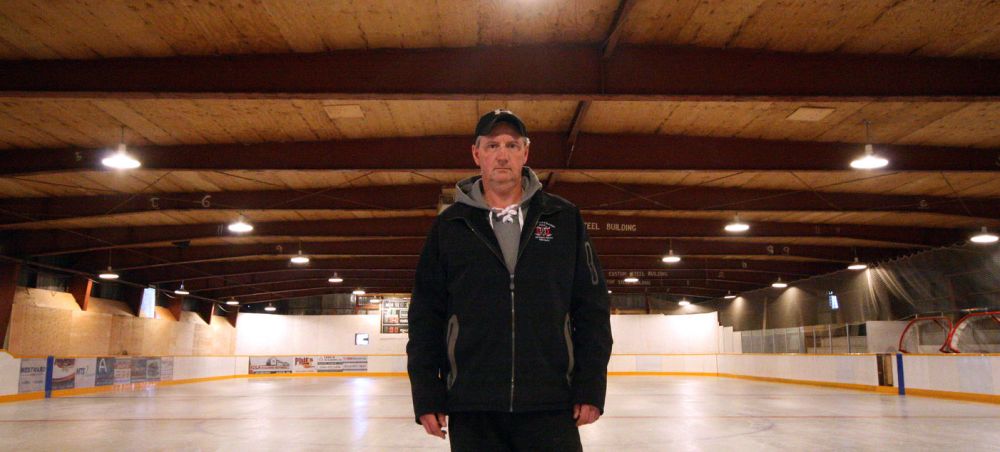
In the research he has done since, Henry said it’s not uncommon for people who undergo traumatic experiences such as the loss of life to black out a period of time from their memory.
The last thing he remembers is playing hockey the night before in Langruth, a hamlet 55 kilometres north of MacGregor.
“I played hockey up in Langruth, and if it would have happened up there, then who knows?” said Henry, who lives in MacGregor.
The following night, however, while playing hockey in the Austin Amateur Hockey League, Henry collapsed on the ice.
Austin is 12 kilometres west of MacGregor on the Trans-Canada Highway.
From what friends have shared with him since the incident, Henry said he was skating back into his own zone to retrieve a puck, when, after turning up ice and making a pass to one of the forwards on the team, he went down.
Austin Fire Department deputy chief James Zacharias just happened to be in the stands watching the game that night.
“I was standing there visiting with a friend and I saw him laying on the ice and I could see the panic on the faces of the players playing with him and I knew it was serious,” Zacharias said.
After rushing to the ice to assess the situation, Zacharias bypassed the 911 system and contacted two local volunteer firefighters, telling them to bring the defibrillator to the rink immediately while another spectator made the call to emergency personnel.
Then, with the help of two players on the ice, Zacharias rolled Henry onto his back and removed his helmet.
Henry wasn’t wearing shoulder pads, which saved some time as Zacharias and others began CPR.
While Henry’s pulse and breathing were erratic at the beginning, Zacharias said the situation turned dire not long after.
“People were talking to 911 and they were yelling down that they want a pulse count and finally I yelled back that we don’t have that,” Zacharias said.
A split-second later, the doors swung open as a local firefighter streaked into the building with the defibrillator.
“They came running,” said Zacharias, adding that the fire hall is only about five blocks from the arena.
He estimates it took five minutes from the time the call went out until the time the unit showed up at the rink.
After cutting off his jersey, Zacharias hooked up the device to Henry’s chest. Defibrillators are designed to deliver a dose of electrical current to the heart, causing it to re-establish its normal rhythm in the body.
“There was a point where after I shocked him once, and I remember the chief had showed up and he’s done quite a bit of ambulance work, and I looked at him like I don’t know what else to do,” said Zacharias, who has been a firefighter for 15 years.
“And he kind of said ‘Yeah, there’s nothing you can do.’ Then, after the next shock he started breathing again.”
While the whole process happened fast, Zacharias said he relied on his training, which allowed him to slow everything down and do what needed to be done.
“It’s a night you’ll never forget. It was pretty amazing.”
Henry was later loaded into an ambulance, which came from MacGregor, and after a quick stop at Portage District General Hospital he was transported to St. Boniface Hospital in Winnipeg.
The next thing he remembers is waking up in the hospital with a myriad of machines surrounding him.
“It’s quite the feeling when you have no idea why you’re in the hospital and you’re laying there with all these tubes hanging out of you,” Henry said.
Doctors explained to him that he had a buildup of plaque around his heart. During the game, a piece of this plaque broke off and constricted blood flow through his arteries.
Medical staff performed a quadruple bypass surgery the day after he was admitted.
Today, Henry has two major reminders of the harrowing experience in the form of scars. One on his chest, where they opened him up to perform the surgery, and another from his upper thigh to ankle, where they removed a long portion of his vein for the bypasses.
“It’s amazing what they can do,” Henry said. “There were so many people involved and everything went so well. It’s hard to believe it happened the way it did. Everything kind of fell into place.”
Henry, who has never been a smoker, said doctors told him the buildup of plaque near his heart was due to his diet.
Since the incident, he has changed they types of foods that he eats.
And, while he’s always been active playing hockey and baseball, Henry said he takes his exercise regime more serious and has lost some weight compared to four years ago.
“I didn’t expect it,” he said. “Looking back now, there were signs that should have triggered me that I was having problems.”
One of the biggest warning signs was tightness in his chest whenever he would begin warming up for hockey or baseball. Henry said he chalked it up to acid reflux and nothing more.
The whole experience might have been the most stressful on Henry’s family, including his wife Patty and children Jillian, Shawn, Kolby and Kendall, who range in ages from 28 to 20.
Henry said he has asked his wife multiple times about the day his heart stops because for some reason the information just won’t stick.
“In one way, I wish I could remember it and in one way it’s probably just as well that I don’t.”
One thing that has stuck, however, is how his perception has changed.
“I definitely don’t take anything for granted anymore,” Henry said.
Charles Tweed is the Brandon Sun’s senior political and rural reporter