
The War From Here: Stinson made history, emergency landing
Advertisement
Read this article for free:
or
Already have an account? Log in here »
We need your support!
Local journalism needs your support!
As we navigate through unprecedented times, our journalists are working harder than ever to bring you the latest local updates to keep you safe and informed.
Now, more than ever, we need your support.
Starting at $15.99 plus taxes every four weeks you can access your Brandon Sun online and full access to all content as it appears on our website.
Subscribe Nowor call circulation directly at (204) 727-0527.
Your pledge helps to ensure we provide the news that matters most to your community!
To continue reading, please subscribe:
Add Brandon Sun access to your Free Press subscription for only an additional
$1 for the first 4 weeks*
- Enjoy unlimited reading on brandonsun.com
- Read the Brandon Sun E-Edition, our digital replica newspaper
*Your next Free Press subscription payment will increase by $1.00 and you will be charged $20.95 plus GST for four weeks. After four weeks, your payment will increase to $24.95 plus GST every four weeks.
Read unlimited articles for free today:
or
Already have an account? Log in here »
Hey there, time traveller!
This article was published 29/08/2015 (4056 days ago), so information in it may no longer be current.
Deadly crashes at international air shows in recent weeks have dominated headlines, raising questions about vintage planes and safety.
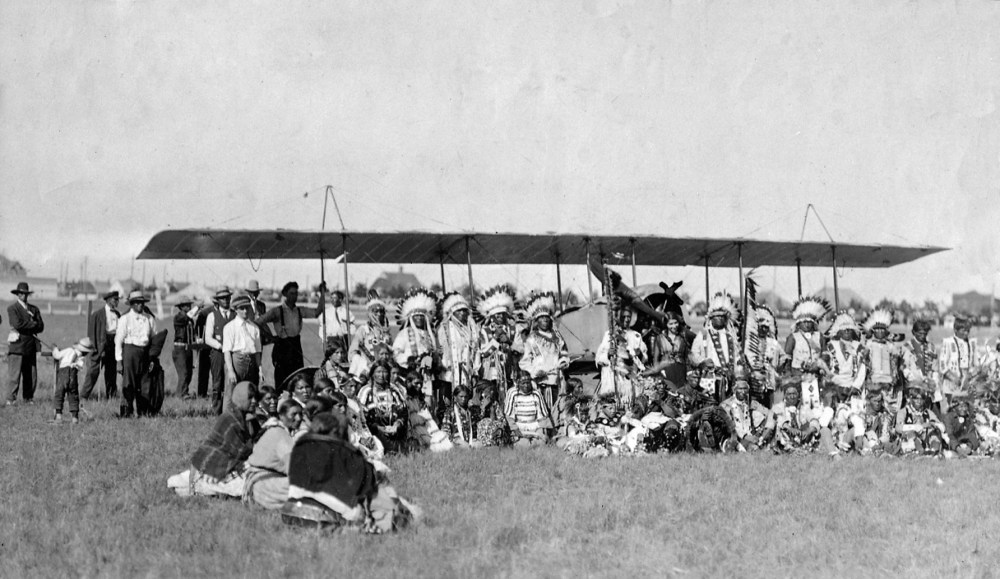
In fact, it was nearly 100 years ago, near Douglas, that aviator Katherine Stinson had to make her own emergency landing in her biplane after visiting the soldiers at Camp Hughes on July 24, 1916.
Stinson’s short yet remarkable aviation career is well documented, chronicling a lifetime of achievements in less than a decade.
Born in Fort Payne, Ala., a dozen years before the Wright brothers successfully made their first powered flight, Stinson initially became a stunt pilot to subsidize her piano career but, under the tutelage of pilot Max Lillie, she quickly demonstrated an aptitude for flying.
Her siblings, Marjorie, Jack and Edward, would also pursue successful careers in aviation.
Stinson was the fourth woman in American history to earn her pilot’s licence, the young aviator obtaining it in July 1912 at the age of 21.
She was the first woman to master the loop-the-loop, a feat she accomplished in 1915 in a plane she had built herself. At the time, only three pilots before her had mastered that particular stunt.
Stinson is also credited with being the first person to fly a plane at night, and she is reportedly the first pilot to have performed night skywriting.
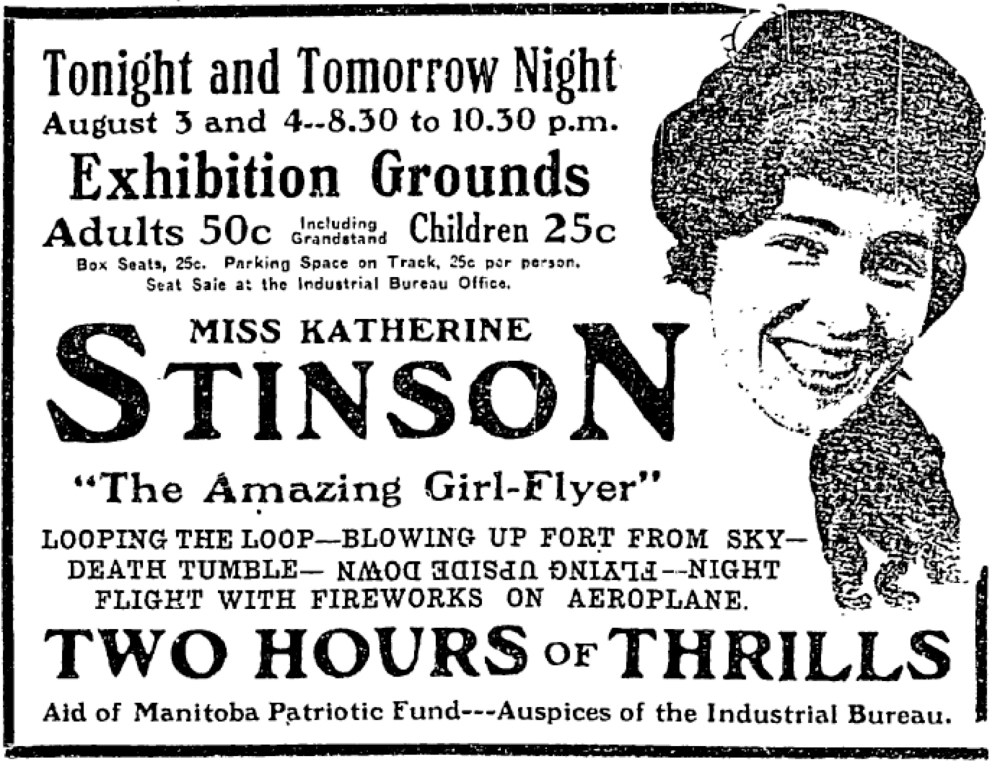
On April 7, 1916, the Attraction Committee of the Brandon Summer Fair Board began exploring the possibility of hiring an aviator for its summer entertainment. The Robinson Amusement Corporation recommended Stinson, an aviator who was capable of performing aeronautical stunts. She was contracted for eight flights with a “no flights, no pay” agreement.
In the local paper, Stinson was billed by the Brandon Summer Fair as the “famous lady aviator who loops the loops a dozen or more times while in the air, and at night plays the part of an eccentric comet, looping the loop and leaving a trail of flame in her course.”
Stinson fitted Roman candles or magnesium flares on the wings of her aeroplane for her evening fireworks exhibitions at the fairs. She required a half-mile of track on which to taxi and used burning tar barrels to guide her landings. The barrels, when available, were placed at intervals along the edge of a track and the cutting of the plane’s motor was the auditory cue to flare up the fires with gasoline in order to guide in the plane.
On the last evening of the Summer Fair, Stinson was reportedly unable to fly because of mechanical difficulties exacerbated by windy conditions. That day, a large contingent of soldiers from Camp Hughes had visited the fair and expressed disappointment at missing her flying demonstrations.
To make it up to the “soldier boys,” Stinson arranged to fly in her plane to Camp Hughes the following day. Stinson departed from the fairgrounds on Saturday morning to make the 20-minute flight to the military camp. Other dignitaries and guests followed in their motor cars.
Stinson toured the camp from the air and on the ground, joining the headquarters staff for luncheon before returning to Brandon for the weekend.
On her return flight to Brandon, Stinson ran into trouble at 4,500 feet in the air. Strong headwinds caused her biplane’s engine to cut out, necessitating an emergency landing. Thinking she was following the main highway, Stinson glided to a landing in an oat field belonging to Will Black.
The local paper reported a thousand people converged on Black’s property after witnessing the plane’s descent. Soldiers piled into the camp’s motor cars and raced to the scene to give aid. The headquarters staff instructed its mechanics to load themselves into the large auto trucks and bring with them the contents of their machine shop.
While the biplane’s wings had caught in the vegetation and caused the plane to tip, the only damage was a broken camshaft. Stinson walked away uninjured and went on to perform at events in Regina and Winnipeg later that week.
The press reported Stinson’s 30-week North American tour was earning her $150,000 that year (approximately $2.9 million in today’s dollars). It is not known what the Brandon Fair Board paid Stinson that summer, but a 1917 quote shows Stinson requested $2,000 (equivalent to approximately $32,000 today) for eight flights with an additional $100 per flight for evening fireworks performances.
Following her 1916 Canadian fair circuit, Stinson continued to achieve other firsts.
She became the first female pilot to fly in Asia, where she performed exhibition flights in Japan and China in early 1917. That year, she also set a long-distance record for a solo flight between San Diego and San Francisco, and she became the first female pilot commissioned by the U.S. Postal Service for its airmail service. As well, Stinson flew the first airmail flight in Western Canada between Calgary and Edmonton on July 9, 1918.
However, Stinson’s aeronautical accomplishments were not enough to earn her acceptance as a volunteer pilot for the United States air force. The U.S. military twice rejected Stinson’s air force applications, allegedly because of her sex.
.jpg?w=1000)
The rejections were especially ironic and likely frustrating for Stinson since she, along with her family, had established the Stinson School of Flying in San Antonio, Texas, in 1913.
It was there that Canadian cadets in the Royal Flying Corps were sent for training beginning in 1916. Both Katherine and her sister Margaret, who was an accomplished pilot in her own right, taught the men at their flight school.
It is possible, however, that the U.S. government believed Katherine Stinson was too valuable an asset to send overseas. In addition to training RAF pilots, Stinson volunteered with the Red Cross. Her aeronautic stunt shows, which included demonstrating military maneuvers, helped fundraise nearly $32 million in today’s currency for the organization.
Stinson, however, was determined to serve overseas. She finally managed to enlist near the end of the war, but as an ambulance driver, not as a pilot.
Sadly, while serving in Europe, Stinson contracted influenza. And while the infection did not end her life, respiratory complications had grounded her flying career by 1920.