
Flood aid sought for cottage-owners
Province backs expansion of disaster program
Advertisement
Read this article for free:
or
Already have an account? Log in here »
We need your support!
Local journalism needs your support!
As we navigate through unprecedented times, our journalists are working harder than ever to bring you the latest local updates to keep you safe and informed.
Now, more than ever, we need your support.
Starting at $15.99 plus taxes every four weeks you can access your Brandon Sun online and full access to all content as it appears on our website.
Subscribe Nowor call circulation directly at (204) 727-0527.
Your pledge helps to ensure we provide the news that matters most to your community!
To continue reading, please subscribe:
Add Brandon Sun access to your Free Press subscription for only an additional
$1 for the first 4 weeks*
- Enjoy unlimited reading on brandonsun.com
- Read the Brandon Sun E-Edition, our digital replica newspaper
*Your next Free Press subscription payment will increase by $1.00 and you will be charged $20.95 plus GST for four weeks. After four weeks, your payment will increase to $24.95 plus GST every four weeks.
Read unlimited articles for free today:
or
Already have an account? Log in here »
Hey there, time traveller!
This article was published 05/11/2010 (5798 days ago), so information in it may no longer be current.
The province and Lake Winnipeg communities want Ottawa to rewrite the rules on who’s eligible for financial disaster assistance when big lake storms hit cottage country.
But Selkirk-Interlake MP James Bezan said that’s not as simple as sounds, as other provinces have to agree, too.
The feud between the two levels of government over disaster funding comes as the cleanup from last week’s storm continues and officials eye building new and higher dikes on Lake Winnipeg to protect homes and cottages.
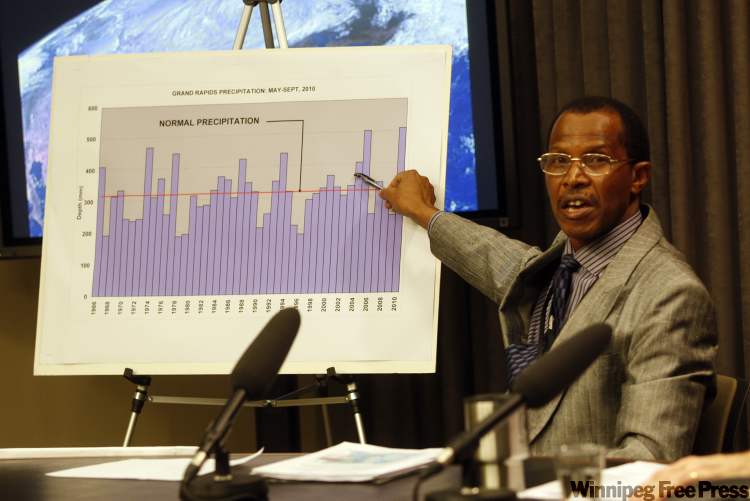
Officials on Thursday made it abundantly clear there will be future storms as the climate changes and southern Manitoba gets soggier from heavy rain, causing lake levels to rise.
“Clearly, the scale of what we’re dealing with points to the importance of federal, provincial, municipal and individual cost-sharing,” Infrastructure Minister Steve Ashton said.
In 2005 the province spent $8 million to build dikes in communities in the south basin of Lake Winnipeg from Riverton to Victoria Beach to protect them from fall storms.
“I think at the time some people questioned whether this was really necessary,” Ashton said. “Is there anybody that questions that now after seeing what happened? We had the threat in 2005. We had the reality in 2010.”
Now the province wants to use disaster financial assistance (DFA) money to help repair and raise dikes and build new ones to protect towns and cottages. But the problem is DFA money does not cover seasonal residences.
“I would certainly say given what’s happened this year, we would more than welcome federal participation because this kind of mitigation works,” Ashton said. “We’ve seen it.”
Bezan said to change the rules of the DFA agreement, other provinces have to agree with Manitoba.
“We’ve never said that we’re opposed to changing the rules,” he said.
The storm hit 17 communities, including five First Nations, in the south basin. Each declared a state of emergency to respond quickly to flooded homes, roads and breached dikes. An early damage estimate is $7 million. About 100 homes and cottages saw varying degrees of flooding.
Water Stewardship Minister Christine Melnick said heavy rain since May contributed to the storm.
From May to September — the wettest summer and fall in 30 years — precipitation for southern Manitoba and the Interlake was 160 per cent above normal. A lot of that water flowed into Lake Manitoba and Lake Winnipeg, the latter seeing the third-largest in-flow since records have been kept, said Steve Topping, executive director of Manitoba Water Stewardship’s infrastructure and operations division.
All that water in Lake Winnipeg put it at 715.1 feet above sea level — its highest level since 1968 –when the Oct. 27 storm hit. Peak north winds of 80 to 110 kilometres per hour blew water from the north basin into the smaller south basin. High waves ripped apart shoreline and caused flooding. Twin Lakes Beach and Delta Beach at the south end of Lake Manitoba saw similar damage.
RM of St. Clements Mayor Steve Strang said cottagers should get equal treatment under DFA.
“You shouldn’t be set aside because you have a seasonal cottage. You pay your taxes, too, on both places whether full-time or seasonal.”
Lake Manitoba cottager Alice Dent and others said cottagers should be eligible because high lake levels are causing more erosion and more flooding.
“We’ve lost so much property we’ve had to move our boathouse three times,” she said. “Our property is worthless. People are paying big bucks for nothing.”
bruce.owen@freepress.mb.ca
Storm’s trail of destruction
Stay away from damaged parks
The province wants people to stay away from its parks that suffered storm damage last week.
The province says there was significant erosion of shorelines at Grand Beach, Patricia Beach, Winnipeg Beach and Camp Morton provincial parks on Lake Winnipeg. There was also damage to infrastructure near the shores of some parks including Grand Beach’s boardwalk. On Lake Manitoba, there was extensive shoreline damage at St. Ambroise Provincial Park.
Conservation Minister Bill Blaikie said while there has been extensive erosion of sand dunes and beach ridges at some of the parks, it’s expected these areas will be restored naturally over time.
Funding help
The province is making disaster financial assistance (DFA) available to those hit by last week’s storm.
DFA is generally available for evacuation costs, costs to prevent or limit imminent damage and for non-insurable damage to basic and essential property such as principal residences, buildings and other non-insurable losses essential to the operation of eligible farms and small businesses.
People can find information to begin their DFA assessment by going online at www.manitobaemo.ca or calling 1-888-267-8298.
The province also said that homeowners, farmers and businesses can now apply for assistance to help cover the costs of flood-proofing their property including work done since March 2009.
The program is aimed at helping those in areas where the flood risk is highest such as the Red River area north of Winnipeg. It will be delivered over six years and cover a maximum total project cost of $100,000. Similar to the 1997 flood-proofing program, the landowner is responsible for paying 14 per cent of the total project cost.
The deadline for applications is Dec. 31. The application form, program guidelines booklet and construction guidelines are at www.manitoba.ca/waterstewardship or by calling 1-866-MANITOBA (1-866-626-4862).
The province will also make $1.2 million available to help municipalities complete feasibility studies for construction of new dikes or improvements to existing community dikes.