
Story trumps technology for ‘Cars 2’ director
Advertisement
Read this article for free:
or
Already have an account? Log in here »
We need your support!
Local journalism needs your support!
As we navigate through unprecedented times, our journalists are working harder than ever to bring you the latest local updates to keep you safe and informed.
Now, more than ever, we need your support.
Starting at $15.99 plus taxes every four weeks you can access your Brandon Sun online and full access to all content as it appears on our website.
Subscribe Nowor call circulation directly at (204) 727-0527.
Your pledge helps to ensure we provide the news that matters most to your community!
To continue reading, please subscribe:
Add Brandon Sun access to your Free Press subscription for only an additional
$1 for the first 4 weeks*
- Enjoy unlimited reading on brandonsun.com
- Read the Brandon Sun E-Edition, our digital replica newspaper
*Your next Free Press subscription payment will increase by $1.00 and you will be charged $20.95 plus GST for four weeks. After four weeks, your payment will increase to $24.95 plus GST every four weeks.
Read unlimited articles for free today:
or
Already have an account? Log in here »
Hey there, time traveller!
This article was published 02/07/2011 (5423 days ago), so information in it may no longer be current.
HOLLYWOOD, California — In 1989, back in the early days of Pixar Studio, the pioneering computer-animation house made a short 3-D film called Knick Knack.
The people at Pixar were enormously proud of it — but nobody saw it.
"The problem was that there was not one theatre in the world that could show 3-D," recalls John Lasseter, the guru behind Pixar’s unbroken chain of successes. "So we went 16 years without ever seeing it in 3-D."
The technological revolution has changed all that. When Lasseter, now the chief creative officer for both Pixar and Disney animation studios, unveils "Cars 2" to the world, it will be garnished with a galaxy of memorable 3-D effects. For Lasseter, these moments reflect Pixar’s continuing evolution and its readiness to harness the latest in technology.
"When digital projection in theatres made it possible to start doing 3-D, I was so excited, because I’ve always felt, with our medium of computer animation, it’s a truly three-dimensional world within our computer," Lasseter says. Which is why he long lamented the fact that audiences could normally only experience the wonders of digital animation in a 2-D situation. Now, new technical advances have made a breakthrough possible.
The studio had previously offered 3-D versions of Up and Toy Story 3, but Lasseter says "Cars 2" is different, having been conceived with 3-D in mind from the beginning.
"I’ve always been interested in taking a look at our worlds in 3-D. We don’t do the gimmicky stuff. We like to include elements that look cool in 3-D, but don’t take you out of the story. They enhance the story."
And, of course, for Lasseter — as it was for the legendary Walt Disney — story eclipses technology in being the most important component of any animated feature.
"Why hasn’t the industry learned that lesson?" he asks. "I don’t know. I’ve learned the lesson. Disney’s earned the lesson."
The 54-year-old visionary has shown up for this morning’s press session in a celebratory mood, and wearing one of his trademark Hawaiian shirts (he has 365, one for each day of the year). Pixar marks its 25th anniversary this year, and "Cars 2," its 12th feature film, is certain to drive up the studio’s accumulated international grosses well past their current $6.5-billion mark. The new film’s anticipated clout is huge: It has already triggered the licensing industry’s largest merchandising drive in Hollywood history, with more than 300 "Cars"-related products destined for stores.
But meanwhile, back on the mezzanine floor of the Hollywood Renaissance Hotel, Lasseter continues to drive home the importance of story to Pixar’s success — whether it’s the "Toy Story" and "Cars" franchises or "Up," "A Bug’s Life" and "Finding Nemo."
"People ask all the time, ‘How do you guys do it?’ How do you NOT do it? We love movies. We’re passionate about that at Pixar. And at Pixar, we stay focused on what we know is the most important thing: What movies do you like to go and see? I love to be entertained by a great story. That’s what drives us."
"Cars 2" uproots homegrown ace Lightning McQueen (Owen Wilson) from his familiar Radiator Springs milieu and plunges him into the high-octane international-race scene. The World Grand Prix is on, and Lightning, tow-truck pal Mater (Larry the Cable Guy) and his faithful pit crew find themselves in Japan, France, Italy and England, in ferocious competition to determine the world’s fastest car.
In the process, they also become involved in a world of international intrigue, as master spy Finn McMissile (Michael Caine) seeks their help in thwarting a global criminal conspiracy.
Lasseter, who directed Cars 2 himself, is quick to concede that he prepared for it by studying authentic racing footage, as well as classic Hollywood movies of the past — Grand Prix, Le Mans, Days of Thunder — to ensure that Pixar’s computer animators would match these scenes for excitement.
But his ambitions stretch even further. "Cars 2" is also a spy movie — "and we wanted to make it a great spy movie. It’s not a parody of a spy movie. It is aspy movie."
So Lasseter and his colleagues also examined spy movies "at length," paying special attention to classic chase sequences in films like "Bullitt," "Ronin" and "The Bourne Identity." And always, there was the need for a story capable of appealing to both adults and children.
As always, it was a challenge to secure defined characterizations out of a film populated entirely by vehicles. But according to Lasseter, it’s the sort of challenge that became fun.
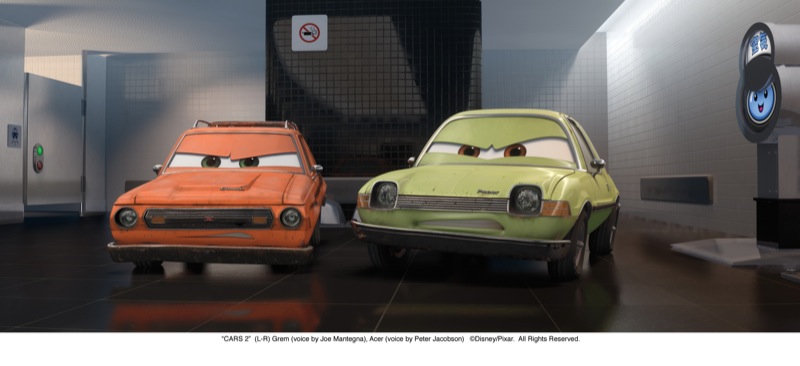
For example, two of the film’s bad guys are Grem, voiced by Joe Mantegna, and Acer, voiced by Peter Jacobson. They show up on the screen as a Gremlin and a Pacer, respectively.
"It was really fun coming up with the lemon cars of the world that would be the bad guys," Lasseter says. "We actually went to some of our friends who work in the automobile magazines and had them draw up a list of notoriously bad cars from around the world."
Ironically, some car companies lacked a sense of humour and made it clear they didn’t want their more notorious products to be used as bad guys.
"So we were kind of limited, but … two of my favourite cars were the Gremlin and the Pacer, because they’re so absolutely unique, and it was really fun to have them as bad-guy characters."
For the car population at large, it was a crucial creative decision to place their eyes on the windshields rather than use the headlights, which are normally regarded as a car’s "eyes."
Lasseter said artists decided that, if the eyes were on a car’s windshield, the entire body became the head, and the four wheels underneath became more credible as limbs — "and then the four wheels act almost like four-legged characters and we can use the front tires for gesturing and talking and stuff like that."
The Queen of England makes an appearance, as a sort of hybrid between a Rolls-Royce and a Bentley. Lasseter didn’t want a normal crown, because it would look too much like a hat, and he didn’t like his animated vehicles to wear hats. But he still wanted some kind of regal trappings.
"We started looking around and found these fantastic old luggage racks that are usually found on Land Rovers, or that sort of car. They were really big, and we said, ‘If we just made a really glitzy luggage rack and put big jewels in it, it kind of looks like a car crown.’ So that’s where the crown was derived from: an old luggage rack, but it’s really kind of fancy and cool."