
‘Everything I’ve ever worked for is here’
Residents of Lake St. Martin beaten down by summer of exile
Advertisement
Read this article for free:
or
Already have an account? Log in here »
We need your support!
Local journalism needs your support!
As we navigate through unprecedented times, our journalists are working harder than ever to bring you the latest local updates to keep you safe and informed.
Now, more than ever, we need your support.
Starting at $15.99 plus taxes every four weeks you can access your Brandon Sun online and full access to all content as it appears on our website.
Subscribe Nowor call circulation directly at (204) 727-0527.
Your pledge helps to ensure we provide the news that matters most to your community!
To continue reading, please subscribe:
Add Brandon Sun access to your Free Press subscription for only an additional
$1 for the first 4 weeks*
- Enjoy unlimited reading on brandonsun.com
- Read the Brandon Sun E-Edition, our digital replica newspaper
*Your next Free Press subscription payment will increase by $1.00 and you will be charged $20.95 plus GST for four weeks. After four weeks, your payment will increase to $24.95 plus GST every four weeks.
Read unlimited articles for free today:
or
Already have an account? Log in here »
Hey there, time traveller!
This article was published 06/08/2011 (5558 days ago), so information in it may no longer be current.
LAKE ST. MARTIN — Three months and counting.
An evacuation this spring, a long hot summer in exile and now this reserve’s residents face the permanent loss of house and home.
“The floods this year finished us off,” Chief Adrian Sinclair said. He’s worried worse is yet to come, with reports that water from the swollen Souris River will bring a wall of water five feet high into Lake St. Martin in October and then frazzle ice this winter.
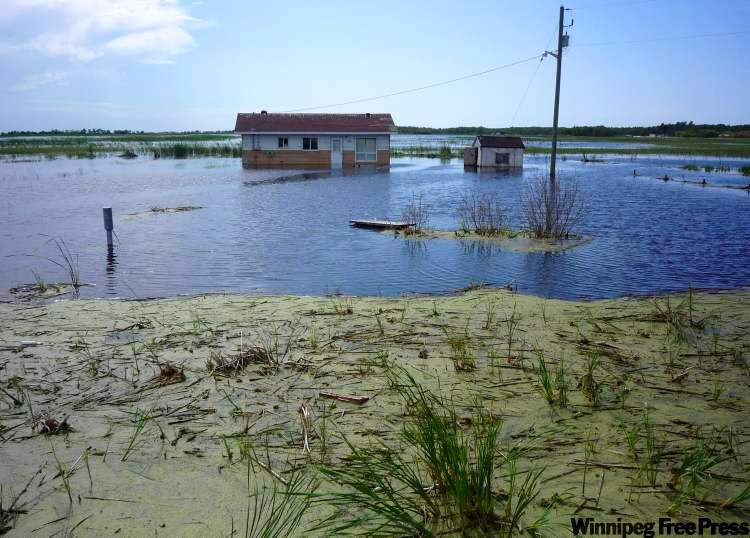
Floods swallowed up in this tiny Interlake First Nation in April. In May, the native firefighters agency that co-ordinates disaster assistance for federal Aboriginal Affairs in Manitoba evacuated 725 people, many reluctantly.
Nearly 600 remain crammed in Winnipeg hotel rooms. Some are reported ‘vanished’ into the seedy underworld of the city. Others fear crime, gangs, drugs and violence.
In May and June, flood water contaminated the water-treatment plant, swallowed 15 houses, ate hundreds of metres of shoreline, and breached a temporary dike. Twice. In July, tonnes of raw sludge from a flooded sewage lagoon at the Little Saskatchewan First Nation next door swept into a meadow near the local church. It was pumped out but the ground remains contaminated. By August, dozens of homes set back from the water looked bone dry but band officials say they’re rotting from underneath. The water table climbed to within 1.3 metres of the surface this year. Mourners watched water flow into two newly dug graves.
The catalogue of damage, from this flood and 50 years of chronic flooding related to the operation of the nearby Fairford River diversion channel would be reason enough to abandon the land, say the chief and band officials.
But there’s worse coming.
“Water Stewardship told us there’s going to be a flood this winter and if the ice jams up, the water has no place to go but to back up into Lake St. Martin. And on top of that, there’s spring runoff. They know what we’re in for. What happens if the temporary dike breaches in the winter?” First Nation CEO Clifford Sumner asked.
If people returned home and disaster struck in January, getting everyone out would trigger another crisis, he said.
As if to punctuate the point, Sumner said he witnessed frazzle ice mow overland in bergs as high as full-grown trees last winter. The memory triggered a shudder. Still, there are people who want to go back home. And there are others who never left, quietly violating the evacuation order.
On a hot afternoon this week, a guard wearing a ball cap dozed, chin on chest behind the wheel of a pickup truck at the end of the dusty gravel road into Lake St. Martin. This is the checkpoint for people coming in and leaving the Ojibway First Nation.
By a rough head count, maybe 55 to 60 people live here. Despite an evacuation order. Despite a security detail.
Despite suspension of water and septic service. Despite a provincial workforce and band members.
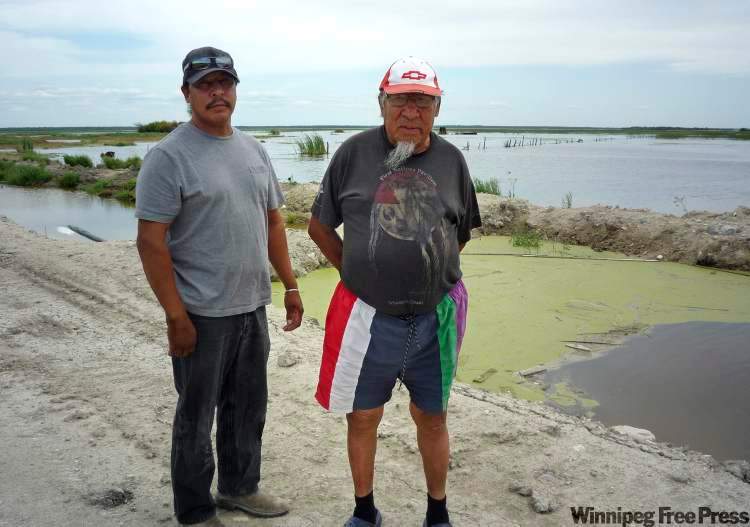
The workforce keeps watch over the pumps, digs pits, and builds a clay berm that’s 15 kilometres long. The dike holds back a metre or more of fluid that’s too disgusting to dignify as water. It’s thickening up under a hot sun, clots of bright green scum sticking to the clay berm.
On the other side, are homes. Like Frank Beardy’s home. He lets a visitor use his bathroom. The water in the toilet bowl is mellow yellow. It was hauled from the treatment plant at a cost of $30, a gift Beardy’s son arranged so his dad could come home. “I go back and forth because I’m staying with my (other) son in Fairford,” said Frank Beardy, 73, who makes the 20-minute return trip every day.
“I miss my home,” he said.
Frank’s son, Clint Beardy, a fisher and hunting outfitter, believes if only the temporary dike were made permanent, then people could still live here.
“There’s no denying there’s water damage… but you can see it’s not as bad as it seems.”
He texts twice for emphasis days later: “I wanna stay. Everything I’ve ever worked for is here.”
At the shoreline, homes on the wrong side of the dike squat in the yellow water. Tops of fences poke up, the only signs left of yards and pastures.
Two-hundred metres inland, the contrast is startling. Split-level homes sit empty. Bungalows built higgledy-piggledy with separate septic fields look normal in cosy cul de sacs.
“I currently live in Lake St. Martin. There is no flooding happening here. The reserve is as dry as a bone. People can come home,” Wayne Beardy insists. He’s a holdout, too.
Wayne’s wife and children are evacuees in Winnipeg and like other families, they sneak home on weekends.
As chief, Sinclair’s heard those pleas. “They say it looks OK. Can’t we go home? But how can we do that?”
He said he’s working to get the dike finished and he has no intention of trading the old reserve for a new one. He wants both. “Why would we want to abandon the land where we grew up? The cemetery is there. We want to keep the dike to protect the land but we can’t live there any more.”
But it’s also true the evacuation is ripping the fabric of this community.
As for suggestions he’s somehow to blame, the chief’s reaction is a rare display of exasperation. “When you ask me if ‘I’m using the flood,’ that bugs me. I’m not using the flood to relocate the reserve. I’m worried about the safety of my people and if I didn’t worry about the safety of my people, what kind of a leader would I be?”
Former chief Tony Marsden said years of flooding took its toll. This year’s flood capped the destruction.
His wife Cindy Marsden said overland flooding filled the crawlspace this spring, for the first time. “When we went back, the mould was climbing halfway up the wall. We live at that first checkpoint in one of those homes that never experienced that before.”
The Marsdens are resigned to an inevitable exile.
Aborginial Affairs Minister Eric Robinson said the province backs the evacuation and sees the search for a new reserve as a top priority, along with the $100-million channel to drain flood water. “The community is damaged, no matter how you look at it.”
The province shelved a plan the First Nation rejected for a temporary village in Gypsumville. They’re now looking at possible sites along Highway 6.
“You know that this has dragged on it seems forever now but ultimately, the ones who are suffering are the ones who are living in hotels in the city of Winnipeg. That’s the last thing we want,” says Robinson.
“The community has suffered tremendously. In the meantime, the government is trying to be as receptive and as agile as possible,” Robinson said.
alexandra.paul@freepress.mb.ca