
Market for spelt ‘increasing all the time’
Advertisement
Read this article for free:
or
Already have an account? Log in here »
We need your support!
Local journalism needs your support!
As we navigate through unprecedented times, our journalists are working harder than ever to bring you the latest local updates to keep you safe and informed.
Now, more than ever, we need your support.
Starting at $15.99 plus taxes every four weeks you can access your Brandon Sun online and full access to all content as it appears on our website.
Subscribe Nowor call circulation directly at (204) 727-0527.
Your pledge helps to ensure we provide the news that matters most to your community!
To continue reading, please subscribe:
Add Brandon Sun access to your Free Press subscription for only an additional
$1 for the first 4 weeks*
- Enjoy unlimited reading on brandonsun.com
- Read the Brandon Sun E-Edition, our digital replica newspaper
*Your next Free Press subscription payment will increase by $1.00 and you will be charged $20.95 plus GST for four weeks. After four weeks, your payment will increase to $24.95 plus GST every four weeks.
Read unlimited articles for free today:
or
Already have an account? Log in here »
Hey there, time traveller!
This article was published 26/08/2011 (5387 days ago), so information in it may no longer be current.
NEAR BRANDON — The golden wheat fields don’t sway like they used to.
That poetic imagery was born a century ago when wheat was much taller.
Plant scientists have bred shorter wheat varieties over the years because tall ones "lodge" — like when someone falls down and can’t get back up — making crop more difficult to harvest. Varieties like ancient spelt wheat were bred out of the picture.
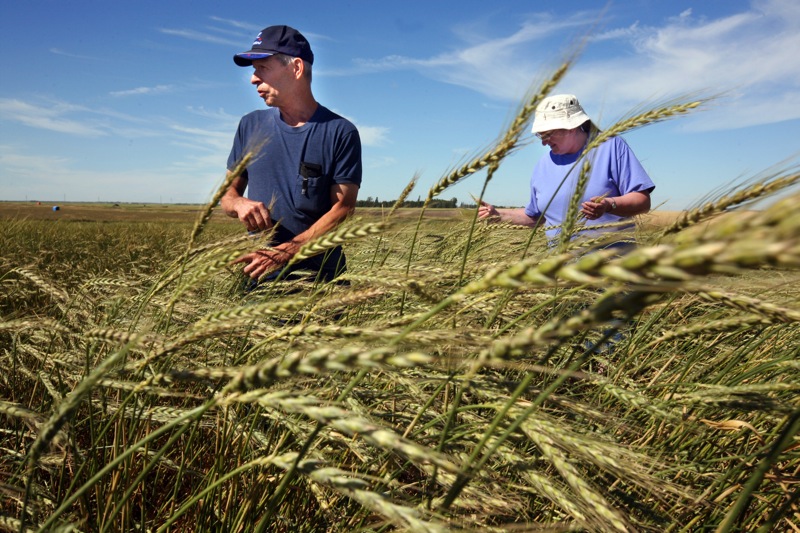
But spelt has been making a comeback, especially for consumers with wheat allergies. It has higher protein and fibre than today’s wheats, and much lower gluten content.
"The spelt market is increasing all the time. Some researchers say by 2020, a full 10 per cent of the population will have issues with gluten," said Pat Pollock, who grows spelt with husband, Larry, just north of Brandon.
The Pollocks supply all the spelt for Tall Grass Bakery in Winnipeg, and Integrity Foods in Riverton.
The Pollocks have been certified organic growers since 2000. Larry was a conventional farmer from the age of 16.
He’s now 62. In the late 1990s, he had an epiphany. Virtually all his income was going to pay for farm inputs like chemicals and fertilizers.
He wasn’t feeding the world so much as on intravenous to agribusiness.
So he started turning over fields to legumes like alfalfa to return nutrients to the soil, and gradually converted to full organic farming. It works for the Pollocks to service a niche market like spelt because they are small farmers with just a section of land.
Spelt has never been cross-bred or hybridized in its estimated 8,000-year lifetime.
It’s referenced in the bible several times. A description of a plague of hail in Exodus 9:31, 32, says the hail ruined flax and barley crops but not spelt because it is later maturing.
Over time, spelt became regarded as a poorer wheat for the lower classes, according to Collier’s Encyclopedia.
Wikipedia says it was a staple food in Europe from the Bronze Age to medieval times.
It was grown in the U.S. in the 1890s but replaced by newer bread wheats in the last hundred years. Spelt matzo is baked in Israel for Passover.
It was removed from commercial production more due to difficulties related to production than end-use quality. Besides growing taller — at nearly two metres (five feet), it grows to about twice the height of conventional wheat — the kernels from spelt are also protected by very hard husks.
Today’s wheats can be taken directly from the field to the mills. But the husk of spelt is hard like a sunflower seed shell, protecting the kernel inside.
So the Pollocks have to break and remove the hulls of spelt before it’s ready to mill, and have had to develop their own machinery to do that.
Spelt has a longer growing season making it susceptible to frost. Its growing season is 112-115 days, versus 90-95 days for today’s wheat varieties.
For that reason, the Pollocks hold back up to two years supply of spelt in their bins to ensure they can still service customers in case of crop failure. And spelt isn’t covered by provincial crop insurance.
The above factors, including lower yields, all add to the cost of spelt flour and baking products.
But it’s divine flour for baking, says Dora Friesen, who runs Integrity Foods with husband, Cornelius. The Friesens were having to source their spelt from Ontario and Saskatchewan before the Pollocks came along.
"It’s absolutely my favourite grain to bake with. It just performs so beautifully. The loaf has good volume, it’s easy to mix by machine or hand, and it has good fibre content," Friesen said.
For consumers, it’s very easy to digest, she said.
While spelt still contains gluten, many people with allergies to gluten can still consume spelt. Spelt also gets better with age.
"The older it is, the better the baking quality. Some bakeries won’t use it until it’s at least two years old," Pat Pollock said.
» Winnipeg Free Press