
Gone Gardenin’ – Persistence paid off with this beauty
Advertisement
Read this article for free:
or
Already have an account? Log in here »
We need your support!
Local journalism needs your support!
As we navigate through unprecedented times, our journalists are working harder than ever to bring you the latest local updates to keep you safe and informed.
Now, more than ever, we need your support.
Starting at $15.99 plus taxes every four weeks you can access your Brandon Sun online and full access to all content as it appears on our website.
Subscribe Nowor call circulation directly at (204) 727-0527.
Your pledge helps to ensure we provide the news that matters most to your community!
To continue reading, please subscribe:
Add Brandon Sun access to your Free Press subscription for only an additional
$1 for the first 4 weeks*
- Enjoy unlimited reading on brandonsun.com
- Read the Brandon Sun E-Edition, our digital replica newspaper
*Your next Free Press subscription payment will increase by $1.00 and you will be charged $20.95 plus GST for four weeks. After four weeks, your payment will increase to $24.95 plus GST every four weeks.
Read unlimited articles for free today:
or
Already have an account? Log in here »
Hey there, time traveller!
This article was published 15/09/2011 (5498 days ago), so information in it may no longer be current.
I find it frustrating to look after a particular plant all growing season and just as it comes into bloom in the fall, frosts strikes and either freezes the plant before it can put forth its display of bloom or else I have to keep covering the plant to protect it from frost so that its flowers can be enjoyed.
By the time bloom appears, we are spending less time relaxing in the outdoor garden because evenings are cooler and darkness falls earlier and earlier. As well, the constant covering and uncovering is not only onerous but it takes its toll on the plant as incremental damage occurs.
Such was the case a number of years ago when I grew acidanthera — just as the buds appeared, so would Jack Frost! I gave up growing acidanthera and had not grown these lovely flowers for a number of years, but in the spring of 2010 I decided to give them another try.
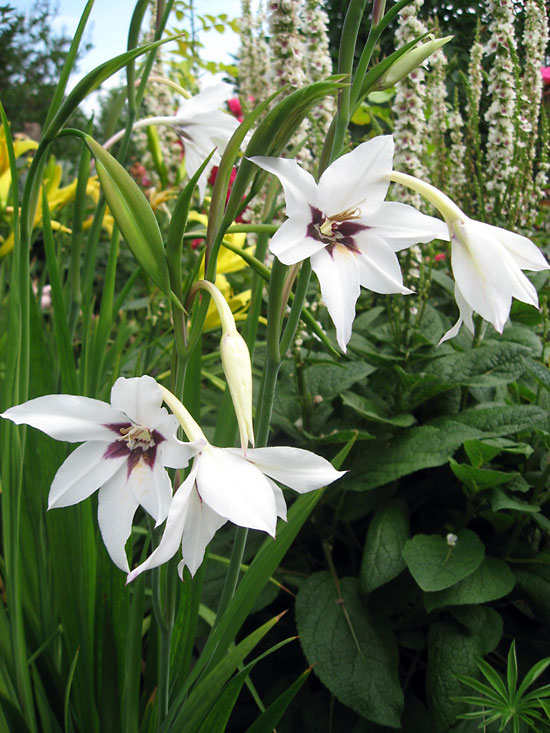
I was determined to find a way to ensure that I got to enjoy the fruits of my labours by doing something different instead of planting the corms directly into the garden as I do with gladioli corms.
Acidanthera are grown from small corms, so I purchased my corms in the early spring and in early April I planted them into a large pot and placed it in my all-season sunroom. Leaves soon appeared and I knew the plants would get too soft and leggy if I left the pot in the sunroom so I moved it into my cold frame on the back patio in early April.
I always put a heater in the cold frame for cold nights, but often during warm sunny spring days, I remove the lid so that the plants don’t get too hot and they get well hardened off and do not get leggy. In lieu of a cold frame, setting the pot outdoors on warm spring days would work.
By mid-May I had a nice pot of acidanthera whose leaves were about 30 centimetres tall, and it was time to plant them into the outdoor garden. I carefully chose the spot where I wanted them to grow.
Then I dug a hole large enough to accommodate the root ball, slipped the whole root ball out of the pot and into the hole, without disturbing the roots to any extent. I had planted 15 corms in the large 10 inch pot — they are similar but much smaller than gladioli corms — so the plants were quite close together, but they did not seemed to object to being planted that closely together as they developed and bloomed during the summer.
Because the plants were perfectly hardened off, they suffered no transplant shock, and by mid-August the buds appeared and the plants began to bloom. Acidanthera prefer the same growing conditions as gladioli — lots of sun, lots of water, and deeply dug, fertile soil with good drainage.
They put on a grand display of bloom. Since they are relatives of the gladioli, they have similar leaves, although somewhat narrower, so they added a grassy-type foliage to the garden that provided a nice contrast in the border and they produced lovely white trumpet-shaped flowers with deep purple centres.
The blooms of acidanthera are very fragrant, which was one of the reasons that I had missed these plants in my garden. I was able to use a couple of stems in a bouquet in our local flower show in mid-August, which I never dreamed of doing before I began to give them a head start indoors in the spring.
Before hard frost occurred in late fall, I dug up the clump of acidanthera, took it into the sunroom and let the foliage die back naturally while I withheld water. After the foliage had died down, I slipped the root ball — still intact — and placed it in a cardboard box covered with some peat moss and put the box in a cool, dry, dark location where I store my gladioli corms for the winter.
I followed the same procedure this year to give my acidanthera an early start and just like last year, I was able to enjoy every last bloom of my acidanthera before Jack Frost made his appearance .
These delightful flowers were a beautiful addition to the late summer garden.
Albert Parsons is a consultant for garden design and landscaping who lives in Minnedosa.
» communitynews@brandonsun.com