
Gone Gardenin’ – Swedish ivy a hit with gardeners
Advertisement
Read this article for free:
or
Already have an account? Log in here »
We need your support!
Local journalism needs your support!
As we navigate through unprecedented times, our journalists are working harder than ever to bring you the latest local updates to keep you safe and informed.
Now, more than ever, we need your support.
Starting at $15.99 plus taxes every four weeks you can access your Brandon Sun online and full access to all content as it appears on our website.
Subscribe Nowor call circulation directly at (204) 727-0527.
Your pledge helps to ensure we provide the news that matters most to your community!
To continue reading, please subscribe:
Add Brandon Sun access to your Free Press subscription for only an additional
$1 for the first 4 weeks*
- Enjoy unlimited reading on brandonsun.com
- Read the Brandon Sun E-Edition, our digital replica newspaper
*Your next Free Press subscription payment will increase by $1.00 and you will be charged $20.95 plus GST for four weeks. After four weeks, your payment will increase to $24.95 plus GST every four weeks.
Read unlimited articles for free today:
or
Already have an account? Log in here »
Hey there, time traveller!
This article was published 16/02/2012 (5365 days ago), so information in it may no longer be current.
Swedish ivy has been a popular house plant for years; it is actually not an ivy at all, but a member of a very large plant family called Plectranthus. Swedish ivy is P. australis, and is characterized by bright green round leaves with scalloped edges.
Although it produces dainty white flowers when it gets enough direct sun and will sometimes even produce some flowers when grown indoors if it gets enough light, Swedish ivy is generally grown as a foliage plant. It can get quite rangy unless it is regularly pinched, and even so, it is usually displayed as a hanging plant.
Plectranthus is a larg genus of the mint (Lamiaceae) family originating in South Africa. Many other varieties of Plectranthus have been developed in the last decade that are more suitable for the outdoor garden because they have sturdier, more attractively colored foliage than the original Swedish ivy.

Members of the Plectranthus plant family are bushy plants, many with a trailing growth habit, which makes them ideal candidates for hanging baskets and tall urns. They combine well with other plants; they are not so vigorous as to overwhelm their neighbours yet do not object to being grown shoulder-to-shoulder with other plants.
Not fussy about their growing conditions, they thrive in locations with semi-shade as well as areas that receive full sun. The amount of bloom the plants produce will increase as the amount of sun the plants receive increases.
Because most gardeners grow Plectranthus for their attractive foliage, lack of bloom is not generally a problem.
Members of the Swedish ivy family like a well-drained soil with lots of humus and they require adequate moisture —they don’t like to be dried out.
They respond well to fertilizer and are easily propagated by cuttings.
Besides the common Swedish ivy, there is a variegated form, P. coleoides, which has similarly shaped leaves but they are dark green with white edges. It is a bushy plant and produces long trailing stems.
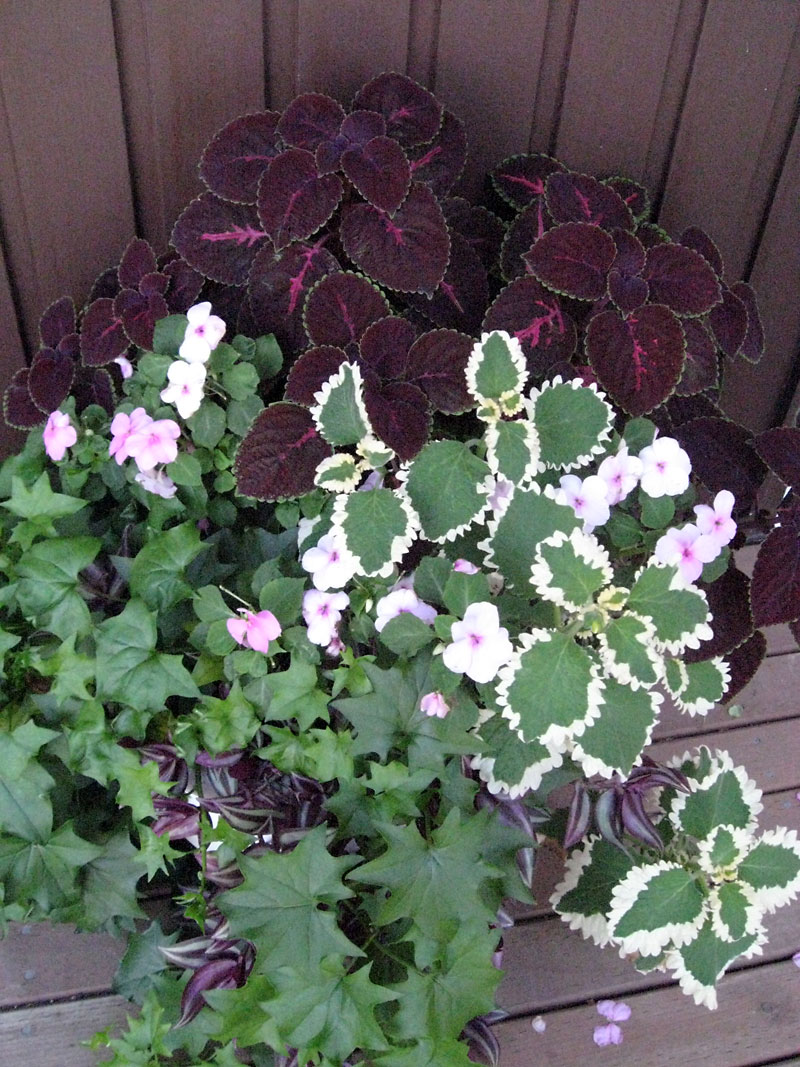
A variegated Plectranthus with much larger leaves, P. forsteri, has turgid 6 cm wide leaves that are very dark green with wide white margins around their edges; it is often offered for sale in greenhouses in the spring.
This Plectranthus is one of the most aromatic and a pungent aroma is released when the leaves are touched.
P. forsteri performs best when it gets direct sunlight and will produce attractive, coleus-like blue flowers. Another form, P. forsteri “Aureus variegatus’ has green leaves with wonderful golden variegation; it has smaller leaves and a bushier growth habit.
I have grown Cuban oregano as a potted plant for years, but in fact this plant is not actually an oregano at all but a Plectranthus, P. ambroinicus. It probably got its name because it does have a slightly oregano-like scent when the leaves are touched.
This particular plectranthus has an upright grown habit and develops into a multi-branched, bushy plant with its small round felted leaves arranged in attractive rosettes at the ends of the many branches. Some people claim that this plant will repel slugs.

P. tomentosa, has leaves very much like those of Cuban oregano although they are spaced wider apart on the stems. The stems of this plectranthus grow very long it is quite a rangy, sprawling plant.
Its common name, Vicks plant, comes from the fragrance that is emitted when the leaves are crushed — a Vicks-like fragrance.
I use several plectranthus as fillers in patio containers in my summer garden and one of my favorites is P. argentatus, which has felted silvery leaves produced on trailing branches. The plants are quite bushy and serve as an excellent filler among other plants in containers.
Plectranthus ecklonii, has dark green leaves with burgundy undersides. The blooms are similar to coleus blooms and literally cover the plants while they are in bloom — The Green Spot often has large containers of this plant on display during the winter, in full bloom.
If you are partial to plants with attractively colored foliage, interesting texture, and unusually aromatic foliage, you might give members of the Plactranthus family a try.
You will enjoy these beautiful and interesting plants both in the outdoor summer garden and in the indoor winter garden.

Albert Parsons is a consultant for garden design and landscaping who lives in Minnedosa.
» communitynews@brandonsun.com