
Mom struggles to meet needs of daughter with rare disorder
Advertisement
Read this article for free:
or
Already have an account? Log in here »
We need your support!
Local journalism needs your support!
As we navigate through unprecedented times, our journalists are working harder than ever to bring you the latest local updates to keep you safe and informed.
Now, more than ever, we need your support.
Starting at $15.99 plus taxes every four weeks you can access your Brandon Sun online and full access to all content as it appears on our website.
Subscribe Nowor call circulation directly at (204) 727-0527.
Your pledge helps to ensure we provide the news that matters most to your community!
To continue reading, please subscribe:
Add Brandon Sun access to your Free Press subscription for only an additional
$1 for the first 4 weeks*
*Your next subscription payment will increase by $1.00 and you will be charged $20.00 plus GST for four weeks. After four weeks, your payment will increase to $24.00 plus GST every four weeks.
Read unlimited articles for free today:
or
Already have an account? Log in here »
Hey there, time traveller!
This article was published 16/02/2013 (4796 days ago), so information in it may no longer be current.
Emma Belhumeur wasn’t supposed to live past three years old. Her mother Rhonda Towler even signed a do-not-resuscitate document when she was two that was never used.
Emma lives with Ohtahara syndrome, an extremely rare version of progressive epileptic encephalopathy, which means she suffers frequent and severe tonic spasms and seizures. She doesn’t speak, she screams and yells. She doesn’t walk — she’s carried. And some days, she may not even wake up.
But Emma has beat the odds and will be celebrating her sixth birthday in April. And although Children’s DisABILITY Services has been quite good over the years by providing various equipment for the house, Towler has been struggling to get the basics for her daughter as of late, including a safe bed and chair.
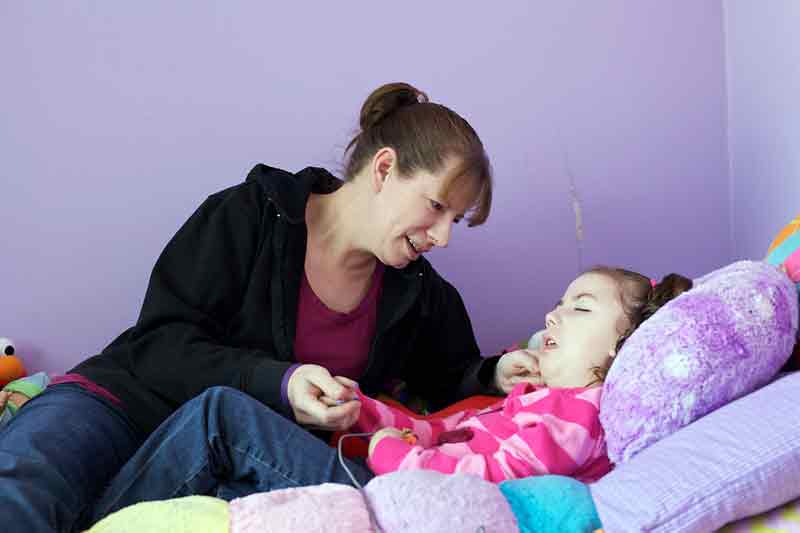
While Emma lies asleep in a bed surrounded by medical equipment in the next room, Towler describes her most recent scare with Emma two weeks ago, in her Brandon home.
In less time than it took to put a load of wet laundry into the dryer, the sound of frantic beeping from Emma’s oximeter was drowned out by a scream Towler had never heard come out of her daughter.
She bolted up the stairs from her basement.
While in the grip of an epileptic fit, Emma was choking on a strap that has to be used while she’s in a wheelchair for safety reasons.
“She was hanging there, choking,” Towler said. “Screaming.”
Because of the severity and frequency of these fits, Emma can only be in special medical chairs, or special medical beds — she has neither.
Emma must be sitting up while she’s fed through a tube, and Towler has no choice but to put Emma in a wheelchair for meal time.
This most recent choking scare could have been avoided had Emma been in a Chill-Out Chair, according to her mom, since her epileptic daughter should only use a wheelchair for transportation.
The deep-seated chair, which retails for about $2,000, is low and wide so she can’t tip over, and it has high armrests and elevates the legs for added security so Emma can sit in her living room without wearing a seatbelt.
Towler has been waiting on a response from CDS regarding the chair, and it wasn’t until yesterday things started looking brighter after a conversation with her case worker.
“It shouldn’t come down to her getting hurt,” Towler said. “We shouldn’t be fighting for a basic need.”
The single mother relies on CDS to provide equipment because she can’t afford it alone.
Most mornings, Towler sets up Emma’s feeding tube and injects a total of eight syringes of medication into Emma. After having a bath and getting dressed, Emma will do some physiotherapy to keep her moving.
Then it’s lunch time, three more syringes, and then some quiet time. After dinner, eight more needles, and then it’s bed time.
The bed in which Emma sleeps does the trick, but it’s far from perfect. Before November, Emma had an inclining hospital bed with protective guard rails.
But at around 4:30 a.m. one November day, during one of Emma’s episodes when her limbs, muscles and mind act with high-voltage independence, her legs got caught in the bed rails.
At the behest of a medical equipment specialist, Towler got rid of the bed, put in an application for a more suitable one, and in the interim made a makeshift medical bed with a regular mattress, lots of pillows and no frame — in case she falls off.
Almost four months have gone by, and Towler just got word yesterday from CDS her application will likely be going through, which leaves Towler caught in red tape, asking why it’s taking so long.
CDS has provided to Towler several large pieces of medical equipment over the last five years, including a rail system that runs from Emma’s bed to the bathroom so she doesn’t have to be lifted. But with Emma about to reach double her life expectancy, Towler said she has to think longer term about how Emma will live her life. And that starts with a proper, safe bed.
The cost of a suitable bed is in excess of $10,000.
Admittedly stressed and tired, Towler loves Emma as much as her other three children. With the feeling of her youngest child living on borrowed time, her days are a mix of anxiety, happiness and guilt, because parents of children suffering from Ohtahara have already seen their children pass.
» gbruce@brandonsun.com