
Shedding light on church treasures
Advertisement
Read this article for free:
or
Already have an account? Log in here »
We need your support!
Local journalism needs your support!
As we navigate through unprecedented times, our journalists are working harder than ever to bring you the latest local updates to keep you safe and informed.
Now, more than ever, we need your support.
Starting at $15.99 plus taxes every four weeks you can access your Brandon Sun online and full access to all content as it appears on our website.
Subscribe Nowor call circulation directly at (204) 727-0527.
Your pledge helps to ensure we provide the news that matters most to your community!
To continue reading, please subscribe:
Add Brandon Sun access to your Free Press subscription for only an additional
$1 for the first 4 weeks*
- Enjoy unlimited reading on brandonsun.com
- Read the Brandon Sun E-Edition, our digital replica newspaper
*Your next Free Press subscription payment will increase by $1.00 and you will be charged $20.95 plus GST for four weeks. After four weeks, your payment will increase to $24.95 plus GST every four weeks.
Read unlimited articles for free today:
or
Already have an account? Log in here »
Hey there, time traveller!
This article was published 01/04/2013 (4817 days ago), so information in it may no longer be current.
Churchgoers at the St. Matthew’s Anglican Cathedral have been basking in the glow from some of the most impressive artwork in the city — but many may never have stopped to realize it.
The stained glass windows inside the 100-year-old building on 13th Street are some of the best in the country, according to an institute that studies such pieces of art.
Patrick Burns, director of the Vancouver-based Institute for Stained Glass in Canada, describes the pieces of art as priceless because of their striking colour and rich detail, which are artifacts of a dead art, according to Burns.
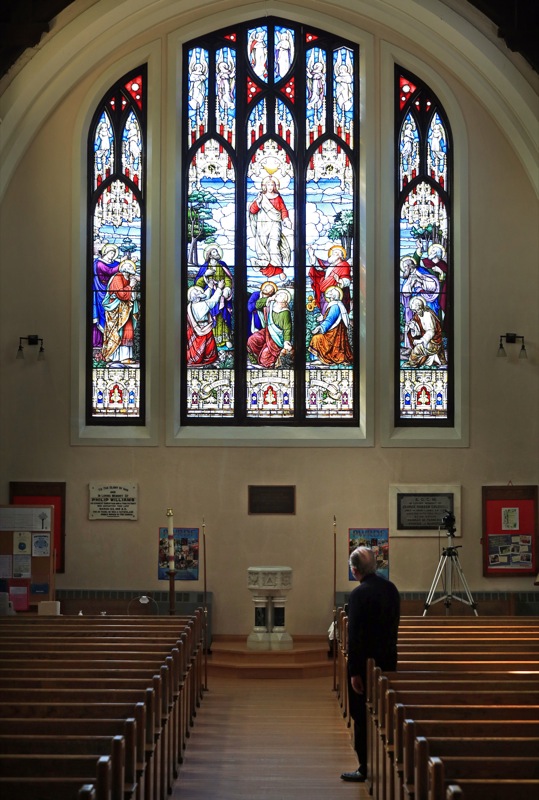
“Even if you’ve been to art school, nobody can draw like that anymore,” he said.
There lies a mystery in the English-style stained windows that keeps even a seasoned researcher like Burns puzzled.
Running along the bottom of a triple lancet stained window is a tribute to the lives lost on the R.M.S. Titanic, which plunged into the Atlantic Ocean the same year as the church was founded.
“To the glory of God and in memory of those who perished in the S.S. Titanic April 15 A.D. 1912,” reads the script, which glows in front of the sunlight.
History buffs will also notice an error in those words, as the notoriously lavish ship was called the R.M.S Titanic — not the S.S.
But the question remains.
Why the Titanic was commemorated in a stained window in the middle of the Canadian Prairies is an open mystery.
“Does that mean somebody from Brandon had gone down on it? It’s possible,” he said. “Or was it that the whole country was in shock.”
Rev. Robin Walker of the church is also at a loss for an explanation for the tribute.
“We believe there were some people in the congregation who had connections to the victims of the Titanic, but we don’t know the exact connections,” Walker said.
The works of art were done by the European-trained Nathaniel Theodore Lyon, who made a name for himself in Canada after opening a studio in Toronto in the early 1900s.
Painters, glass cutters and lead workers all would have worked for months or even years to complete the windows.
Such lavish commissions are normally found in larger cities, Burns said, which points to the wealth in the city at the turn of the 20th century.
“There were some well-off people in Brandon with taste, so whoever commissioned that church had good taste, the minister probably came from England, so he was sophisticated and educated in art,” Burns said.
Along with the money to do it, the Protestant and the Catholic churches were determined to catch up with each other, which translated into breathtaking buildings of worship.
“The Anglicans and the Catholics were kind of competing with each other in that era, trying to make sure they kept up with one another,” Burns said, noting the splendor of the glass work at Brandon’s St. Augustine’s of Canterbury Roman Catholic Church on Fourth Street.
For the close to 14,000 people living in Brandon at the time, when St. Matthew’s opened its doors in 1913, the art displayed would have been some of the best many residents would have ever seen.
“Think about living in Brandon in 1912. Where would you see coloured, illuminated pictures? Certainly not at a movie theatre … going into a church like that would have been the richest art experience that anyone that lived in that town could have.”
Burns first made the trek to the Wheat City last year, while the church was sorting out its insurance policy for the building, but Burns said any dollar figure assigned to them would be meaningless.
He said if the artist were available today, they would cost around $2 million because of the labour and time needed.
Although stained glass work is still available, Burns points to an overall decline in religious fervency and church attendance as possible reasons for the disappearance in the quality displayed in the church’s glass work.
The windows to the past hold many clues to what life was like in the Wheat City just a few decades after the first settlers arrived and could give some indication of some of the prominent citizens of the time. With several names immortalized under the glass installs, Burns said those names are clues to who was wealthy enough to afford to pay for the art.
“If your name has been memorialized in the window, that usually means your family put up the money for the window,” he said.
» gbruce@brandonsun.com