
Fluffy cottonwood seeds could cause problems
Advertisement
Read this article for free:
or
Already have an account? Log in here »
We need your support!
Local journalism needs your support!
As we navigate through unprecedented times, our journalists are working harder than ever to bring you the latest local updates to keep you safe and informed.
Now, more than ever, we need your support.
Starting at $15.99 plus taxes every four weeks you can access your Brandon Sun online and full access to all content as it appears on our website.
Subscribe Nowor call circulation directly at (204) 727-0527.
Your pledge helps to ensure we provide the news that matters most to your community!
To continue reading, please subscribe:
Add Brandon Sun access to your Free Press subscription for only an additional
$1 for the first 4 weeks*
*Your next subscription payment will increase by $1.00 and you will be charged $20.00 plus GST for four weeks. After four weeks, your payment will increase to $24.00 plus GST every four weeks.
Read unlimited articles for free today:
or
Already have an account? Log in here »
Hey there, time traveller!
This article was published 10/07/2013 (4651 days ago), so information in it may no longer be current.
They may look like harmless white fluffy snowflakes flying through the air in the middle of summer, but one Brandon resident warns that cottonwood fluff caught in an air conditioning unit or eavestrough could cause problems for homeowners.
“It looked like one of those unshaved sheepdogs,” Wayne Langlois, who lives on Winter Bay, said after one of his neighbours reminded him to check his own air conditioner for cottonwood fluff. “At times it actually looked like it was snowing out, I’ve never seen it quite so thick.”
Langlois, who before retiring worked in property management for the Manitoba Housing Renewal Corp., said there were four or five areas in the city where he noticed large amounts of white fluff making an annual appearance.
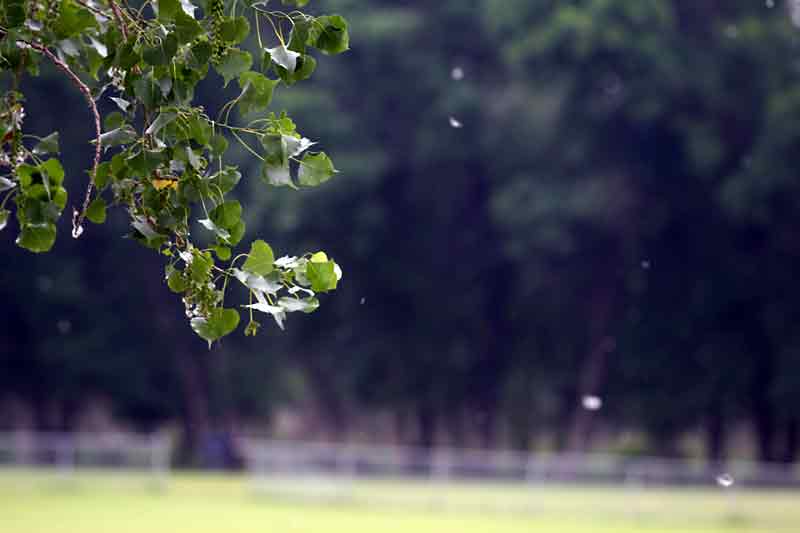
As the weather gets warmer, it’s prime time for cottonwood trees to let their seeds fly filling the air with what looks like tiny white clouds.
Cottonwoods produce seed clusters that Langlois said “burst like popcorn,” which can clog up eavestroughs and creep inside air conditioning units.
If overlooked by new homeowners, it could cost the price of a new air conditioner, which range anywhere from $600 to more than $1,000, he said.
“They’re quite a miraculous thing how they release themselves singularly but in these huge clouds … it’s just caution for individuals who have recently purchased a house or young house owners who aren’t that vigilant to this kind of thing,” he said. “There are families that have moved to Brandon and some were able to get into a housing situation and some of them might not have been prepared to understand that right off.”
Langlois uses a stiff fibre brush to pluck the cottonwoods out of his air conditioning unit at least once a year, but predicts he might have to do it again this summer.
“It takes a little while but it certainly makes a difference in the way your air conditioning runs.”
He said he noticed in some areas of the city, the cottonwood fluffs were “knee deep” and due to their dryness are known to burn rather quickly.
“If you drop a match or a cigarette into it, it’s almost like gun powder and it will follow a trail if this stuff’s up the edge of a street, it will go up a street almost like a dynamite fuse really, really fast,” he said.
“Because it burns so fast … if it’s near a garage door or something or your dry grass the heat generated … will actually ignite cardboard and thin plywood. It doesn’t take long. It’s just kind of a safety thing and a caution to people that just recently bought houses in the area.”
» lenns@brandonsun.com