
No plans for shale gas development: gov’t
Advertisement
Read this article for free:
or
Already have an account? Log in here »
We need your support!
Local journalism needs your support!
As we navigate through unprecedented times, our journalists are working harder than ever to bring you the latest local updates to keep you safe and informed.
Now, more than ever, we need your support.
Starting at $15.99 plus taxes every four weeks you can access your Brandon Sun online and full access to all content as it appears on our website.
Subscribe Nowor call circulation directly at (204) 727-0527.
Your pledge helps to ensure we provide the news that matters most to your community!
To continue reading, please subscribe:
Add Brandon Sun access to your Free Press subscription for only an additional
$1 for the first 4 weeks*
*Your next subscription payment will increase by $1.00 and you will be charged $20.00 plus GST for four weeks. After four weeks, your payment will increase to $24.00 plus GST every four weeks.
Read unlimited articles for free today:
or
Already have an account? Log in here »
Hey there, time traveller!
This article was published 12/08/2013 (4621 days ago), so information in it may no longer be current.
A Manitoba Hydro-funded project to find shallow natural gas in the province is about to wrap up after five years, shedding light on an otherwise poorly understood resource.
With a $150,000 contribution from the Crown corporation, the Manitoba Geological Survey and the University of Calgary have been assessing the potential for unconventional shallow gas as a future resource in Manitoba.
The project is focusing on shallow biogenic gas and shouldn’t be confused with thermogenic gas traditionally associated with crude oil extraction.
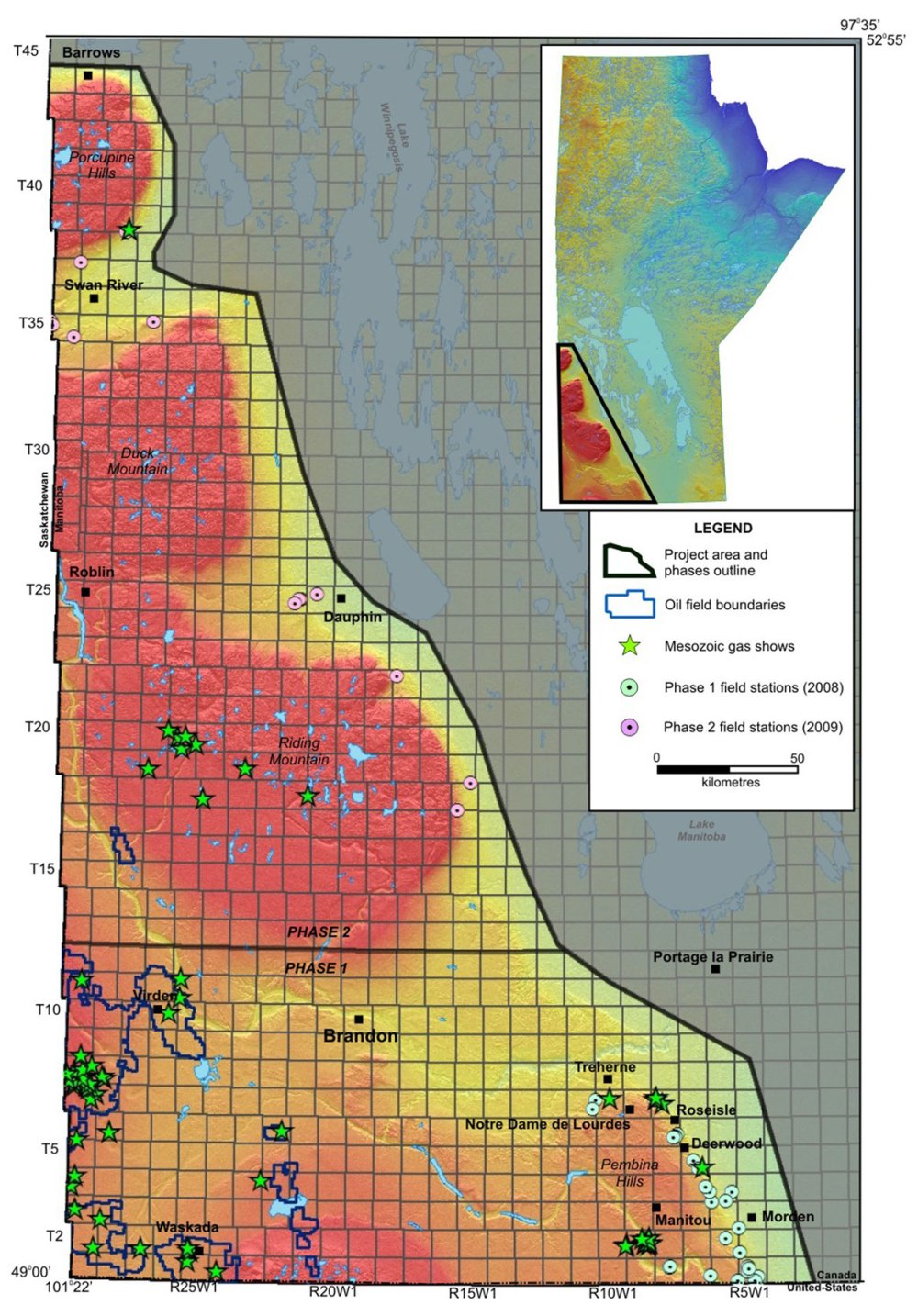
According to project documents, the aim is to provide basic information needed to explore in the “risky” shallow gas pockets in the province for which potential for production creating potentially significant economic benefit.
Natural gas prices remain volatile, and oil prices remain high, which has forced industry to look for more unconventional petroleum reserves — including shallow natural gas, the project asserts.
“Part of the project is to establish whether it’s abundant,” said Jim Bamburak, one of the principle investigators with the project, which has focused on the Waskada Field area, north of Pierson Field, and the Manitou area.
Bamburak said it is possible to extract on a large scale, however he said its best usage right now would be for individual farmers.
“It can be extracted,” he said. “Is it going to be something that is available to large area very quickly? No.
“One hundred years ago, that gas was being produced locally in southwestern Manitoba and (farmers) would use it to heat their barns, for cooking and would use it for light.”
Historical documents indicate up to 12 gas wells drilled in southwestern Manitoba between 1906 and 1933.
“Let’s say you had 20 or 30 farms, each producing this shallow unconventional gas for their own purposes, and you decided to link those together into a pipeline, then that’s when it becomes more practical,” he said. “But you might be dealing 50 to 100 years from now.”
In an emailed statement, a cabinet spokesperson said this project does not indicate Manitoba Hydro will develop natural gas in the future.
It has occasionally provided financial support to Manitoba Geological Survey research programs and in this case, Manitoba Hydro, through the Centra Gas subsidiary, provided support for this project to look at province’s natural gas resources.
“Although shale gas was identified it was not the kind or volume that could be developed today,” the email stated. “Geological surveys do discover a lot of things in our ground but that does not equate to development. There are currently no plans for development of shale gas in the province.”
The Manitoba Hydro-sponsored project will come to a close as the Crown corporation continues to come under fire for its decision to forge ahead with the northern dams — the biggest energy project ever undertaken by the corporation — as a main source of energy for the province despite criticism.
Former Public Utilities Board chairman Graham Lane argued the multibillion-dollar hydro dam isn’t the best option for the province and traditional natural gas should be looked at to address Manitoba’s increasing power demand.
Nearly 100 per cent of Manitoba Hydro’s 2.1 billion cubic metres of natural gas delivered through its system comes from Alberta through a TransCanada pipeline.
“While the cost of producing new hydro-electric power has soared, the cost of producing power from natural gas has fallen, new technology has brought new supply and a collapsing of the price of natural gas — making generation through efficient combined-cycle gas plants a sound economic choice,” Lane said in a column in the Winnipeg Free Press in June.
Days later, Manitoba Hydro fired back with a response to the column defending the decision to forge ahead with the project, on which hundreds of millions of dollars have already been spent.
“After examining the options, Manitoba Hydro has determined that its proposed development of additional hydroelectric generation with increased transmission to the U.S. … is the best one for our customers, resulting in the lowest electricity rates in future years. It is also the best option from an environmental perspective,” read the statement.
As well, Markus Ermisch, spokesperson for the Canadian Association of Petroleum Producers, said export opportunities for natural gas have dwindled.
In the last five years, natural gas exports to the U.S. have declined 16 per cent, a number that is projected to slip further making gas production less appealing in Manitoba, according to Ermisch.
He also pointed to the province’s lack of infrastructure to carry natural gas overseas — something all oil and gas companies are clamouring to do as a result of shrinking U.S. demand.
“The United States has a lot of natural gas themselves,” he said, and operations in Pennsylvania — not Alberta or B.C. — are providing natural gas to Eastern Canada simply because it’s closer.
As a result, interest in Manitoba’s natural gas is limited.
“Manitoba may become a prospect down the road.”
» gbruce@brandonsun.com