
CN wants safer, stronger tank cars
Older models involved in recent accidents
Advertisement
Read this article for free:
or
Already have an account? Log in here »
We need your support!
Local journalism needs your support!
As we navigate through unprecedented times, our journalists are working harder than ever to bring you the latest local updates to keep you safe and informed.
Now, more than ever, we need your support.
Starting at $15.99 plus taxes every four weeks you can access your Brandon Sun online and full access to all content as it appears on our website.
Subscribe Nowor call circulation directly at (204) 727-0527.
Your pledge helps to ensure we provide the news that matters most to your community!
To continue reading, please subscribe:
Add Brandon Sun access to your Free Press subscription for only an additional
$1 for the first 4 weeks*
- Enjoy unlimited reading on brandonsun.com
- Read the Brandon Sun E-Edition, our digital replica newspaper
*Your next Free Press subscription payment will increase by $1.00 and you will be charged $20.95 plus GST for four weeks. After four weeks, your payment will increase to $24.95 plus GST every four weeks.
Read unlimited articles for free today:
or
Already have an account? Log in here »
Hey there, time traveller!
This article was published 14/01/2014 (4510 days ago), so information in it may no longer be current.
OTTAWA — The railway industry wants to “aggressively phase out” older model tank cars that have been implicated in several recent accidents, the head of CN Rail’s safety division told an industry forum Monday.
But the consensus at the daylong workshop was there’s no quick fix for a decades-old problem that has almost 80,000 substandard DOT-111 tank cars carrying flammable liquids on North American tracks.
And whatever the solution, the cost eventually will be borne by consumers.
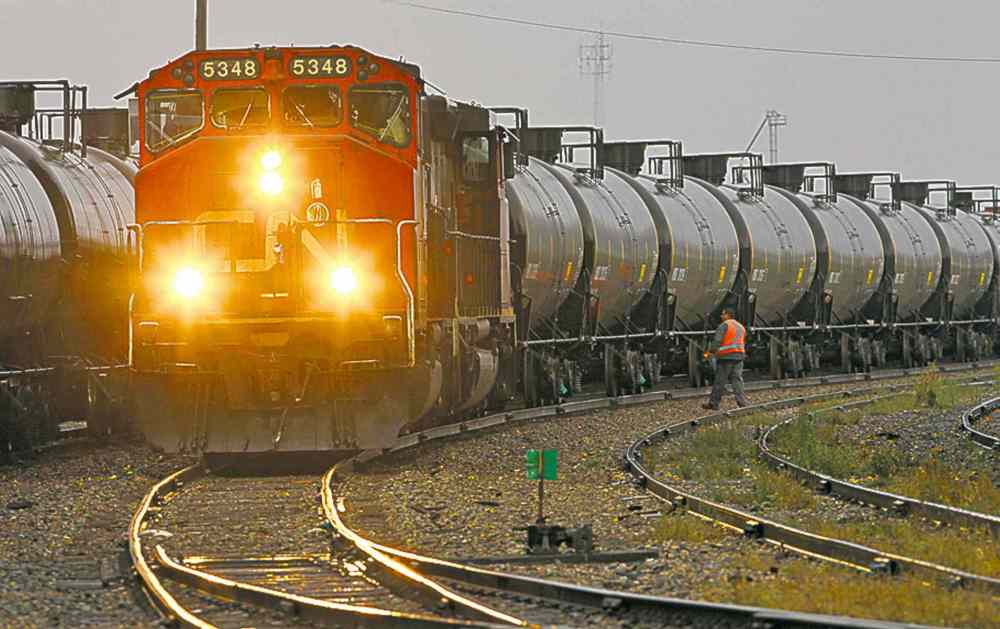
Sam Berrada, director general of safety and occupational health services for CN, told an overflow crowd of industry types, regulators, lobbyists and local first responders railways “will continue to push aggressively” for safer, stronger tank cars.
A derailment and fire involving a CN train in northwestern New Brunswick last week has renewed calls for greater safety in the booming oil-by-rail trade, which became an international cause following last summer’s deadly derailment and fire in Lac-Mégantic, Que.
Transport Minister Lisa Raitt responded on the weekend by promising the government will formalize the standard for new tank car construction adopted by the rail industry in October 2011.
“Our government’s new tougher standards to the DOT-111 tank cars are part of our commitment to making the rail sector safer,” spokesman Remi Moreau said in an email Monday.
But the government’s announced standards are not new and not tougher — they simply match those already voluntarily adopted by industry more than two years ago.
The forum heard from CN’s Berrada and others that even better cars than the post-2011 model might be in order, although Berrada did praise the performance of three post-2011 cars involved in the New Brunswick derailment.
Moves to date, however, don’t even begin to address the vast majority of older rolling stock.
Governments in Canada and the United States have been reluctant to deal with the huge number of older DOT-111s, in part because of the cost and logistics of an overhaul.
Moreau said Raitt has asked an advisory council “to report back to the minister on additional enhancements and recommendations with respect to the DOT-111.”
Raitt will be working on the standards with her U.S. counterpart, Transportation Secretary Anthony Foxx, Moreau added.
An official with the Canadian Transportation Agency also told the forum the government is considering the idea of a rail-industry disaster fund, similar to the fund financed by the shipping industry for environmental cleanups at sea.
Monday’s forum heard that out of 335,000 tank cars of all types in use in North America, 228,000 are the model known as DOT-111. About 92,000 DOT-111s are used to carry flammable liquids, and only 14,000 of those are the new, stronger cars built after October 2011.
That means 78,000 older DOT-111s remain the workhorse of the oil-by-rail boom.
“You can’t just snap your fingers and change the fleet overnight,” Bob Ballantyne, a career railway man who now works for the Freight Management Association of Canada, said.
Ballantyne told the forum railway companies collectively own fewer than 700 tank cars (CN Rail owns just 20), while eight leasing companies own more than 243,000 tankers and shippers own another 79,000.
Retrofitting older cars can cost more than $70,000 each, while new tank cars cost well over $100,000.
“It is, I think, inevitable that safety will be enhanced and there will be increased costs for consignors, consignees, carriers, governments and the general public,” said Ballantyne. “How these increased costs will be allocated across the supply chain remains to be seen.”
— The Canadian Press