
Canadian women’s hockey team rescues fourth Olympic gold medal in Sochi
Advertisement
Read this article for free:
or
Already have an account? Log in here »
We need your support!
Local journalism needs your support!
As we navigate through unprecedented times, our journalists are working harder than ever to bring you the latest local updates to keep you safe and informed.
Now, more than ever, we need your support.
Starting at $15.99 plus taxes every four weeks you can access your Brandon Sun online and full access to all content as it appears on our website.
Subscribe Nowor call circulation directly at (204) 727-0527.
Your pledge helps to ensure we provide the news that matters most to your community!
To continue reading, please subscribe:
Add Brandon Sun access to your Free Press subscription for only an additional
$1 for the first 4 weeks*
- Enjoy unlimited reading on brandonsun.com
- Read the Brandon Sun E-Edition, our digital replica newspaper
*Your next Free Press subscription payment will increase by $1.00 and you will be charged $20.95 plus GST for four weeks. After four weeks, your payment will increase to $24.95 plus GST every four weeks.
Read unlimited articles for free today:
or
Already have an account? Log in here »
Hey there, time traveller!
This article was published 20/02/2014 (4503 days ago), so information in it may no longer be current.
SOCHI, Russia – Canada and the United States have waged plenty of pitched battles for women’s hockey supremacy over the last 25 years.
But Canada’s 3-2 overtime win for a fourth consecutive Olympic gold medal reached a new level of drama, even for these two combatants.
Thursday’s electrifying final will be dissected and revisited for years to come. There was Canada’s comeback late in the third period, the puck bouncing off the post of Canada’s empty net, controversial calls by the officials in overtime, a breakaway by Hayley Wickenheiser that almost turned into penalty shot for the win and finally, Marie-Philp Poulin’s golden goal at 8:10 of overtime.
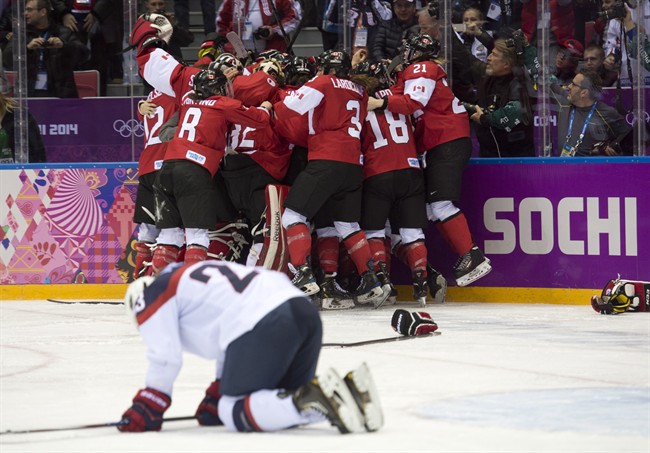
“I thought about the parents in the stands tonight,” Canadian forward Jayna Hefford said. “It must have been an amazing thing to watch and a terrifying thing to watch and that’s great for women’s hockey.”
Trailing 1-0 after two periods and down two goals deep into the third, Canada scored twice in the final 3:26 of the regulation. Suddenly that gold that had been slipping away was within reach again.
When the defining moments arrived in the final, Canada had experienced players such as Wickenheiser, Hefford and captain Caroline Ouellette to help guide the team through the storm.
The United States was young, fast and talented, but lacked the poise to finish Canada off when the gold was within their grasp.
“We were very calm, regardless of the score,” Wickenheiser said. “We always believed we could come back and win. We have enough experience in the room.
“We understand the moment and how to deal with the big games.”
Brianne Jenner kicked off Canada’s comeback at 16:34 of the third. U.S. captain Meghan Duggan scored in the second period and Alex Carpenter had a power-play goal in the third.
In a rematch of the goaltenders from the 2010 final, Edmonton’s Shannon Szabados made 27 saves for the win, while Jessie Vetter stopped 28 shots in the loss.
The only other women’s team to win more consecutive Olympic gold is the U.S. in women’s basketball with five in a row from 1996 to 2012.
With four straight gold medals in women’s hockey Wickenheiser, Hefford and Ouellette joined Soviet biathlete Alexander Tikhonov and German speedskater Claudia Pechstein as gold medallists in four consecutive Winter Games.
This was the fifth Winter Olympics for Wickenheiser, 35, and Hefford, 34, the fourth for 34-year-old Ouellette, and possibly the last for all three.
The prospect of gold in Sochi seemed dim when head coach Dan Church abruptly quit on Dec. 12 for reasons that are still opaque. Church would only say there was a lack of confidence in his ability to do the job.
Enter Kevin Dineen, a fired NHL coach who made his international coaching debut in Sochi and whose previous experience coaching females was his daughter’s team in the summer.
The Canadian women lost every game but one after Dineen’s arrival. They were playing games exhausted from punishing workouts designed to battle-harden them for Sochi.
“This was the toughest season for us, gruelling physically, mentally,” Hefford said. “The challenges with the coaching situation, I will say Dan Church did a fabulous job with this group while he was here and Kevin did a fabulous job when he came in.”
Four years after scoring both of Canada’s goals for gold in Vancouver, Poulin was a heroine again in Sochi with two more for gold.
Szabados was out of Canada’s net with just over a minute to go when U.S. Kelli Stack whipped the puck down the ice for what would have been an empty-net winner. It struck the left post and dribbled wide.
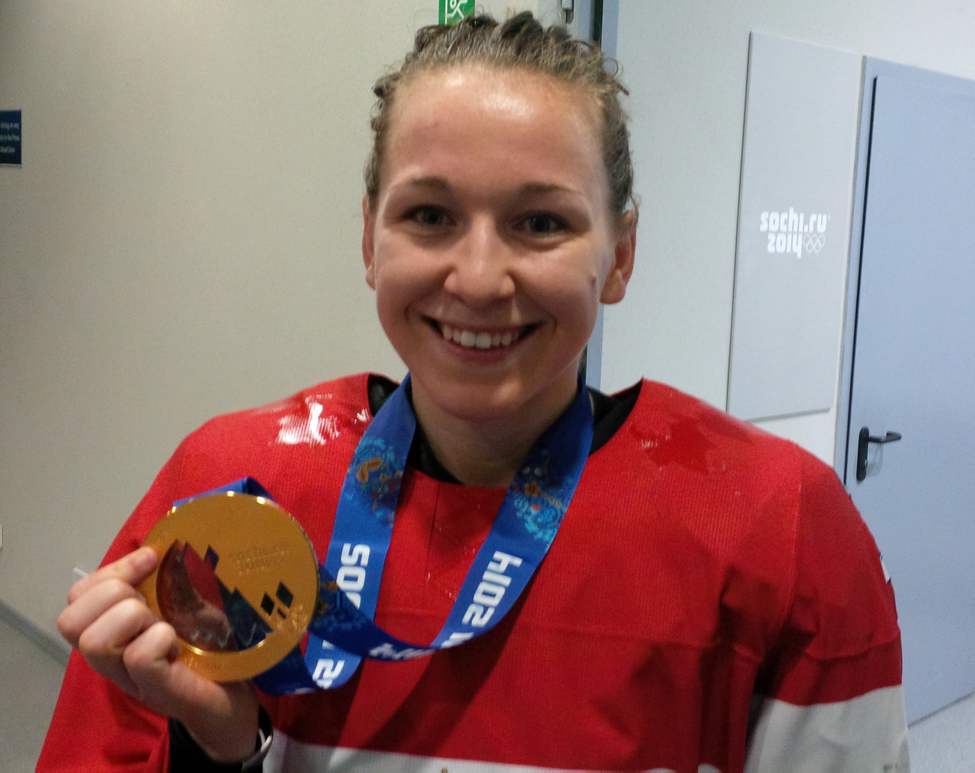
Poulin pulled Canada equal with 55 seconds remaining in regulation and then came her overtime goal.
“It’s an amazing moment,” Poulin said. “I think we all know it was a team effort tonight. I’m so happy we got that gold medal back.”
Prime Minister Stephen Harper spoke to both Poulin and Ouellette after the game to congratulate the team, according to a team official.
In overtime, Canadian defender Catherine Ward was serving a cross-checking minor when American forward Jocelyne Lamoureux was given a slashing minor, to the dismay of the American bench.
Wickenheiser took off on a breakaway and was hauled down by Hilary Knight. Dineen howled for a penalty shot, but Knight went to the box and Poulin scored on the ensuing four-on-three.
The face of the U.S. players were drawn and stony as they accepted their medals and some were in tears as they walked past reporters after the game.
“I don’t know how it happened,” Stack said. “I’m shocked. Bad luck. I feel every bounce went their way. So it’s tough.”
The Swiss defeated Sweden 4-3 earlier for Switzerland’s first Olympic medal in women’s hockey.
Canadian forward Meghan Agosta-Marciano was named to the tournament all-star team alongside Knight and U.S. forward Amanda Kessel, defencemen Megan Bozek of the U.S. and Jenni Hiirikoski and goaltender Florence Schelling.
Finland forward Michelle Karvinen, Hiirikoski and Schelling were chosen the best players at their position by the International Ice Hockey Federation directorate.
Canada and the U.S. outscored their opposition by a combined 88-4 in Vancouver and nine tournament games there were decided by a goal differential of five or more. Jacques Rogge, then the president of the International Olympic Committee, said ‘we cannot continue without improvement.”
In Sochi, Canada and the U.S. outscored their opposition 40-13. Three games were decided by a goal differential of five or more.
The prospect of women’s hockey getting booted from the Olympics because of a competitive imbalance was already disappearing when IIHF president Rene Fasel declared women’s hockey was in the Winter Game to stay.
“I believe we were able to shut those people up that were saying women’s hockey doesn’t belong, because it does,” Schelling said after the bronze-medal game.
wfpvideo:3233254275001:wfpvideo