
Exhibit unearths stories of Brandon College war effort
Advertisement
Read this article for free:
or
Already have an account? Log in here »
We need your support!
Local journalism needs your support!
As we navigate through unprecedented times, our journalists are working harder than ever to bring you the latest local updates to keep you safe and informed.
Now, more than ever, we need your support.
Starting at $15.99 plus taxes every four weeks you can access your Brandon Sun online and full access to all content as it appears on our website.
Subscribe Nowor call circulation directly at (204) 727-0527.
Your pledge helps to ensure we provide the news that matters most to your community!
To continue reading, please subscribe:
Add Brandon Sun access to your Free Press subscription for only an additional
$1 for the first 4 weeks*
- Enjoy unlimited reading on brandonsun.com
- Read the Brandon Sun E-Edition, our digital replica newspaper
*Your next Free Press subscription payment will increase by $1.00 and you will be charged $20.95 plus GST for four weeks. After four weeks, your payment will increase to $24.95 plus GST every four weeks.
Read unlimited articles for free today:
or
Already have an account? Log in here »
Hey there, time traveller!
This article was published 12/09/2014 (4254 days ago), so information in it may no longer be current.
It’s estimated that half of the pilots who served in the First World War died and the life expectancy of airmen on the Western Front was merely weeks.
It was a risky endeavour to take to the skies to contribute to the war effort — one that Lt. Kenneth Campbell, a Brandon College student, took on.
He beat the odds and survived the war. But just seven days after armistice was declared, Campbell died of pneumonia — likely while waiting to return to life in Brandon.
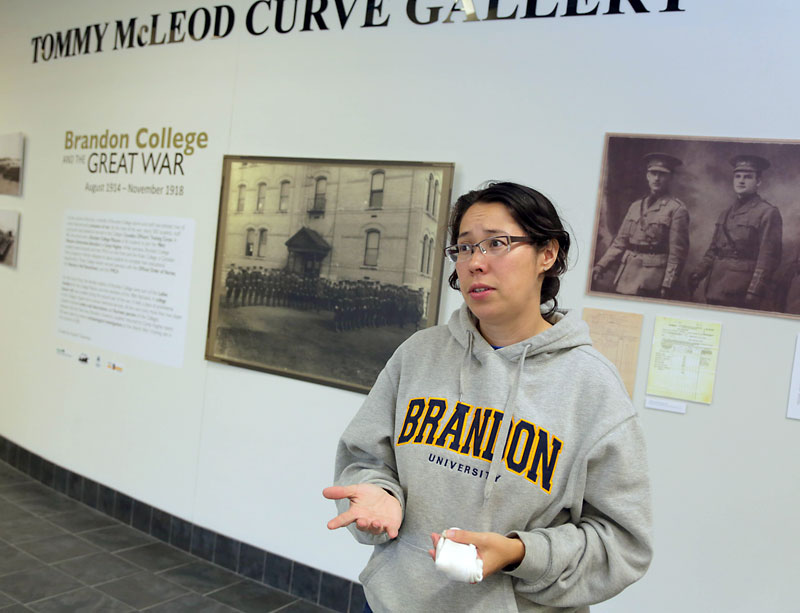
Campbell was one of an estimated nine Brandon College students who were part of Britain’s Royal Flying Corps and his is one of dozens of stories unearthed in the new public exhibition, “Brandon College and the Great War,” on display at Brandon University beginning today.
“Imagine seeing all these things at war that no one has really talked about and then you get the flu and you die,” said Suyoko Tsukamoto, a BU alumnae who started the project in 2012 in preparation for archeological research at Camp Hughes, the First World War training base east of Brandon.
“This was a great way to learn about the First World War. We’re usually given the history of World War I from the British perspective and on a wide scale.”
As Canada marks the 100th anniversary of the Great War this year, the exhibit delves into yet another small local pocket of people who served — the students and faculty of the city’s college. The tales of young men who dropped their lives as students to serve are told through archived photos, documents and Camp Hughes artifacts.
“Going through the archives, it’s very interesting to see how close and tight-knit the college was,” Tsukamoto said. “These intimate relationships these students had with each other … all these students had such high hopes and prospects and ambitions and ideas of what the war would mean.”
More than 500 students, staff and alumni — including two from the very first year of classes at the college in 1899 — joined the war effort, according to Tsukamoto.
Like Campbell, fellow college student Arthur Hosie had an equally tragic and ironic death.
The matriculation and music student led three separate attacks at Regina Trench where all his men around him died or were severely wounded. After the attacks subsided, Hosie was killed by a sniper bullet while tending to one of the hurt soldiers.
The following year, in 1917, his brother Robert was awarded the Military Cross for bringing in wounded soldiers under heavy shell fire on the Somme front. However, he died in March of that year after a dramatic decline in health which was documented in the pages of the Brandon Daily Sun. He was first described as “slightly wounded,” then “seriously ill,” then “dangerously ill” and on March 3, he had reportedly “died of wounds.”
Checking casualty lists in the newspaper became a normal, daily routine for Brandonites. When bigger, more heated battles took place overseas, newspapers, including the Sun, would publish a morning list and an evening list.
It’s unclear how Robert Hosie died, Tsukamoto said, but based on the how his health declined, it’s possible he died from a backfired gas attack.
“Brandon College and the Great War” is on display in the Tommy McLeod Curve Gallery in the John E. Robbins Library at BU until Dec. 31. A reception to officially open the exhibition will be held tonight at 7 p.m. It is open to the public.
» gbruce@brandonsun.com
» Twitter: @grjbruce