
Economic outlook anything but boring
Advertisement
Read this article for free:
or
Already have an account? Log in here »
We need your support!
Local journalism needs your support!
As we navigate through unprecedented times, our journalists are working harder than ever to bring you the latest local updates to keep you safe and informed.
Now, more than ever, we need your support.
Starting at $15.99 plus taxes every four weeks you can access your Brandon Sun online and full access to all content as it appears on our website.
Subscribe Nowor call circulation directly at (204) 727-0527.
Your pledge helps to ensure we provide the news that matters most to your community!
To continue reading, please subscribe:
Add Brandon Sun access to your Free Press subscription for only an additional
$1 for the first 4 weeks*
- Enjoy unlimited reading on brandonsun.com
- Read the Brandon Sun E-Edition, our digital replica newspaper
*Your next Free Press subscription payment will increase by $1.00 and you will be charged $20.95 plus GST for four weeks. After four weeks, your payment will increase to $24.95 plus GST every four weeks.
Read unlimited articles for free today:
or
Already have an account? Log in here »
Hey there, time traveller!
This article was published 27/11/2014 (4383 days ago), so information in it may no longer be current.
It was billed as a 2015 economic outlook.
But rather than grind through the standard economic metrics, Dylan Jones, the CEO of the Canada West Foundation, gave the Manitoba Chambers of Commerce lunchtime crowd a fascinating and nuanced macro analysis of the province’s economic fortunes.
The clever presentation was framed around a striking similarity to the five major goals of Winnipeggers back in 1875 to today — transportation; access to cheap power; people and attracting immigrants; out-competing U.S. cities, which has become continental competitiveness; and the capacity to raise capital.
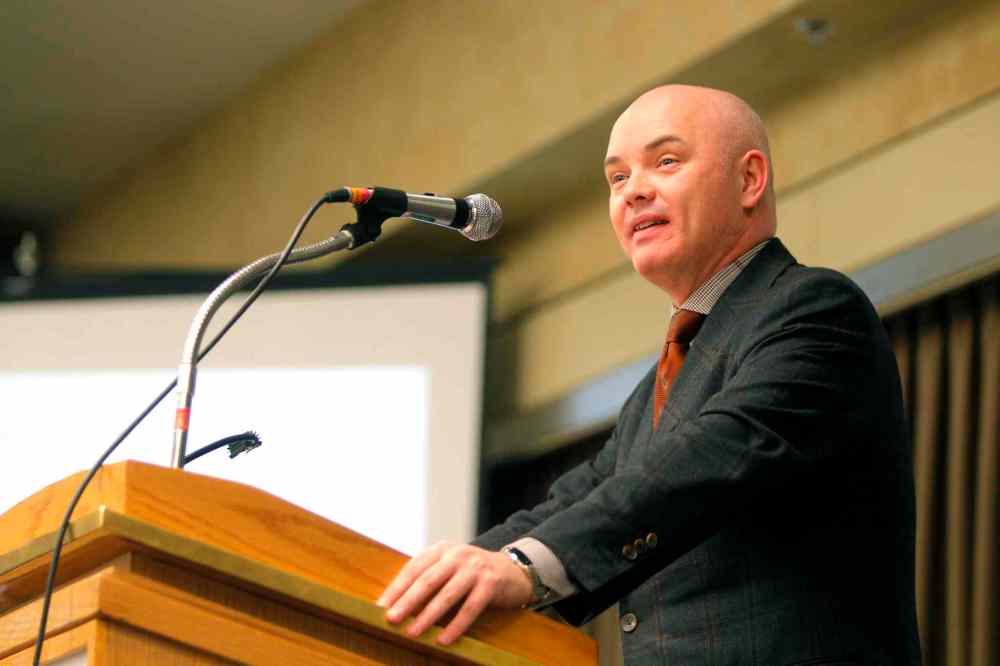
He held attention despite the pronouncement at the outset that Manitoba’s diversified economy was boring. “What would it take to change that story for Manitoba to spur its manufacturing, commodity and service sectors to entirely new highs rather than having to trade off against each another?” he asked rhetorically.
Not that he had any easy prescriptions, but Jones gave a provocative analysis of the macro issues that also drilled down to the some of the fundamental drivers of this economy.
- On the issue of transportation, the Canada West Foundation just released a paper that calls for the creation of a national private-public body to guide increased investment in critical trade infrastructure. He said there has to be more of that kind of collaboration between private and public sectors.
- On the energy front, he reminded people although we may think hydroelectricity is great and carbon-based fuels are bad, hydro does not have the same clean, virtuous reputation in the U.S. as it does in Canada.
“Winnipeg still has the lowest electricity costs of major Canadian cities, and it needs to be a core strategic priority for Manitoba to retain that advantage,” he said. “We also need an even stronger effort in the United States to strengthen the brand of Canadian hydro.”
- He acknowledged the relative success Manitoba has achieved in attracting immigrants, but was frank and helpful about Manitoba’s great challenge in addressing the human-resource potential of the province’s aboriginal population.
He said liberal democracies can succeed over autocratic regimes that spend more on economic development without worrying about issues by successfully blending the policies of inclusion with the policies of growth.
He asked, “Are we really extending these benefits (universal education, tolerance of different races, relatively low cost and high quality of living) effectively to the almost 20 per cent of Manitobans who are aboriginal?”
He said we need a “profoundly” greater effort to unlock the potential of our aboriginal people and we need to have the courage to ask more of aboriginal people and their leadership.
“There is nothing more toxic than the racism of low expectations, and we must shake ourselves out of hopelessness and complacency on the aboriginal file.”
- As for competitiveness, Jones is not alone in his observations about the potential the province has to leverage its core competencies to take advantage of the surge in global middle-class consumers, expected to grow from two billion to five billion by 2030.
“Western Canada has an opportunity to position itself as a preferred supplier of food, energy and materials and related services and manufacturing,” he said. “These will help support the largest improvement in living conditions in human history.”
- When it comes to raising capital, the former deputy minister of government affairs for the Saskatchewan government raised the issue of Manitoba’s non-membership in the New West Partnership.
He said in his opinion, Manitoba would do much better if it were a member.
“The message to foreign investors that comes from being part of the New West Partnership is that by doing business with you, they are entering a common market — a market with nearly 10 million people and an economy worth half a trillion dollars,” he said. “Compare that to Manitoba’s market of a million people and $60 billion.”
martin.cash@freepress.mb.ca
History
Updated on Thursday, November 27, 2014 6:15 AM CST: Replaces photo