
Gone Gardenin’ – Hat plant … alligator plant … whatever. It’s weird and wonderful
Advertisement
Read this article for free:
or
Already have an account? Log in here »
We need your support!
Local journalism needs your support!
As we navigate through unprecedented times, our journalists are working harder than ever to bring you the latest local updates to keep you safe and informed.
Now, more than ever, we need your support.
Starting at $15.99 plus taxes every four weeks you can access your Brandon Sun online and full access to all content as it appears on our website.
Subscribe Nowor call circulation directly at (204) 727-0527.
Your pledge helps to ensure we provide the news that matters most to your community!
To continue reading, please subscribe:
Add Brandon Sun access to your Free Press subscription for only an additional
$1 for the first 4 weeks*
- Enjoy unlimited reading on brandonsun.com
- Read the Brandon Sun E-Edition, our digital replica newspaper
*Your next Free Press subscription payment will increase by $1.00 and you will be charged $20.95 plus GST for four weeks. After four weeks, your payment will increase to $24.95 plus GST every four weeks.
Read unlimited articles for free today:
or
Already have an account? Log in here »
Hey there, time traveller!
This article was published 12/03/2015 (4094 days ago), so information in it may no longer be current.
While I am whiling away the winter gardening in my sunroom, I always appreciate unusual plants, plants that have a strange appearance or behave in peculiar ways.
Certainly I have my old favourite plants that are not that unusual, such as my extensive geranium collection, but a few offbeat plants make my indoor garden that much more interesting.
I recently acquired quite a different plant from a gardening friend when I visited his garden last fall. He had moved his extensive plant collection outdoors for the summer and was in the process of taking things back indoors for the winter and trying to pare down his collection by disposing of duplicate plants. So he gave me a Mexican hat plant.

This unusual plant is sometimes called ‘mother of thousands,’ and for good reason. It has not one, but two methods of natural propagation, and both methods are quite strange. The plant has oblong, lance-shaped leaves that are slightly cupped and are about 15 centimetres long and three centimetres wide.
For some reason, as the plant grows, the upper leaves get quite a bit larger and heavier than the lower ones. The plant becomes top-heavy and bends over under the weight of this heavier foliage.
While it is growing, the plant also develops lateral roots along its stem and when the plant bends over, these roots will make contact with the soil and new plants will emerge where these lateral roots attach themselves to the soil.
If this odd method of producing offspring isn’t peculiar enough, the Mexican hat plant has an even more unusual way of propagating.
At each leaf node, two or three leaves emerge and the leaf nodes are spaced along the stem about eight to 10 centimetres apart. The edges of the green leaves — which are unusual unto themselves, having blotchy purple undersides — have spoon-shaped bulbous spurs along their edges that bear young plantlets.
These tiny plantlets gradually develop roots while still attached to the leaves and gradually they detach themselves from the leaves and fall to the soil surface and grow into new plants.

The edges of the leaves, before the plantlets begin to fall, are completely lined with these tiny plantlets, giving the leaves a very unusual appearance. Some people, seeing this alligator-like texture, call the plant by another name — alligator plant.
The Mexican hat plant belongs to the same genus of plants as the kalanchoe, and although the two plants share some common characteristics, such as the slightly spoon-shaped leaves, the kalanchoe is grown as a flowering plant while the Mexican hat plant is grown for its foliage. It only rarely blooms, but when it does, it produces a tall, umbrella-shaped umbel of small, pink, bell-shaped flowers.
Although I grow this plant partly for its unusual foliage, its real attraction for me is its strange propagation behaviour. The Mexican hat plant is a succulent plant native to Madagascar so it also fits into my large collection of cacti and succulents
The Mexican hat plant can get to be about a metre tall but I don’t allow mine to get more that about 45 centimetres before I cut it back. I cut the top off and plant to create a new plant — a third way this plant can be propagated. If I need extra plants, I allow the old plant to sprout new growth instead of discarding it.
Sometimes I take a few of the tiny plantlets that have fallen to the soil surface and place them on the surface of a pot of soilless mix that has had some sand added, where new plants will develop. This is usually not necessary, however, as from time to time I will find a Mexican hat plant growing in the pot of another plant and I simply transplant it into its own pot to create a new plant.
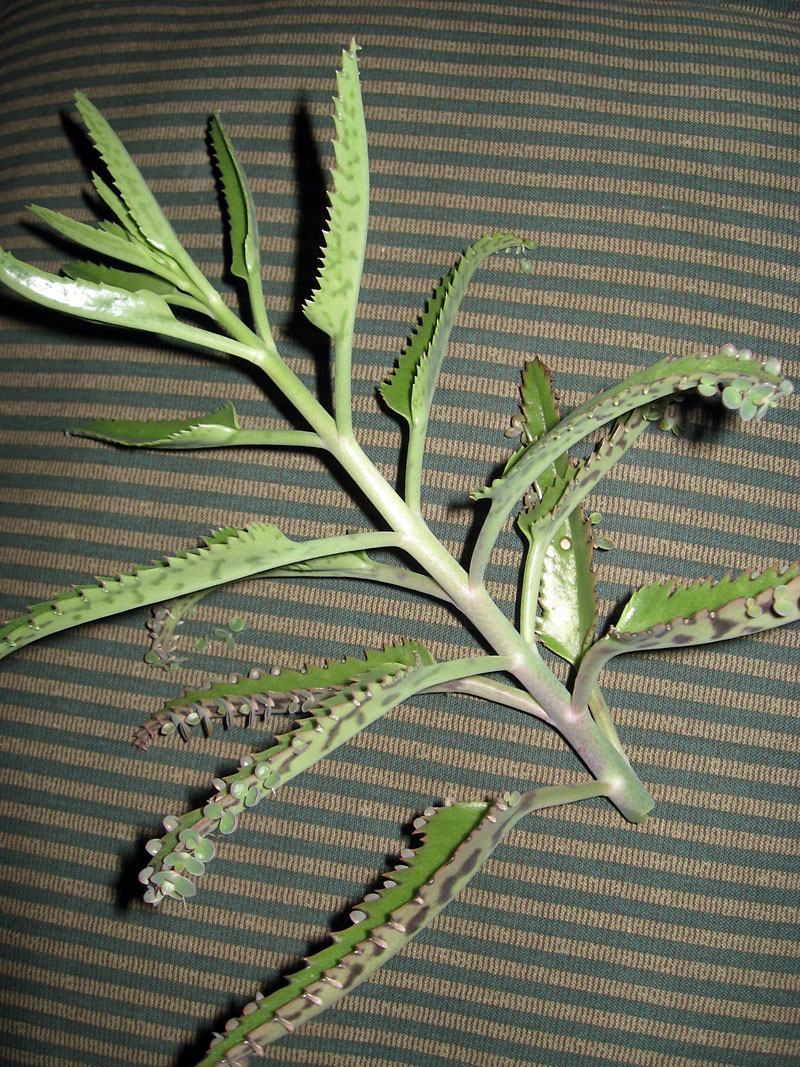
I am always amazed at how far these tiny plantlets travel — I have found small plants growing in pots a metre or more away from the parent plant — maybe it has some Mexican jumping bean genes! There are always some of these plantlets on the soil surface of the pot in which the parent plant is growing, so there is no shortage of propagation material.
I keep the Mexican hat plant indoors as an interesting houseplant, but I also incorporate a few of these unique plants into the succulent containers I plant up in the spring for use in my outdoor garden. It is quite fast growing, getting much taller than most other succulents, but it does not get too large in the short three months that the succulent planters are outside.
The Mexican hat plant will not tolerate frost, but frost would kill most of the other succulents I have, so I always bring the succulent planters indoors before fall frost and do not put them outdoors until danger of frost is past.
All parts of the Mexican hat plant are poisonous to humans and pets. Since I don’t generally go around eating my houseplants and I have no pets, this characteristic does not worry me, but anyone who has small children or pets should keep this in mind.
The Mexican hat plant is most unusual, and if you like unique plants, you might add one to your plant collection.

Albert Parsons lives, writes, and gardens in Minnedosa.
» communitynews@brandonsun.com