
VE Day hits home in local veteran’s war diary
Advertisement
Read this article for free:
or
Already have an account? Log in here »
We need your support!
Local journalism needs your support!
As we navigate through unprecedented times, our journalists are working harder than ever to bring you the latest local updates to keep you safe and informed.
Now, more than ever, we need your support.
Starting at $15.99 plus taxes every four weeks you can access your Brandon Sun online and full access to all content as it appears on our website.
Subscribe Nowor call circulation directly at (204) 727-0527.
Your pledge helps to ensure we provide the news that matters most to your community!
To continue reading, please subscribe:
Add Brandon Sun access to your Free Press subscription for only an additional
$1 for the first 4 weeks*
*Your next subscription payment will increase by $1.00 and you will be charged $20.00 plus GST for four weeks. After four weeks, your payment will increase to $24.00 plus GST every four weeks.
Read unlimited articles for free today:
or
Already have an account? Log in here »
Hey there, time traveller!
This article was published 11/05/2015 (3981 days ago), so information in it may no longer be current.
Seventy years ago, Frank Sullivan scrawled an entry in his war diary — its four short sentences marked his place in history, and are a source of pride for his family to this day.
“We heard today the war is over for us,” Sullivan wrote. “Are we ever happy. No drinks. I thank God for bringing me through.”
Sullivan, a Second World War veteran, passed away about 33 years ago, but his diary has been passed along to his grandson, Brandon lawyer Patrick Sullivan.
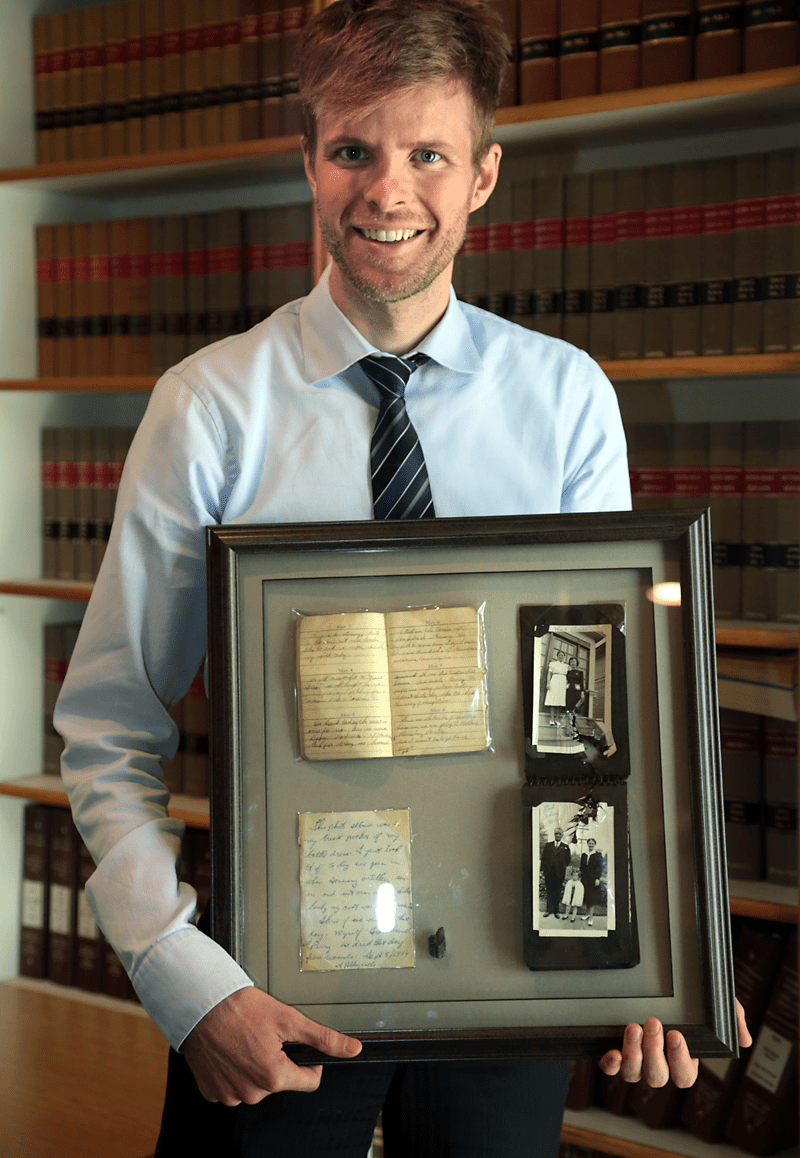
The framed book hangs alongside Frank’s war medals and a piece of shrapnel from a German shell that once lodged in his arm.
Also on the wall is the family photo album he carried with him in Europe during the war. It’s pierced with a hole from another piece of the same shell.
The objects have drawn the attention of Sullivan’s clients.
“Someone asks about them every day,” Sullivan says.
But last week, they took on added significance when Sullivan happened to notice the dates displayed by the open diary.
It was turned to May 5, 1945, the day the Second World War ended in the Netherlands.
Last week, parading Canadian veterans were thanked by Dutch citizens for the prominent role they played in liberating the Netherlands 70 years ago.
And Frank Sullivan, a Brandonite born and raised, played a part in that key moment in history.
Sullivan was born on Dec. 7, 1921, in Brandon where he lived in the family home on Princess Avenue East and worked for the Canadian Pacific Railway as a warehouse man.
In January 1942, he enlisted at CFB Shilo with the 13th Field Regiment of the Royal Canadian Artillery.
He was among the soldiers who landed in Normandy on D-Day, June 6, 1944.
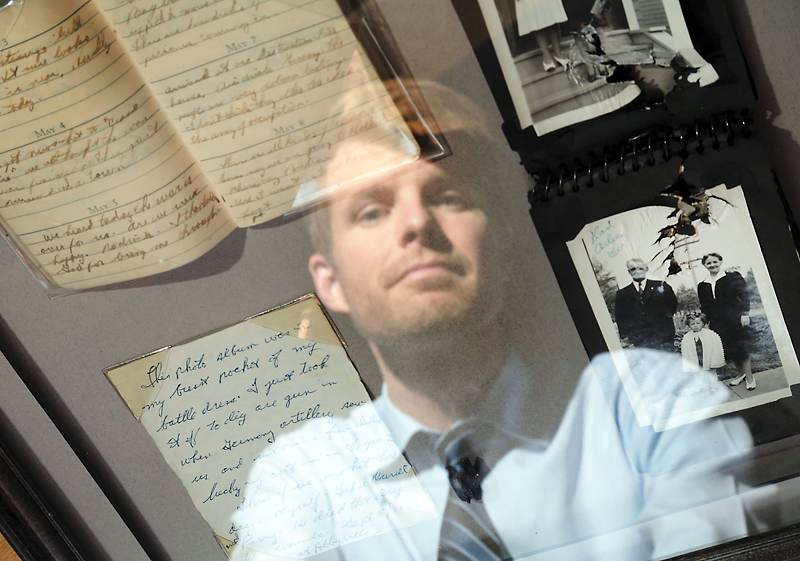
In September 1944, he was wounded in France but rejoined his unit. Shrapnel had lodged in his arm when a German shell burst above him.
Another fragment pierced a hole through a small family photo album he carried with him in his jacket pocket. Prior to the shell exploding, he’d laid the jacket on the ground.
He was wounded again in December 1944 while in Holland, when he was blown from his truck by a mine and injured his back. He rejoined his unit a few days later and finished out the war.
The 13th Field Regiment’s history describes the final days of war.
Sullivan and his regiment had just crossed into Germany from Holland when word came of the enemy’s wish to surrender.
The regiment took a position at Bagband, and on May 4, 1945, negotiations for the surrender of northwest Germany were complete. By 8 a.m. on May 5, all resistance in Holland and northwest Germany ceased. The guns fell silent.
Three days later, Nazi Germany surrendered and brought the war in Europe to an end.
“The cessation of hostilities was an anti-climax,” states the regiment history. “It was difficult to realize it was all over, that the guns would no longer be needed, that the soldiers who were the enemy yesterday were but harmless individuals today.”
As a frontline soldier, Sullivan had seen many horrors.
He witnessed his friends die beside him, he and fellow soldiers were bombed by members of their own allied airforce, and another Canadian once gunned down his German prisoners.
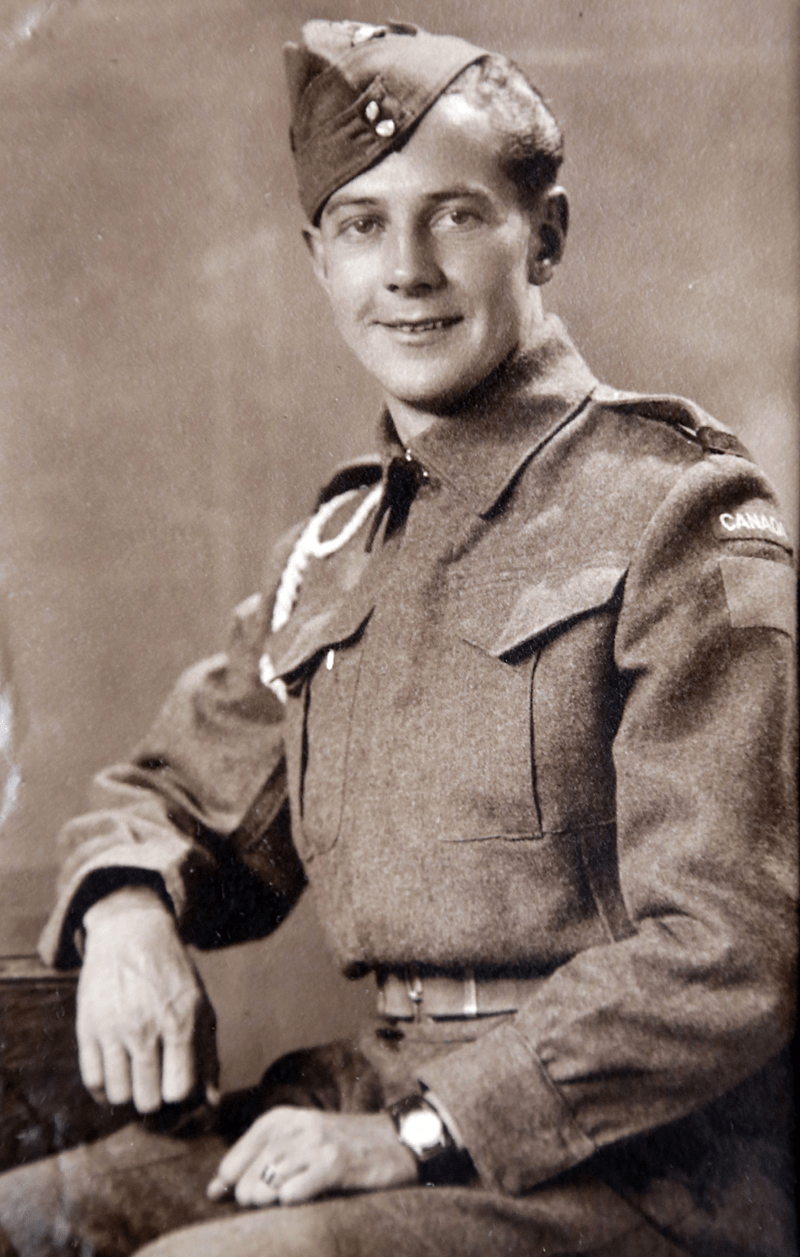
After returning home to Canada, Sullivan’s pain from his back injuries remained, and he had hearing loss from the firing of the artillery gun.
Yet, despite those lasting injuries, he raised a family and ran a successful business.
He wed his wife, Kay, in 1947 and raised two sons.
He returned to work at CPR until he retired and started Sullivan’s Hobbies in 1965.
Sullivan died in 1982 at 60 years old. His widow believed the pain and mental cruelty of the war accounted for his early death.
» ihitchen@brandonsun.com
» Twitter: @IanHitchen