
Fate of Cargill grain elevator yet to be decided
Advertisement
Read this article for free:
or
Already have an account? Log in here »
We need your support!
Local journalism needs your support!
As we navigate through unprecedented times, our journalists are working harder than ever to bring you the latest local updates to keep you safe and informed.
Now, more than ever, we need your support.
Starting at $15.99 plus taxes every four weeks you can access your Brandon Sun online and full access to all content as it appears on our website.
Subscribe Nowor call circulation directly at (204) 727-0527.
Your pledge helps to ensure we provide the news that matters most to your community!
To continue reading, please subscribe:
Add Brandon Sun access to your Free Press subscription for only an additional
$1 for the first 4 weeks*
- Enjoy unlimited reading on brandonsun.com
- Read the Brandon Sun E-Edition, our digital replica newspaper
*Your next Free Press subscription payment will increase by $1.00 and you will be charged $20.95 plus GST for four weeks. After four weeks, your payment will increase to $24.95 plus GST every four weeks.
Read unlimited articles for free today:
or
Already have an account? Log in here »
Hey there, time traveller!
This article was published 12/08/2015 (4070 days ago), so information in it may no longer be current.
Perched high above, a bird looks out at Brandon through a hole in the side of the former Cargill elevator on Pacific Avenue.
The crumbling elevator was once a centrepiece of the city’s economy as farmers trucked grain to the Wheat City, where it would be loaded into railcars and sent east and west to market.
Today, the last wooden elevator in Brandon stands empty, surrounded by a steel fence with junk strewn across a concrete pad adjacent to it.
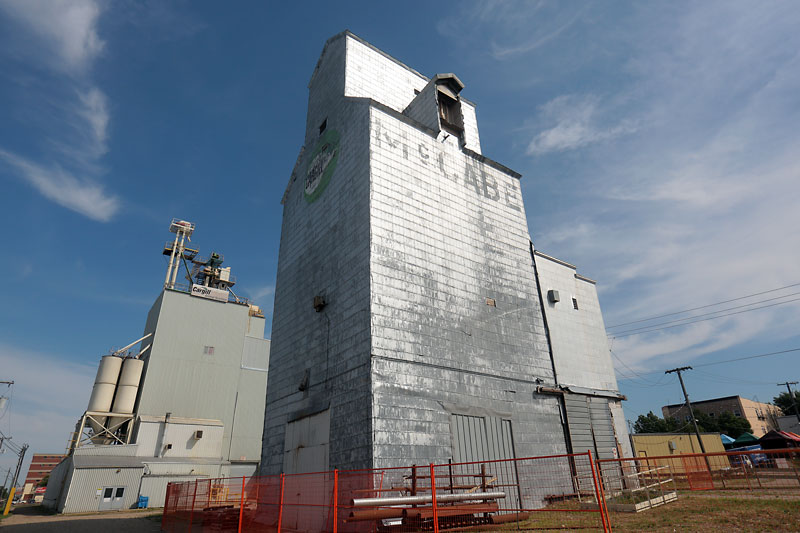
Across the lot, located at 12th Street and Pacific Avenue, sits Cargill’s feed mill, which shuttered its doors at the end of 2014.
Cargill used the old wooden elevator for storage after demolishing another storage elevator at 13th Street and Pacific in 2010.
“Maintaining our high level of standards at the wooden facility is not economically viable, therefore we made the difficult decision to close its feed mill facility in Brandon,” said Cargill spokeswoman Connie Tamoto.
The faded decals of “Cargill,” “National” and “McCabe” are still visible on the side of the building as a reminder of the ghosts of grain companies past.
Cargill plans to sell the property, according to Tamoto, who wouldn’t disclose specific details or answer whether Cargill would sell the facility to a heritage group looking to restore the elevator.
There have been no permits pulled to demolish the elevator, according to City of Brandon spokeswoman Allison Collins.
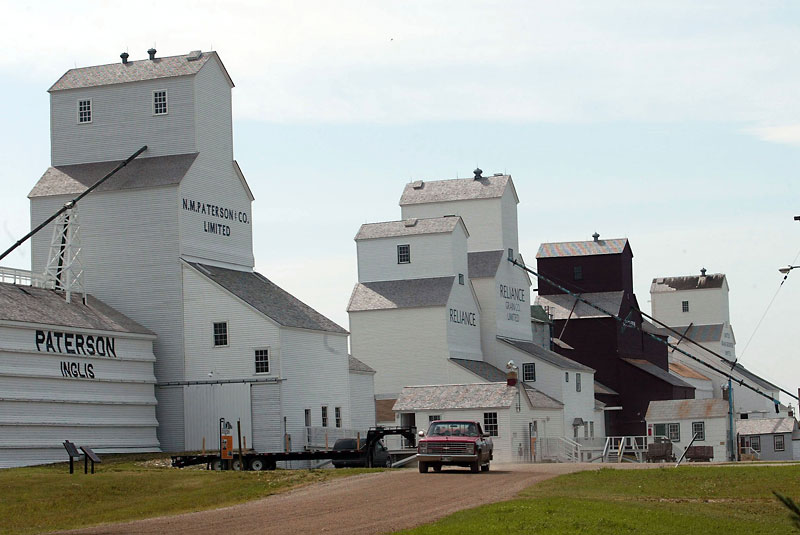
In Inglis, a local heritage committee was formed in 1994 intent on saving five elevators beside the railway.
Four of the five elevators have stood in the community since 1922. Rows of elevators were once a prominent staple in Prairie communities and the only known row left standing is at Inglis, according to Ernie Neubauer, who manages the Inglis Grain Elevators National Historic Site.
“Inglis is the only place in Western Canada and I can’t find any in the (United) States either that has the original elevators,” Neubauer said. “None were moved in and none were moved out. They were all built on site.”
Through federal and provincial grants and private donations, $1.93 million was raised to restore the elevators.
Neubauer said between 600 to 800 visitors from as far away as Sweden and Australia stop in each summer to see the elevators.
“It’s important to protect them because there are no more,” Neubauer said. “It’s like having an antique car — it’s the only 1933 Ford in North America — wouldn’t you want to preserve and protect it? It’s Prairie farming history.”
There were once 5,700 hip-roof elevators in existence, according to Neubauer, a number he said has shrunk to fewer than 300, which are mainly owned privately by farmers.
Brent Bellamy, senior design architect for Number Ten Architectural Group, believes the iconic Prairie elevator should be elevated to similar status as the East Coast’s lighthouses.
In 2010, the federal Heritage Lighthouse Protection Act was adopted, allowing community groups to nominate structures for heritage designation and work with Parks Canada to access funding and establish business plans for their redevelopment, according to Bellamy. Through this program, 74 lighthouses recently received heritage protection, and another 75 will likely be listed over the next two years.
“We often think of heritage buildings as arched window stone buildings in the downtowns of cities, but the grain elevator is as important to the history of our country as any one of those,” Bellamy said. “They are not necessarily important as an individual building as they are in collection — their presence on the prairie landscape.”
The first wooden grain elevator in Canada was built in 1879 in Niverville, Bellamy said. It was a small, round building powered by two horses. Until that time, grain was stored in flat warehouses, such as the one that still exists at Brookdale, and brought to market in bags that were loaded by hand.
The railway presented an opportunity to ship grain to the world, but would require a larger and more advanced system of transfer. In response, the modern grain elevator was born.
“Grain elevators were once the centre of life in Prairie towns and cities,” Bellamy said. “With some careful thought and help from government, they represent an opportunity today to become that again, just in a different incarnation. It is easy to discard them as a relic of the past but they can be a symbol of the future as well.”
Calls to Coun. Kris Desjarlais (Rosser) and Vanessa Hamilton (Riverview), co-chairs of the city’s heritage advisory committee, were not returned by press time.
» ctweed@brandonsun.com
» Twitter: @CharlesTweed