
Travelin’ Westman — Be true to your school
Advertisement
Read this article for free:
or
Already have an account? Log in here »
We need your support!
Local journalism needs your support!
As we navigate through unprecedented times, our journalists are working harder than ever to bring you the latest local updates to keep you safe and informed.
Now, more than ever, we need your support.
Starting at $15.99 plus taxes every four weeks you can access your Brandon Sun online and full access to all content as it appears on our website.
Subscribe Nowor call circulation directly at (204) 727-0527.
Your pledge helps to ensure we provide the news that matters most to your community!
To continue reading, please subscribe:
Add Brandon Sun access to your Free Press subscription for only an additional
$1 for the first 4 weeks*
*Your next subscription payment will increase by $1.00 and you will be charged $20.00 plus GST for four weeks. After four weeks, your payment will increase to $24.00 plus GST every four weeks.
Read unlimited articles for free today:
or
Already have an account? Log in here »
Hey there, time traveller!
This article was published 19/09/2015 (3850 days ago), so information in it may no longer be current.
CARTWRIGHT — When parents sent their children to class in Cartwright this year, it marked the 25th year students have attended an independent high school in the small southwestern Manitoba community.
In April 1991, Turtle Mountain School Division trustees voted to close the high school portion of the K-12 school for the following year. The plan, which called for Grade 10 to 12 students to be bused to Killarney for courses as a cost-saving measure, caused an uproar in Cartwright.
What couldn’t have been forecasted then, however, is that the school board’s decision would end up shaping a community’s character, testing its resolve, solidarity and soul.
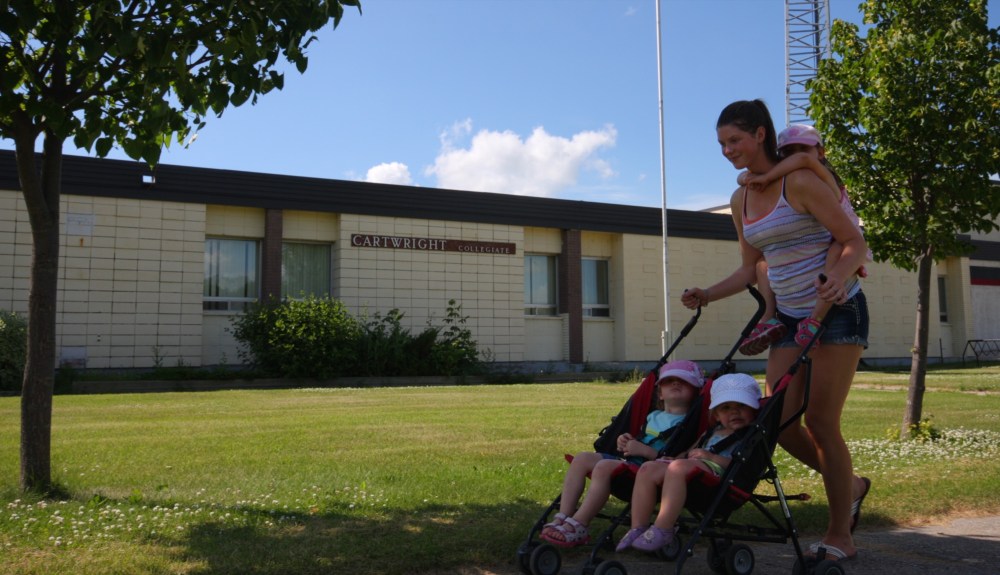
In the days that followed that 1991 vote, parents pulled their children from classes as a sign of disapproval and protest.
At the time, the Brandon Sun reported about Wendy Thomson, who picked up her two sons, Shayne, 9, and Conner, 6 and yanked them from classes. While Thomson’s children, who were in elementary school, weren’t directly affected by the closure, the entire community stood in unity against the board’s decision.
“I didn’t think I was going to be this emotional. It’s really tearing at my heartstrings,” Thomson told a reporter while choking back tears. “But I’m in full support of what we’re doing.”
Thomson said she was apprehensive about her family’s future, but “I know that my town will support me 100 per cent. I’m fully confident we’ll get through this.”
Throughout the summer of 1991, the chasm between the community and the school board grew so wide a conciliator was brought in.
A report filed by the conciliator to then-Manitoba Education Minister Len Derkach said the residents of Cartwright were willing to negotiate, but the school board — consisting of 11 members who voted six to five in favour of transferring students — was sticking by its decision.
When conciliation failed, Cartwright residents took a different approach to ensure their children were educated at home.
Cartwright petitioned the Department of Education to turn approximately 135,000 acres of land previously under the jurisdiction of the Turtle Mountain School Division into a new division called the Cartwright School Division.
The land transfer would cover Cartwright and the surrounding area as the community had already partially broken away from the Turtle Mountain division by forming the Cartwright Community Independent School (CCIS), a private high school for the 28 eligible high school students.
The goal was to operate the school for one year and then have a public school division in place the following year, according to Betty Mowbray, who along with her husband Tom became spokespeople for the community.
The final straw came near the end of October, when a Cartwright-area trustee resigned from the board after five years of service.
Gordon Mullin handed in his letter of resignation on the premise that the six trustees from Boissevain and Killarney, the division’s two largest centres, had their own mandate and refused to address the concerns of the remaining five trustees who represented the smaller communities of Minto, Ninette and Cartwright.
“We just had absolutely no voice in there at all,” Mullin said. “It just wasn’t worth it. The frustration was too much.”
During the initial protest in Cartwright, two parents lowered the school’s flag to half-mast. While at the time, they believed the battle to keep the school was just beginning, their actions seem apt now, symbolizing the death of a public high school in Cartwright that has persisted to this day.
But, as so often is the case in life, just as one door closes, another door opens.
Determined to keep their school, Cartwright residents defied the odds in those early years, defiant of a system designed to slowly force them into a death knell.
Zero government grant money was available to the school for the first three years, forcing the community to raise “a phenomenal amount of money,” according to current CCIS board member Donalee Mowbray.
In the years that followed, Grades 10 and 11 returned to the public school system when the Pembina Valley School Division, now called the Prairie Spirit School Division, took responsibility for the grades.
Today, Cartwright is charged with raising approximately $50,000 to $60,000 per year to make certain its children graduate in the community, with additional funding coming from the province on a per-student basis.
According to a spokeswoman for Manitoba Education and Advanced Learning, Cartwright has received between $25,500 and $64,600 over the past five years, depending on the number of students enrolled.
“Funding is set at 50 per cent of public school net operating expenditures from two years previous to the current funding year,” the spokeswoman said, adding that additional resources for textbooks are provided and funding for level two and three special needs students is at the same rate as the public school system.
One of the last schools to transition from private to public was in 2005 when Fairway Colony School joined the Beautiful Plains School Division.
Mowbray said there’s no guarantee Cartwright could ever transition back into a public school, especially with the challenges faced by rural school divisions.
“Keeping CCIS in operation not only allows our kids to continue to graduate at home, but it also keeps us in control of our own fate as a community,” she said.
Fundraising has become a way a life in Cartwright, a community of approximately 300 surrounded by the former RM of Roblin, which adds another 700 people, according to Statistics Canada.
From “Pam’s Pennies,” spearheaded by Pam McIntyre who collects and rolls small change, to community suppers where volunteers feed up to 300 people, there is no such thing as a fundraiser too big or small.
Since the beginning, at the core of it all has been the community service auction, which happens triennially and raises upwards of $45,000 in one evening.
This year happens to be one of those three years as the community rallies to host the auction on Nov. 7.
“Area businesses are always very generous with their donations of product and service, and many individuals and families come up with creative ways to use their talents and interests to help benefit the school,” Mowbray said, adding that at the last auction, a family donated a boat ride around Rock Lake that was followed by a pickerel fry at their cabin.
A microcosm of the community’s conviction, the boat ride and fish fry went for $1,300.
CCIS has even set up automatic withdrawals that allow past graduates to donate $25 per month to ensure the school perseveres. Grade 12 students are required to pay tuition, albeit a nominal amount of $100.
It’s a lot of fundraising and work, but it’s imperative, according to Mowbray.
“A community without a school has trouble attracting young people who want to settle and raise families there, businesses have trouble finding staff. Without a stable workforce, industry is less likely to establish in your town,” she said.
“When students are bused to other towns, parents tend to do more shopping out of the community because they are travelling for extracurricular activities and it’s convenient to just ‘pick something up on the way home.’”
Quinn Mullin, 20, graduated from CCIS two years ago.
Her graduating class consisted of just nine people. Small classes meant everyone had to participate in order to have many of the same activities larger schools enjoy. A testament to that mentality, Mullin played volleyball, sat on student council and was on the yearbook committee.
“I wouldn’t have it any other way,” she said, standing in front of the school where she graduated. “I loved being able to grow up and go to school in my community. I think if you take the kids out of school, it’s going to make that town die because they’re the future.”
Mullin recently graduated from Lakeland College in Vermillion, Alta., where she was a member of the rodeo team after participating in the Manitoba High School Rodeo Association through CCIS.
This summer, she returned to work at the Cartwright daycare after getting her early learning and child care certificate.
Mullin said going to a small school instilled values and principles in her that some students in larger centres might not need to focus on — places where it’s easy to find a group of friends or clique of like mind.
“You have to get along with everyone, and if you have an issue with someone in your class, you better find a way to get over it because they’re your friends,” she said.
Working together is a sentiment the whole community prescribes to, and has been all too willing to put their money where their mouth is when it mattered most.
For Mowbray, 1991 might have been the year that galvanized a community. It tested Cartwright’s mettle and the community came out stronger on the other side.
“This community fought together, against all odds, managed to find a solution that saved the school at a time when many other communities were not so lucky,” she said. “I think that shared experience, albeit a difficult one, really brought the community together and to this day we reap the benefits of that.
“Graduation day in Cartwright is always a triumphant moment, not only for the students, parents and teachers, but also for the community as a whole because we all play a part in making it happen.”
» Have a historical, quirky or compelling story in your community? Well, we want to know about it for our new column, Travelin’ Westman, which will see Brandon Sun reporter Charles Tweed visit a different Westman community each week. Send your story ideas to ctweed@brandonsun.com and be sure to include “Travelin’ Westman” in the subject line.