
Obama, Trudeau further some Arctic goals but miss others: experts
Advertisement
Read this article for free:
or
Already have an account? Log in here »
We need your support!
Local journalism needs your support!
As we navigate through unprecedented times, our journalists are working harder than ever to bring you the latest local updates to keep you safe and informed.
Now, more than ever, we need your support.
Starting at $15.99 plus taxes every four weeks you can access your Brandon Sun online and full access to all content as it appears on our website.
Subscribe Nowor call circulation directly at (204) 727-0527.
Your pledge helps to ensure we provide the news that matters most to your community!
To continue reading, please subscribe:
Add Brandon Sun access to your Free Press subscription for only an additional
$1 for the first 4 weeks*
*Your next subscription payment will increase by $1.00 and you will be charged $20.00 plus GST for four weeks. After four weeks, your payment will increase to $24.00 plus GST every four weeks.
Read unlimited articles for free today:
or
Already have an account? Log in here »
Hey there, time traveller!
This article was published 10/03/2016 (3658 days ago), so information in it may no longer be current.
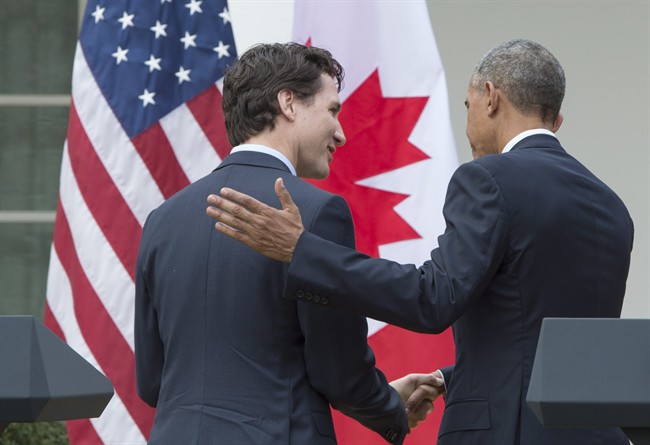
Prime Minister Justin Trudeau and U.S. President Barack Obama pushed forward some long-held goals for the Arctic at their Thursday meeting in Washington, D.C.
But experts say the two leaders also missed a chance to restrict a major contributor to pollution and loss of sea ice in northern waters.
“I was hoping to see a declaration that the U.S. and Canada would unilaterally ban the use of heavy fuel oil within their territorial and internal waters,” said Michael Byers, a professor of international law at the University of British Columbia and an expert on Arctic politics.
Heavy fuel oil is a major source of black carbon, a sooty emission that darkens sea ice and snow and quickens its melt. It is considered a pollutant and has already been banned off North America’s east and west coasts.
A document released by Trudeau and Obama only says: “We will determine with Arctic partners how best to address the risks posed by heavy fuel oil use and black carbon emissions from Arctic shipping.”
That puts those talks at the mercy of Russia, which isn’t interested in a ban, said Byers.
Still, Arctic observers pointed out the two leaders seem to have adopted good ideas from each other.
Canada is formally backing an American initiative to ban all commercial fishing in northern waters until research can determine sustainable harvest levels. The United States was the first to ban such fishing in its Arctic territory, a ban which Canada later copied.
Talks have already occurred with other major fishing nations. Now Canada and the U.S. will seek a formal treaty to ensure the rest of the world does the same.
“The leaders call for a binding international agreement to prevent the opening of unregulated fisheries in the central Arctic Ocean to preserve living marine resources and promote scientific research in the region,” the document says
The united front is good news, said Scott Highleyman with the environmental arm of the Pew Charitable Trusts. Highleyman, who has followed the issue closely, suggested that even better news is Canada’s offer to hold the next series of talks.
“When diplomats start doing that, that means they think there’s some momentum.”
The U.S. will also work with Canada on developing low-impact northern shipping corridors that would take into account ecological and cultural areas, migration patterns of animals such as whales, indigenous use and navigation data quality.
That’s something Canada’s Transport Department has been working on for years, said Byers.
“It’s a further step in bilateral co-operation on shipping matters that involve the Northwest Passage,” he said. “Any incremental increase in co-operation will help to build confidence in Washington that Canada can manage the waterway and protect the interests of both (countries).”
The two governments also reaffirmed their support for science-based decision-making with strong input from indigenous people.
Most of the announcements made Thursday involve talks that have been going on for years. None, Byers pointed out, involve “spending money and building stuff.”
The document Trudeau and Obama agreed on was widely hailed.
“We are impressed by the depth of the commitment to support a strong Arctic future for people and species,” said David Miller of the World Wildlife Fund.
Sue Liebenson of Pacific Environment said: “We are thrilled to see these issues highlighted in today’s joint statement from the White House. We look forward to leadership from both the U.S. and Canada on creating common sense regulations.”
— Follow Bob Weber on Twitter at @row1960
Related Articles
Gregoire-Trudeau, Obama talk girls' education

Advertisement Advertise With Us
Advertisement Advertise With Us