
How Brandon East was won
Advertisement
Read this article for free:
or
Already have an account? Log in here »
We need your support!
Local journalism needs your support!
As we navigate through unprecedented times, our journalists are working harder than ever to bring you the latest local updates to keep you safe and informed.
Now, more than ever, we need your support.
Starting at $15.99 plus taxes every four weeks you can access your Brandon Sun online and full access to all content as it appears on our website.
Subscribe Nowor call circulation directly at (204) 727-0527.
Your pledge helps to ensure we provide the news that matters most to your community!
To continue reading, please subscribe:
Add Brandon Sun access to your Free Press subscription for only an additional
$1 for the first 4 weeks*
- Enjoy unlimited reading on brandonsun.com
- Read the Brandon Sun E-Edition, our digital replica newspaper
*Your next Free Press subscription payment will increase by $1.00 and you will be charged $20.95 plus GST for four weeks. After four weeks, your payment will increase to $24.95 plus GST every four weeks.
Read unlimited articles for free today:
or
Already have an account? Log in here »
Hey there, time traveller!
This article was published 07/05/2016 (3681 days ago), so information in it may no longer be current.
Poll-by-poll data from the recent provincial election suggests it may be difficult, but not impossible, for the NDP to regain its foothold in Brandon East in four years’ time, according to Brandon University political scientist Kelly Saunders.
“Incumbents are always favoured,” Saunders said. “You’re able to build a profile and you have a ground game as long as your people are engaged. You have that machine to build from, and if you deliver on some key promises, it helps in subsequent elections.”
Progressive Conservative MLA-elect Len Isleifson won the seat with 52.2 per cent of the vote, capturing 3,669 of the 7,033 votes with 35 rejected ballots and 82 declined. It was a historic win as the NDP had held the seat since its inception in 1969 with only two MLAs — Len Evans and Drew Caldwell —representing the consistency in its 47-year existence.
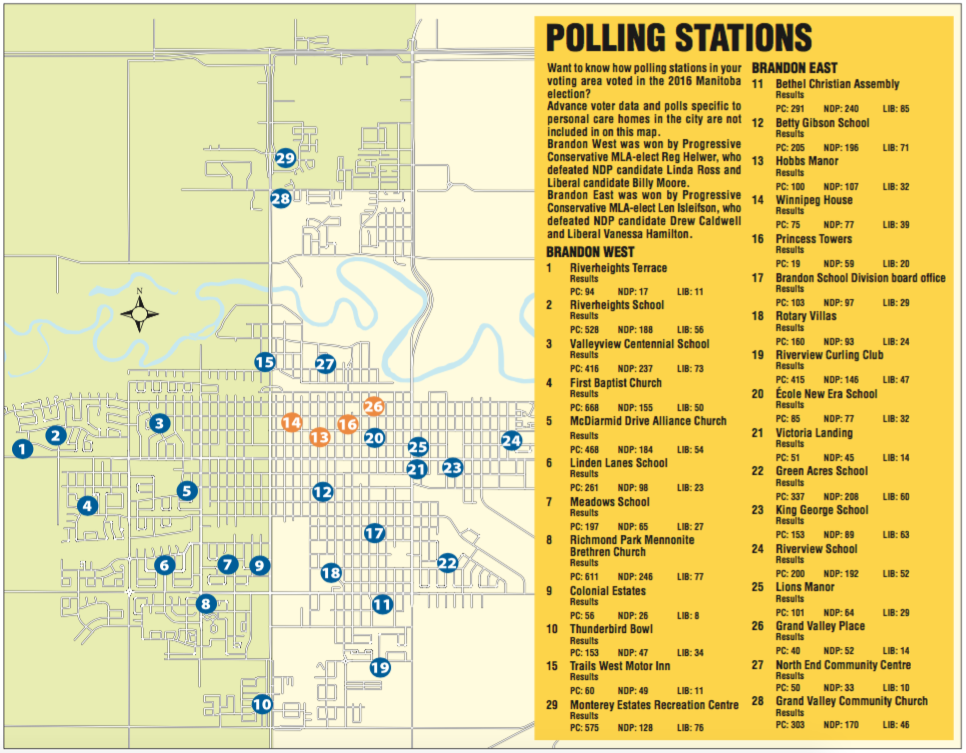
Changing demographics in Brandon East is one of the main reasons behind Isleifson’s victory.
The constituency’s south end has experienced a boom with several new builds. Much of the residential explosion has come in the form of houses for upper middle-class wage earners.
“The south end numbers really show, what those of us who live in Brandon already know first-hand, that there has been a lot of movement in the riding,” Saunders said. “New subdivisions are being created. Certainly when the boundaries were changed, we knew there would be some impacts on voting and those south end numbers speak to that.”
Isleifson didn’t lose a single poll to Caldwell in any voting area that has land south of Richmond Avenue. While the results of some polling stations were very close, including one tie, others were a landslide in favour of the former city councillor.
In southern areas where voters cast ballots at the Riverview Curling Club, Isleifson captured a whopping 68 per cent of the vote with three rejected ballots and six declined. A total of 415 voters checked the PC box, while Caldwell garnered 146 votes, or 24 per cent, and Liberal Vanessa Hamilton received 47 votes, or eight per cent.
While Hamilton’s support in the south was only three per cent less than her constituency-wide support, Caldwell’s gap was 12 per cent.
The numbers are more stark when compared to 2011, when Caldwell won 52 per cent of the vote in the same area. In that election, Caldwell received 365 votes compared to 311 for Progressive Conservative Mike Waddell and 23 for Liberal Shaun Cameron. There was a fourth candidate in 2011, the Green Party of Manitoba’s Vanda Fleury, but her impact at the polls was negligible.
Another reason for the blue wave was some New Democratic faithful decided to stay home on election day, according to Saunders.
Two polling stations at Winnipeg House in Brandon illustrate that trend. Caldwell narrowly defeated Isleifson at Winnipeg House, a Manitoba Housing complex located west of downtown. Caldwell garnered 77 votes compared to Isleifson’s 75 and Hamilton’s 39 in the two voting areas at Winnipeg House. In 2011, however, Caldwell picked up 127 votes, compared to 68 for the Tories and 20 for the Grits.
“It’s clear that some people chose to stay home as a protest,” Saunders said.
Another poll, Lions Manor, depicts another trend indicating that some previous New Democrat voters supported the Liberals.
In 2016, 195 voters cast ballots at Lions Manor, compared to 196 in 2011. The Tories got virtually the same number of votes in 2016 (101) compared to 2011 (100). Support for the Liberals, however, jumped from four votes in 2011 to 29 in 2016 at the expense of the New Democrats, who saw their vote tally fall from 92 to 64. There was also one declined vote in 2016.
“These voters felt compelled to go to the polls, but decided to park their vote with another party,” Saunders said. “When they do that they tend to pick a party that is more ideologically similar with the party they supported in the past.”
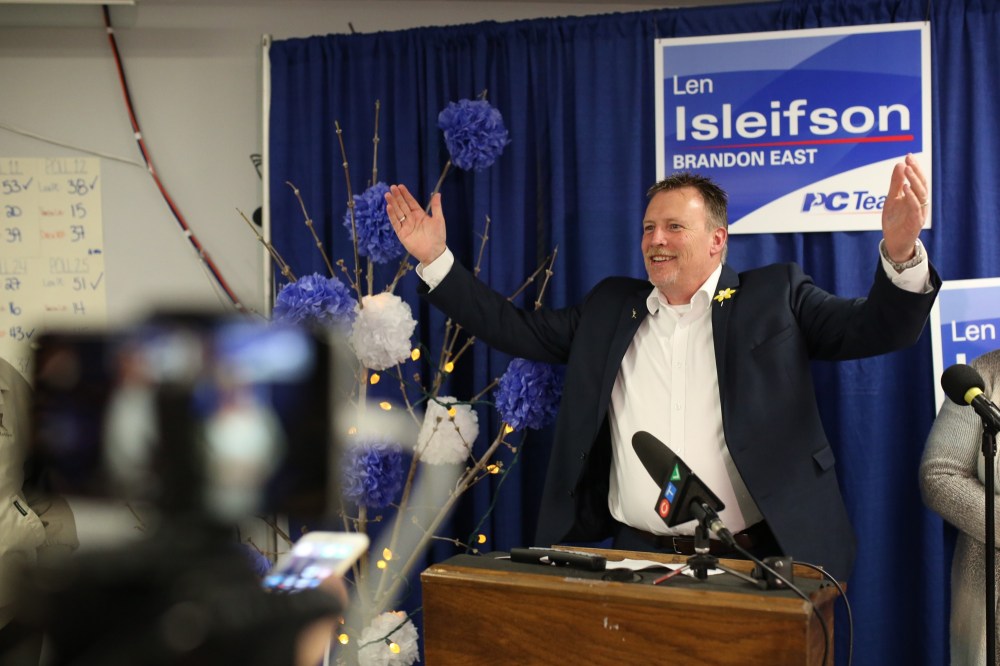
Declined votes soared across the province with more than 4,000 voters choosing not to support any candidate. In Brandon, 82 voters declined their ballots in the East compared to 134 in the West, where PC MLA-elect Reg Helwer cruised to victory.
Helwer narrowly won the seat in 2011, but made big gains at virtually every polling station in the constituency to defeat NDP candidate Linda Ross. Helwer finished with 69.2 per cent of the vote, while Ross captured 23.2 per cent and Liberal Billy Moore secured 7.6 per cent.
Saunders said she wasn’t surprised that more voters declined their ballots in Brandon West as it was believed to be a safe seat for the Tories in this election.
“In Brandon East, every voter knew that their vote was going to count,” Saunders said.
Despite all the data, Saunders said elections are becoming more and more unpredictable acrosss Western Canada.
In the past, voters took a lot of political cues from their family, workplace and income bracket, according to Saunders. Those cues, however, are dissipating.
“Those political cues don’t matter as much as they did 30 or 40 years ago,” Saunders said. “Voters are willing to shift their votes around from election to election depending on what the issues are, who the leaders are and who their local candidate is.”
“Every election is a chance for any party to make headway.”
» ctweed@brandonsun.com
» Twitter: @CharlesTweed