
White buffalo birth becomes a reminder of tradition
Advertisement
Read this article for free:
or
Already have an account? Log in here »
We need your support!
Local journalism needs your support!
As we navigate through unprecedented times, our journalists are working harder than ever to bring you the latest local updates to keep you safe and informed.
Now, more than ever, we need your support.
Starting at $15.99 plus taxes every four weeks you can access your Brandon Sun online and full access to all content as it appears on our website.
Subscribe Nowor call circulation directly at (204) 727-0527.
Your pledge helps to ensure we provide the news that matters most to your community!
To continue reading, please subscribe:
Add Brandon Sun access to your Free Press subscription for only an additional
$1 for the first 4 weeks*
- Enjoy unlimited reading on brandonsun.com
- Read the Brandon Sun E-Edition, our digital replica newspaper
*Your next Free Press subscription payment will increase by $1.00 and you will be charged $20.95 plus GST for four weeks. After four weeks, your payment will increase to $24.95 plus GST every four weeks.
Read unlimited articles for free today:
or
Already have an account? Log in here »
Hey there, time traveller!
This article was published 16/05/2016 (3735 days ago), so information in it may no longer be current.
SIOUX VALLEY DAKOTA NATION — The fence line of a Sioux Valley Dakota Nation pasture has become a shrine to the sacred animals penned inside.
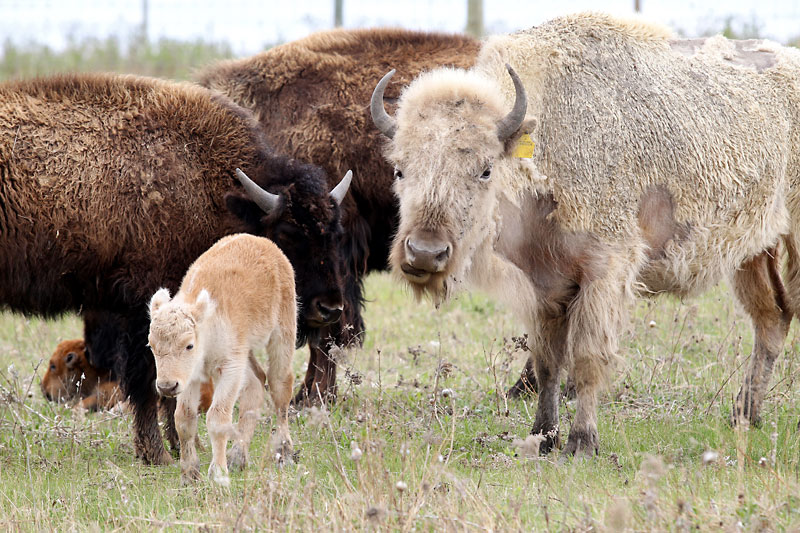
Colourful fabric and beads have been tied to the barbed wire as offerings to the community’s six-year-old female white buffalo and her newborn white calf.
The small cream-coloured male buffalo was born on May 7, and is one of eight calves born into the First Nation’s herd of 24 this spring.
“You can see with all the offerings, there’s people that are praying for something,” Sioux Valley Chief Vince Tacan said, adding that people have travelled from other communities to visit the buffalo. “They can identify with this more than they can identify with sitting in a church.”
Within the Dakota, Lakota and Nakota Sioux nations of Canada and the United States, the 2,000-year-old legend of the White Buffalo Woman carries great weight and forms the basis of many traditions and ceremonies — not least of all the pipe, or chanupa, ceremony.
An article describing the legend in a 1988 edition of The Dakota Times newspaper reads: “The White Buffalo Woman showed the people the right way to pray, the right words and the right gestures. She taught them how to sing the pipe-filling-song and how to lift the pipe up to the sky.”
Today, the birth of a white buffalo calf signals the return of the deity and is a symbol of hope and peace for many First Nation communities.
Sioux Valley’s female white buffalo is the offspring of Assiniboine Park Zoo’s albino bull buffalo, Blizzard. She was gifted to the First Nation from the City of Winnipeg in 2010, and has since birthed four calves — the most recent of which being the only albino calf.
Tacan says that while he isn’t a very religious person, he recognizes the significance in having two white buffalo in such a small herd.
“I guess I didn’t believe it at first, but now I’m seeing that there is something happening that we can’t explain,” he said.
If anything, the number of people who have visited the pasture to pray upon the calf’s arrival has made the chief realize his community is craving a return to traditional practices.
“It’s reminding us that we have the pipe, we have these ceremonies that we need to keep up with, we need to follow our own beliefs,” he said. “People are searching for something here, they’ve lost out on a lot — on language, on family, on kinship.”
Sioux Valley’s two dozen buffalo reside in a rolling pasture on the Tacan family farm — located one half mile off Highway 21 —and are cared for primarily by the chief and his brother, Tony Tacan. However, the brothers claim no ownership over the herd.
“This is the community’s (herd), we’re just the caretakers,” said Tony, who is also a band council member. “It’s considered a great honour to look after the white buffalo and the rest of the herd as well.”

While the Tacans aren’t opposed to people visiting their land to see the buffalo and leave offerings, they do have an issue with turning the animals into a side show.
“We’ve been asked to display (our white buffalo) at the Summer Fair, but we’re not into that,” Chief Tacan said. “We want to be respectful of the buffalo. I mean, I don’t think anyone else would put a religious symbol like this on display.”
In the same vein, the buffalo are treated like wild animals and none of them have names.
Tacan hopes to incorporate the white buffalo — and the teachings that surround them — into a youth conference scheduled to take place at Sioux Valley this summer. The conference will deal with issues of drug and alcohol abuse, suicide and the intergenerational effects of residential schools and the Sixties Scoop.
“We need to get our young people to understand why things are the way they are,” Tacan said. “The main thing, I think, is identity so the buffalo form part of that identity and any strategy that helps people get on with their lives is a good thing.”
» ewasney@brandonsun.com
» Twitter: @evawasney