
Irish Montrealers push for memorial to 6,000 immigrants who died of ship fever
Advertisement
Read this article for free:
or
Already have an account? Log in here »
We need your support!
Local journalism needs your support!
As we navigate through unprecedented times, our journalists are working harder than ever to bring you the latest local updates to keep you safe and informed.
Now, more than ever, we need your support.
Starting at $15.99 plus taxes every four weeks you can access your Brandon Sun online and full access to all content as it appears on our website.
Subscribe Nowor call circulation directly at (204) 727-0527.
Your pledge helps to ensure we provide the news that matters most to your community!
To continue reading, please subscribe:
Add Brandon Sun access to your Free Press subscription for only an additional
$1 for the first 4 weeks*
- Enjoy unlimited reading on brandonsun.com
- Read the Brandon Sun E-Edition, our digital replica newspaper
*Your next Free Press subscription payment will increase by $1.00 and you will be charged $20.95 plus GST for four weeks. After four weeks, your payment will increase to $24.95 plus GST every four weeks.
Read unlimited articles for free today:
or
Already have an account? Log in here »
Hey there, time traveller!
This article was published 29/05/2016 (3803 days ago), so information in it may no longer be current.
MONTREAL – Many of the people taking the Victoria bridge in or out of Montreal may not realize they’re driving over a mass graveyard.
A 10-foot tall engraved stone, placed on a median between the lanes of traffic, announces that the site is the resting place of some 6,000 Irish immigrants who died of typhus in ‘fever sheds’ along the riverbank in 1847-48 after fleeing famine in overcrowded ships.
The stone, stained black from exhaust fumes, sits in a little-visited industrial zone near the foot of the bridge, and some members of the Montreal’s Irish community say the city needs to do a better job of honouring the chapter of Canadian history it represents.
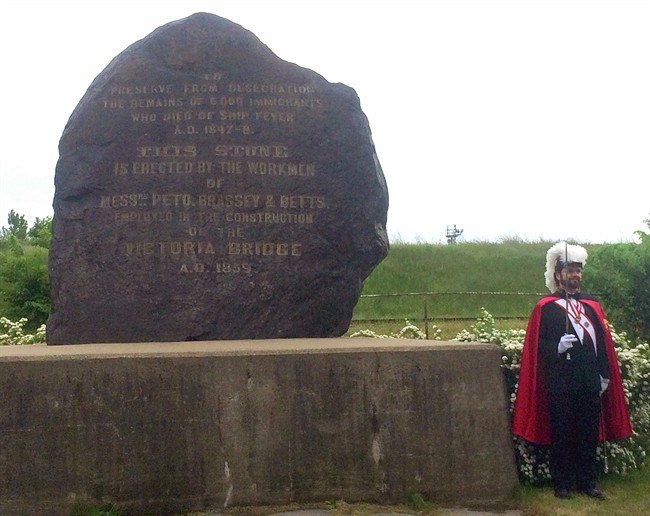
“This is the largest single burial site of the Great Hunger in the world outside of Ireland itself,” said Victor Boyle, one of the directors of the Montreal Irish Memorial Park Foundation.
“It’s also the first memorial to that event outside of Ireland.”
But he says that while cities such as Toronto have prominent memorials to their Irish ship fever victims, Montreal’s much-larger number of dead are going unrecognized.
On Sunday, about 100 members of the Irish community took part in an annual walk to the site.
The ceremony, led by the Ancient Order of Hibernians, has taken place in some form or other since 1865 — six years after the stone was erected by mostly-Irish Victoria bridge construction workers who stumbled across the graves.
Now, Boyle’s foundation is trying to get permission to transform a parking lot adjacent to the site into a memorial park in time for Montreal’s 375th anniversary in 2017.
Boyle says the park would honour not only the Irish victims but also the Montrealers who risked their health and safety to help them, ranging from clergy members to British soldiers to Montreal’s mayor, John Easton Mills, who contracted typhus and died in 1847 after visiting the fever sheds.
He also wants to salute the many Quebecois families who adopted Irish orphans into their families.
He says Montreal’s mayor, Denis Coderre, has met with the park foundation on two occasions and expressed support for the project.
The group will also meet in the coming days with the federal Crown corporation that oversees the vacant lot they’re hoping to transform.
Boyle said the group won’t rest until there’s a “meaningful” homage in place.
“All these decades later, and we’re still having ceremonies here,” he said. “That shows we’re never going to forget.”