
Builders question development charge
Advertisement
Read this article for free:
or
Already have an account? Log in here »
We need your support!
Local journalism needs your support!
As we navigate through unprecedented times, our journalists are working harder than ever to bring you the latest local updates to keep you safe and informed.
Now, more than ever, we need your support.
Starting at $15.99 plus taxes every four weeks you can access your Brandon Sun online and full access to all content as it appears on our website.
Subscribe Nowor call circulation directly at (204) 727-0527.
Your pledge helps to ensure we provide the news that matters most to your community!
To continue reading, please subscribe:
Add Brandon Sun access to your Free Press subscription for only an additional
$1 for the first 4 weeks*
- Enjoy unlimited reading on brandonsun.com
- Read the Brandon Sun E-Edition, our digital replica newspaper
*Your next Free Press subscription payment will increase by $1.00 and you will be charged $20.95 plus GST for four weeks. After four weeks, your payment will increase to $24.95 plus GST every four weeks.
Read unlimited articles for free today:
or
Already have an account? Log in here »
Hey there, time traveller!
This article was published 12/09/2017 (3270 days ago), so information in it may no longer be current.
The consumer will ultimately pay for a new development charge, according to the Construction Association of Rural Manitoba.
Kelvin Orr, CARM president, was the first of many to speak out at the City of Brandon public hearing held on Monday.
“As a builder, I do know that margins have never been tighter and return on investments is getting increasingly hard to achieve,” he said. “So my question is, can the consumer afford to pay more?”
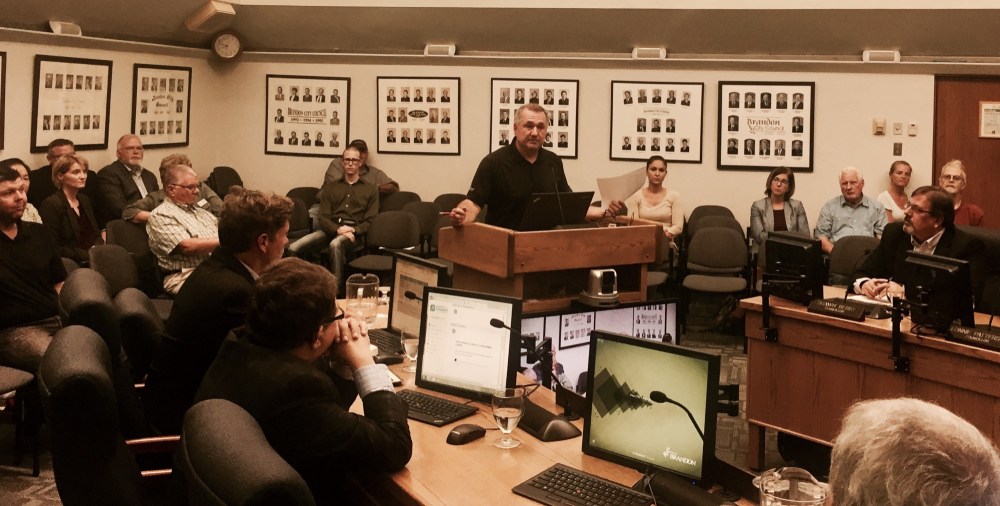
Orr said CARM is worried that this proposed charge would hit the affordable housing market hard.
“We continue to hear that the rent is high in Brandon … no entry-level homes available,” he said. “If you think of adding an extra cost to each unit … that’s pushing the cost of construction up, which in turns pushes rent per month or cost per unit higher. Where is the breaking point, where people cannot afford to live in Brandon anymore?”
The special meeting of council was held to focus solely on the development charges issue and listen to the feedback from the public. The city is looking at establishing the new charge to help pay for new infrastructure that is required for Brandon to grow. This would include capital projects needed in relation to transportation, water, wastewater and drainage.
While many speakers praised the city for being open and transparent, there were also comments from developers that asked council to slow the process down.
“As of now we have not seen a clear plan of how these funds will be tracked, allocated and accounted for,” Orr said. He also questioned if this will push potential developers to other communities.
“These are questions that are hard to answer, but need to be asked and looked at,” he said.
Steve McMillan, vice-president of planning services with VBJ Developments, said the time frame has been difficult for developers to deal with.
“It’s a lot of information for people who are even in the business to understand,” he said. “It seemed almost overwhelming.”
The proposed development charge has been revised following months of feedback and consultation. What is currently before council is a “hybrid charge” — a combination of fees per net hectare and per unit, which would share network infrastructure cost between land developers and builders. There are also different considerations for established areas of the city versus emerging areas.
Cathy Snelgrove, Brandon Chamber of Commerce secretary-treasurer and chair of the chamber’s business development committee, said the business community agrees the city needs to figure out how to fund growth.
“We’re interested of course in doing that, because that helps us strengthen our business community,” she said. “The challenge that we’ve got is we understand from the proposal put forward how builders and developers will fund their portion of the growth. Our big concern is how is the city going to fund their portion of the growth.”
The estimated net cost of infrastructure projects needed for growth over the next 30 years is just under $125 million. The proposal suggests the city could collect $58.2 million through development charges over the next three decades, which would leave $66.6 million to be paid for through property taxes. Currently, the city recovers some infrastructure costs from developers through development agreements that are often entered into as a condition of subdivision, rezoning or conditional use applications.
“In principle, the chamber is supportive of development cost charges, they’ve been used and proven in lots of other communities, but … we won’t really get the full ramification or full understanding of this proposal until we see how council puts that through at time of budget,” Snelgrove said.
» jaustin@brandonsun.com
» Twitter: @jillianaustin