
Workshop confronts forced migration
Advertisement
Read this article for free:
or
Already have an account? Log in here »
We need your support!
Local journalism needs your support!
As we navigate through unprecedented times, our journalists are working harder than ever to bring you the latest local updates to keep you safe and informed.
Now, more than ever, we need your support.
Starting at $15.99 plus taxes every four weeks you can access your Brandon Sun online and full access to all content as it appears on our website.
Subscribe Nowor call circulation directly at (204) 727-0527.
Your pledge helps to ensure we provide the news that matters most to your community!
To continue reading, please subscribe:
Add Brandon Sun access to your Free Press subscription for only an additional
$1 for the first 4 weeks*
- Enjoy unlimited reading on brandonsun.com
- Read the Brandon Sun E-Edition, our digital replica newspaper
*Your next Free Press subscription payment will increase by $1.00 and you will be charged $20.95 plus GST for four weeks. After four weeks, your payment will increase to $24.95 plus GST every four weeks.
Read unlimited articles for free today:
or
Already have an account? Log in here »
Hey there, time traveller!
This article was published 08/11/2017 (3203 days ago), so information in it may no longer be current.
Violent conflict has erupted in our home country. With bombs falling daily, my family of seven can no longer work or go to school. Food is hard to come by, and many of our relatives and friends have been killed.
We are faced with the harrowing question: Do we stay or do we leave?
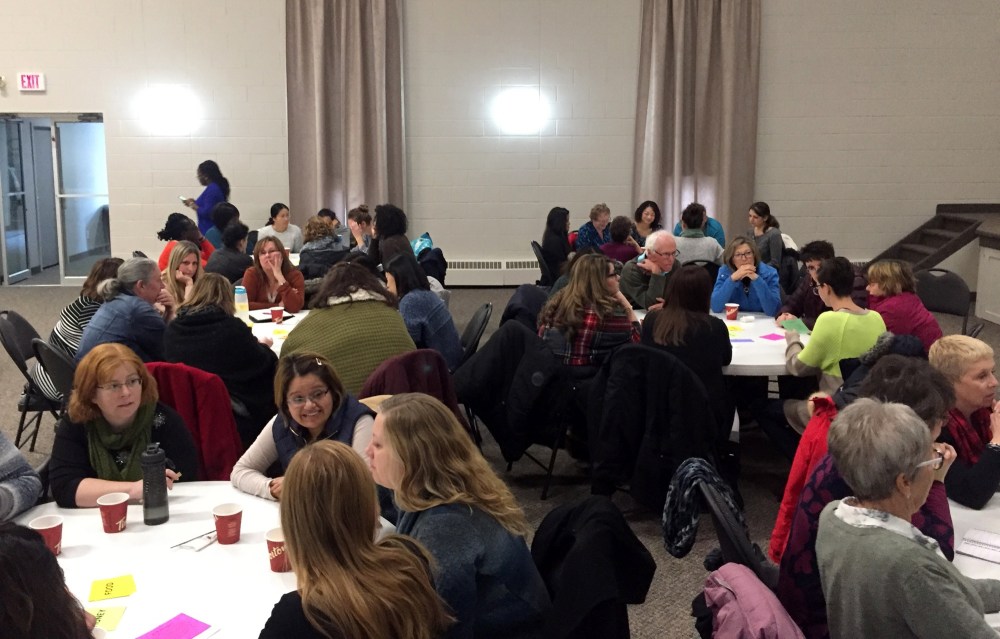
This was the starting point of “Forced to Flee,” a forced migration simulation at McDiarmid Drive Alliance Church. On Tuesday, I was one of 45 people who participated in the workshop, which aims to shine a light and create a better understanding of what thousands of people around the world are faced with when they are forced to leave their country.
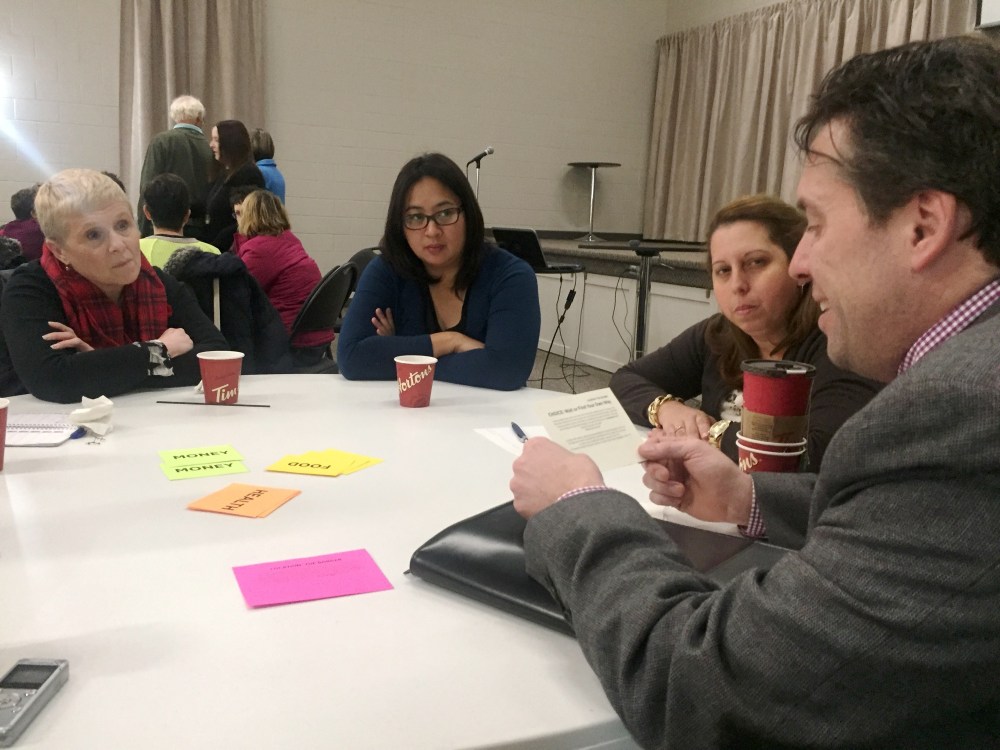
The simulation was presented by Manitoba Association of Newcomer Serving Organizations, in partnership with Westman Immigrant Services and Mennonite Central Committee Manitoba.
Participants were split up into six “households,” all with different scenarios and decisions to be made. Each family begins with a limited amount of resources in the categories of money, health and food. Throughout the workshop, families are presented with cards describing their situations, and options to consider.
Despite not all having proper identification, my family chose the option of leaving immediately. We decided to take our chances, rather than ordering documents and hoping they arrive amid the conflict.
We packed our bags and set out. After walking for days, we encountered a military road block, where officers questioned us and harassed the women. They demanded identification and would not let us pass unless we provided money and food.
At this point, the family decided to bribe the military — a risky move, but one of our only options. Our resources were declining, but fortunately we were able to catch a bus to the border.
A desperate family approached us asking for help. Their resources had dried up and their health was declining rapidly. Our family struggled with what to do, as we were already in our own dire situation. I personally felt torn, as I wanted to help, but also wanted to ensure my family remained safe and healthy.
Ultimately, we decided to give away one of our health resources. But the next time we were approached, we decided we couldn’t afford to help.
“It was hard for me,” said Shawn Lehman, principal of J.R. Reid School. “I was angry at some points (of the workshop). I was frustrated. I felt nauseous when I couldn’t help another group, when we were putting our family first.”
Another fellow family member was Linda Chegwin, who said she had to put aside her Canadian mentality of abundance and sharing so she could put herself in the mindset of a refugee.
“There is no guarantee about tomorrow, so my degree of generosity would be modified,” she said. “I would still hope that deep inside I have a generous spirit, but I’m much more cautious … just thinking, where are we going to be tomorrow as a refugee family?”
When we finally get to the border, we join crowds of desperate people. The path is blocked off with a razor wire because the country has already taken in more refugees than it can handle.
What came next was another difficult decision. Do we wait with others — some of whom have already been waiting for days — until we are permitted to cross the border? Do we take our family through the cornfields and try to get into the next country at an unofficial border crossing? Or do we sneak through the forest and try to enter the country illegally?
With dwindling food rations, the group’s decision was to sneak through the forest, thinking we would have better luck than going through a cornfield. After a harrowing journey and almost getting caught, we finally make it to a small town. We see people from our home country who have built a small community. While there is no plumbing or electricity, the group occasionally gets food assistance through humanitarian organizations.
Eventually, our family is approached by a United Nations representative, who encourages us to register at one of the largest refugee camps in the area. Due to our limited resources, our only option is to stay at the camp. It is overcrowded and presents difficult living conditions, but at least it is supported by humanitarian organizations that supply food and health care.
There is the worry that by registering there, our personal information will be shared with the military in our home country. But we don’t have enough money to find temporary shelter elsewhere in the country, nor can we continue migrating to another country.
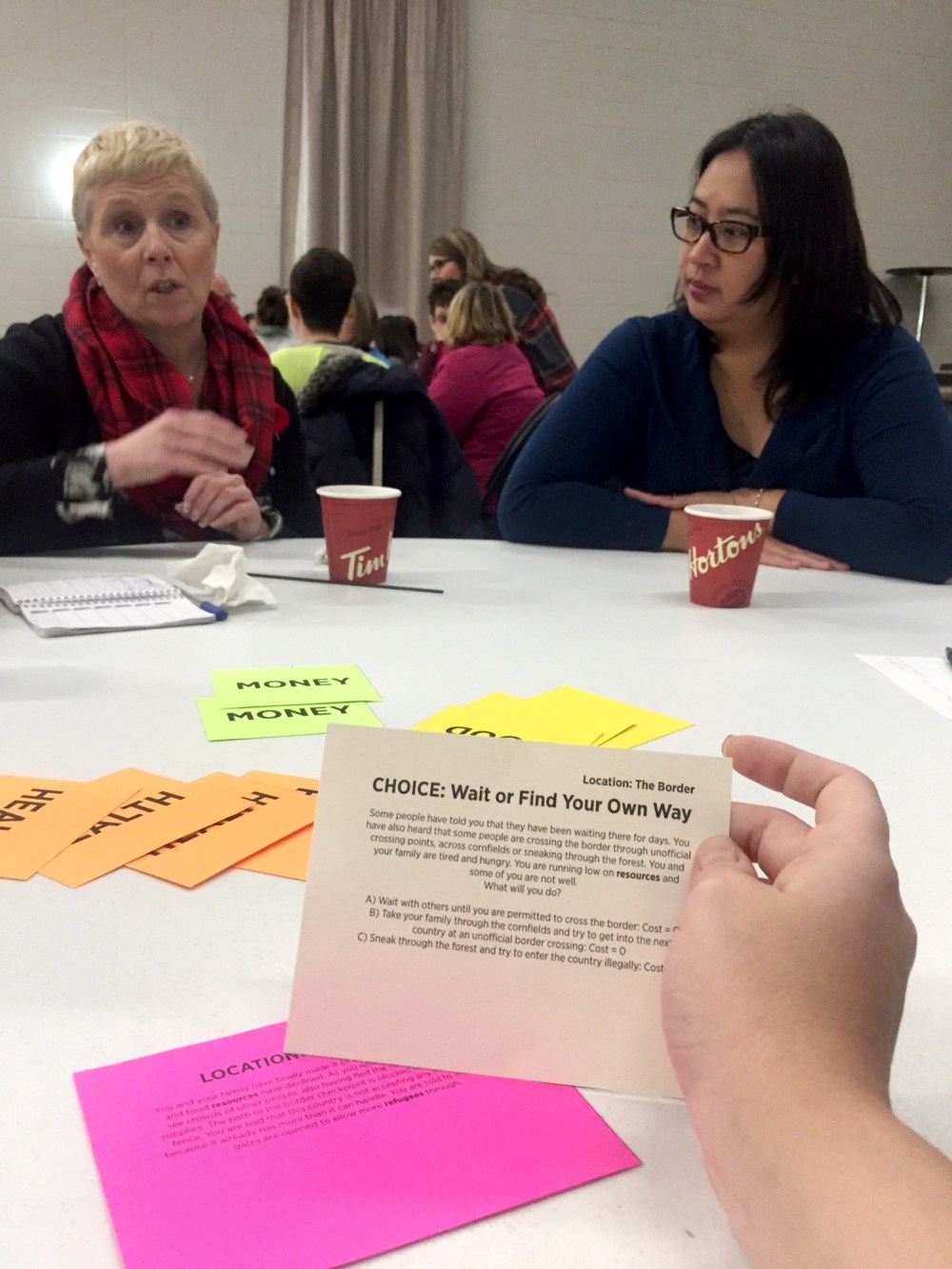
“It’s the turmoil, everybody I think was anxious. We stuck together really well as a unit, even though we had different points of view, we always came to a consensus,” said Debra Gray, of Refuge Brandon.
This was an eye-opening experience for all of us. It was hard to imagine what it would be like to make these desperate, uncertain choices, and the risks you are forced to take, hoping your family will survive. Knowing you are leaving friends and family behind would be a heartbreaking situation. Other participants expressed gratitude to the families who were able to help them stay alive, knowing the refugees didn’t have much to spare. Others expressed guilt for not being able to help.
“It gave me a better understanding of the complex process and the definite challenge,” Lehman said. “It sure created a lot more empathy towards my own perspective of helping refugees or dealing with refugees, especially within our school system.”
ImmaculateNabisere, MANSO program assistant, said the reaction from participants went beyond what they had envisioned. She hopes it ignited emotions that will lead to more discussion in communities.
“Now it’s time to talk about refugee settlement, talk about issues, how can we help,” she said. “How can we help their settlement and integration into communities, be better and smoother?”
In Brandon, there have been 98 government-assisted refugees from Syria and Eritrea come through the Resettlement Assistance Program, between September 2016 and August 2017. Sixteen more refugees are destined for Brandon in the near future.
For those looking to help newcomers to Brandon, there are many volunteer opportunities at WIS, including English classes, family programs, refugee programs and host families.
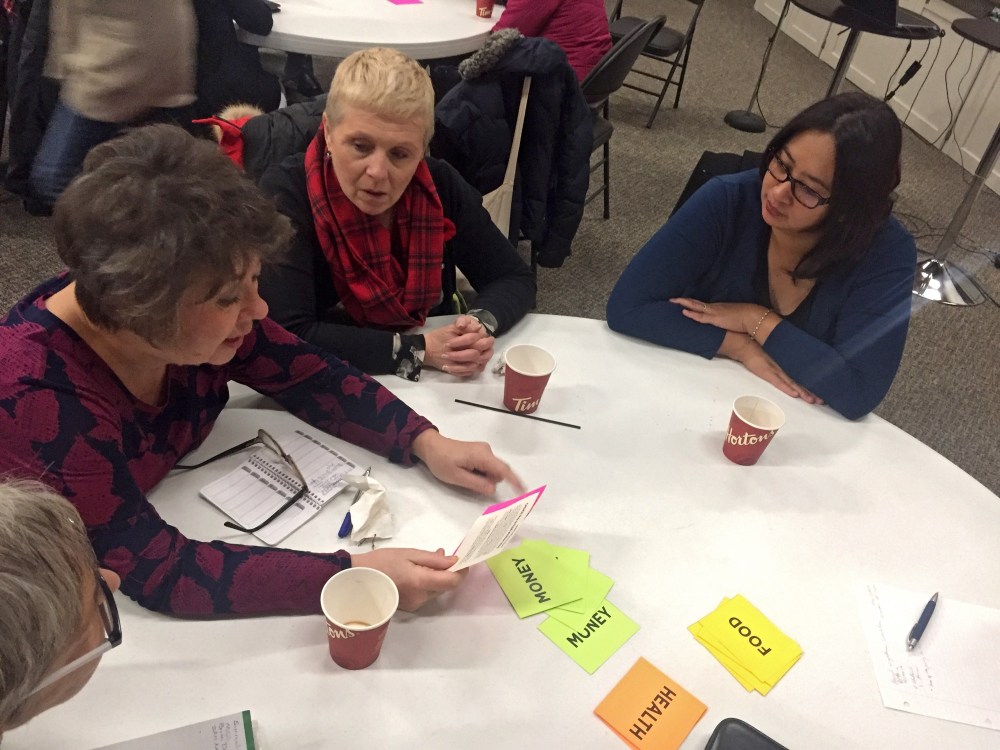
WendyPetersen, WIS’s Resettlement Assistance Program manager, said she was pleased to see participants become enlightened by the simulation process.
“We still go home to our comfortable houses, and food on the table and all of those things, but at the end of the day you’ve got a small snapshot of what it would be like to be in that position.”
» jaustin@brandonsun.com
» Twitter: @jillianaustin