
‘Where the heck did you come from?’
Advertisement
Read this article for free:
or
Already have an account? Log in here »
We need your support!
Local journalism needs your support!
As we navigate through unprecedented times, our journalists are working harder than ever to bring you the latest local updates to keep you safe and informed.
Now, more than ever, we need your support.
Starting at $15.99 plus taxes every four weeks you can access your Brandon Sun online and full access to all content as it appears on our website.
Subscribe Nowor call circulation directly at (204) 727-0527.
Your pledge helps to ensure we provide the news that matters most to your community!
To continue reading, please subscribe:
Add Brandon Sun access to your Free Press subscription for only an additional
$1 for the first 4 weeks*
*Your next subscription payment will increase by $1.00 and you will be charged $20.00 plus GST for four weeks. After four weeks, your payment will increase to $24.00 plus GST every four weeks.
Read unlimited articles for free today:
or
Already have an account? Log in here »
Hey there, time traveller!
This article was published 25/01/2018 (2988 days ago), so information in it may no longer be current.
A fossil nearly the size of a conventional flowerpot sat on an end table at Larry Williamson’s home for years. He knew little about it.
“Every now and then, I looked over at him and thought, ‘How old are you and where the heck did you come from?’” the Brandonite recalled.
There was never a doubt the remains of a snail were imprinted in the rock, the distinctive swirl of its shell hard to miss.
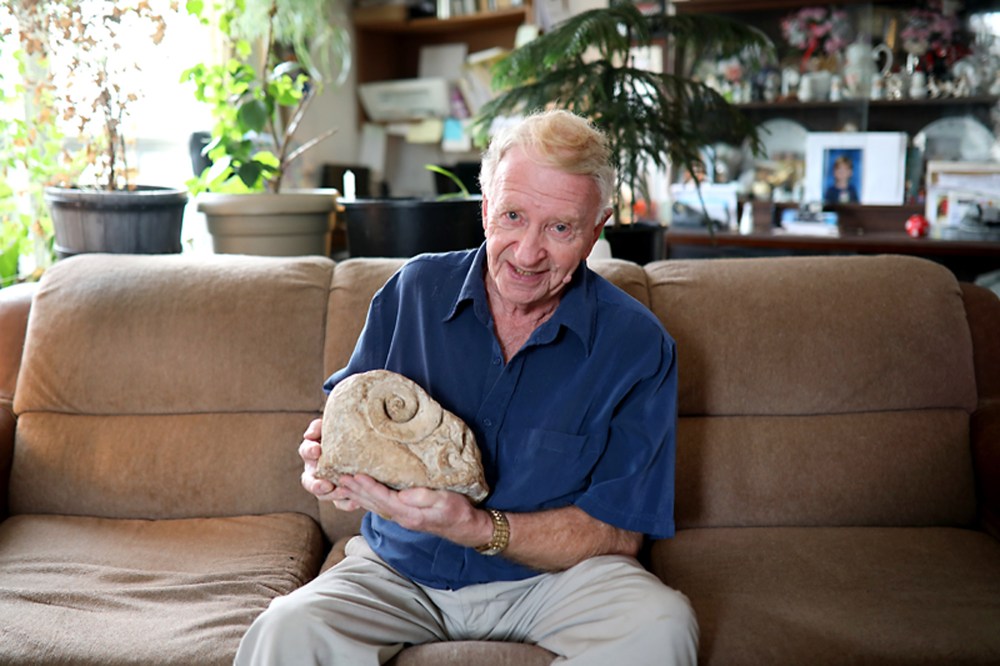
Yet his questions were left unanswered for years, until he read a Brandon Sun story late last year on the new Lake Agassiz book by Bill Redekop. The paperback tells of the massive glacial lake stretching beyond the boundaries of Manitoba, larger than the Great Lakes combined.
Could his fossil have stemmed from that time period, between 8,000 to 14,000 years ago, Williamson wondered? His interest was piqued.
He has since learned his fossil was significantly older.
Williamson contacted the geography department at Brandon University and, this month, met with professor emeritus Harvey Young and professor Rong-Yu Li.
They were impressed, Williamson said. They scanned charts and marveled at the dolomitic limestone rock.
They ruled the fossil is somewhere between 440 to 485 million years old, Li said in an interview.
“That age, that blew me away,” Williamson said.
So did what followed: that the rock would come from the north, deposited near Dauphin by a glacier. The snail lived in saltwater, within a tropical or sub-tropical climate.
Stamped into the fossil is a snail Maclurites manitobaensis, the geologists reasoned, a species that no longer exists.
Williamson spent an hour with the professors, who unraveled a short narrative spanning hundreds of millions of years from a fossil that was essentially a living room ornament for decades.
“Both of them are fantastically knowledgeable, I enjoyed myself thoroughly.”
The rock was discovered in the late 1980s at the game farm Larry and his wife Dianna owned, 10 miles northwest of Dauphin.
One day, a section of their beaver dam was dynamited. The fault of a disgruntled neighbour, the couple figures to this day. No longer held back by the dam, gushing water ran over a road.
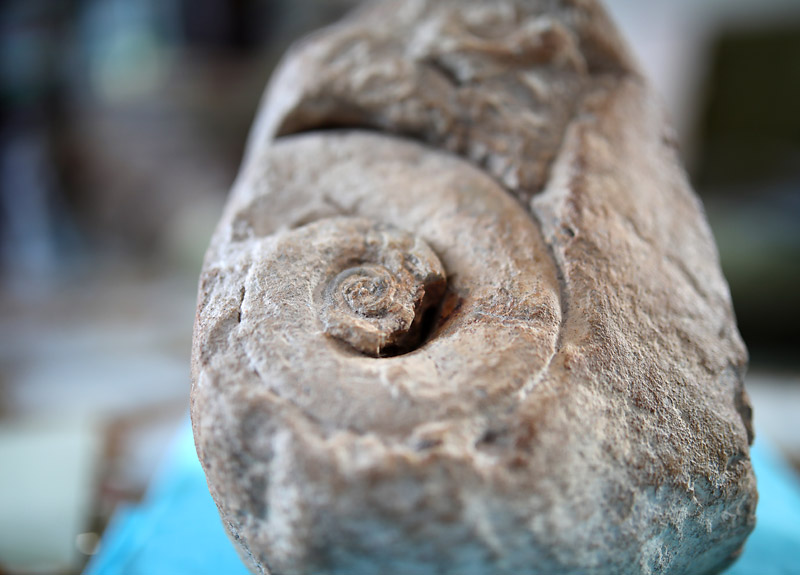
Larry rushed to plug the gap. He was startled when turning around one rock showed the clear engraving of a snail.
By 1992, their game farm ran its course and the couple relocated to Brandon with their children, bringing this hefty rock along with them.
The size of the fossil itself, nearly six inces tall and 10 inches wide, is unique, said BU geography professor Rong-Yu Li.
“We do have some specimens like this kind of fossil,” he said, referring to relics the geology department stores, “but not as big as the one he showed us.”
The world itself is much different today than when that snail lived in a balmy climate.
“Millions of years ago, the whole situation, even the continent’s place or orientation, was quite different from where it is,” Li said. “During that time, maybe, Manitoba was in tropical or sub-tropical zones, rather than nowadays when it’s very cold.”
Williamson, who at 81 works part-time as a security guard, is grateful for the professors’ help. They helped him solve a mystery.
“Now, I can look back (at the rock) and say, ‘I know where you came from.’”
» ifroese@brandonsun.com
» Twitter: @ianfroese