
Gone Gardenin’ — Shrubs can be the perfect addition to any outdoor space
Advertisement
Read this article for free:
or
Already have an account? Log in here »
We need your support!
Local journalism needs your support!
As we navigate through unprecedented times, our journalists are working harder than ever to bring you the latest local updates to keep you safe and informed.
Now, more than ever, we need your support.
Starting at $15.99 plus taxes every four weeks you can access your Brandon Sun online and full access to all content as it appears on our website.
Subscribe Nowor call circulation directly at (204) 727-0527.
Your pledge helps to ensure we provide the news that matters most to your community!
To continue reading, please subscribe:
Add Brandon Sun access to your Free Press subscription for only an additional
$1 for the first 4 weeks*
- Enjoy unlimited reading on brandonsun.com
- Read the Brandon Sun E-Edition, our digital replica newspaper
*Your next Free Press subscription payment will increase by $1.00 and you will be charged $20.95 plus GST for four weeks. After four weeks, your payment will increase to $24.95 plus GST every four weeks.
Read unlimited articles for free today:
or
Already have an account? Log in here »
Hey there, time traveller!
This article was published 26/04/2018 (2995 days ago), so information in it may no longer be current.
Shrubs are an integral part of any landscape; not many home grounds are without them. They add colour, texture, screening and privacy, and a lot of beauty.
Gardeners often choose ninebark shrubs for their landscapes because ninebark is one of the most versatile and easy-to-grow family of shrubs available to prairie gardeners. There are several good varieties that make using ninebark even more versatile because a variety with the appropriate leaf colour and one that grows the desired height can be selected out of a lengthy list of ninebark varieties.
When many folks hear the word ninebark they immediately think of one of the original varieties, ‘Diablo,’ which has become so ubiquitous that it is simply called Diablo, with no other name required — everyone knows what plant is being referenced.
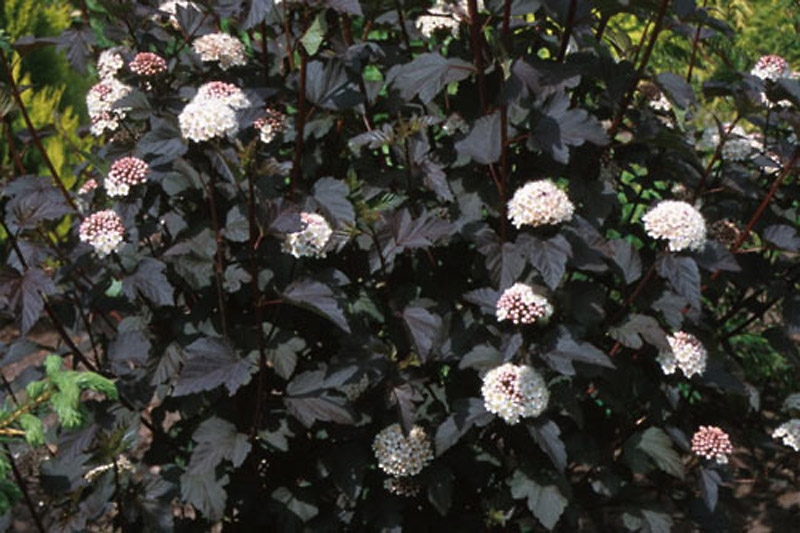
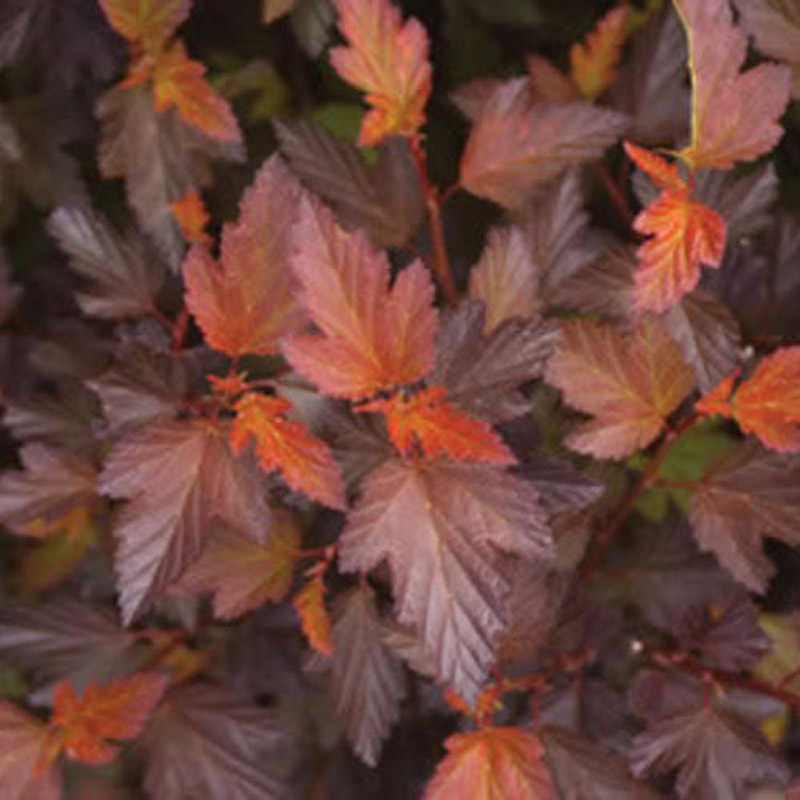
Diablo is a tall shrub, reaching a height of well over three meters. Its dark burgundy foliage is its main attraction and explains why it has become such a popular shrub.
The dark burgundy leaves are heavily veined and produced on branches that have a vertical growth habit. Its upright growth habit means it doesn’t get as wide as some other shrubs so it can be used in more places in the landscape.
Diablo is multi-stemmed and multi-branched, and it is a fast growing shrub that in a couple of years will easily reach two meters in height. It prefers full sun but all ninebarks will perform quite well in part shade. There will be slightly less bloom in such an exposure and any shrub with coloured foliage will be more vividly coloured when exposed to lots of sun than it will when grown in part shade.
Like all shrubs, a newly planted ninebark should be kept well watered until it gets established. After that ninebarks are incredibly drought tolerant and will endure long period without rain with no ill effects.
Diablo is the largest of the ninebarks so if you are looking for a smaller shrub, choose a different variety of ninebark that does not grow as large. ‘Little Devil’ has similar coloured foliage to Diablo, but only grows about 1.5 meters tall.
Its flowers tend to have a purple tint whereas those of Diablo are white. Ninebark flowers are produced in clusters or umbels and the individual flowers are cup-shaped; the flowers appear in June and July and then they are replaced by red seed heads which add colour during the late summer and fall.
Ninebark flowers attract bees, butterflies and even birds — but deer like them also. Aphids and mildew can sometimes attack ninebark shrubs, but generally ninebarks do not experience a lot of disease or insect problems.
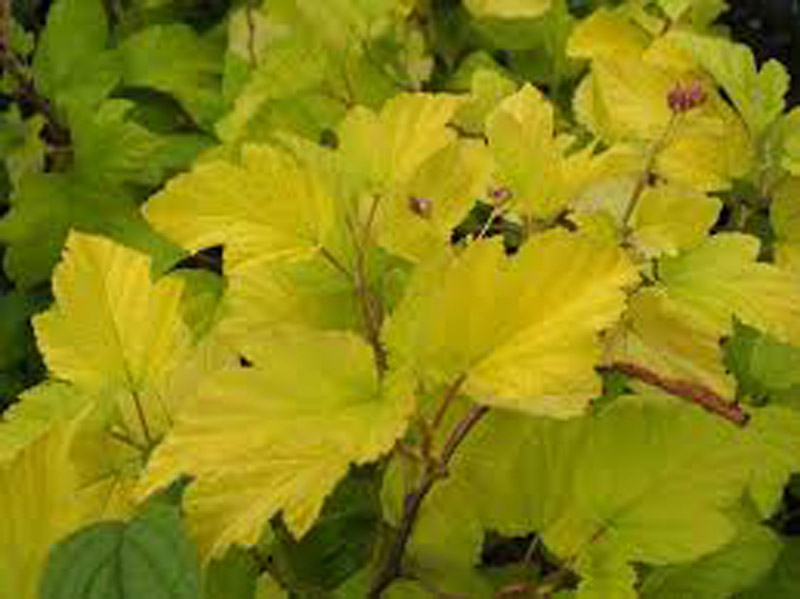
The burgundy-leafed ninebarks are popular, but there are varieties that have gold foliage. ‘Amber Jubilee’ has vibrant multi-coloured foliage of orange, yellow and gold, while ‘Dart’s Gold’ produces pure gold foliage.
Both of these ninebarks produce white flower umbels. ‘Amber Jubilee’ is the shorter of the two, growing to a height of two meters, whereas ‘Dart’s Gold’ will reach almost three meters in height; both have an upright growth habit similar to Diablo. Planting a burgundy-leafed ninebark close to one with gold foliage creates a nice contrast in a shrub border or along a fence.
Ninebarks are fast growing shrubs so they do require consistent pruning. Some people prune the shrubs in the spring before the leaves appear. Spring pruning will remove some of the flower buds so flowering will be reduced; therefore many gardeners prune after the flowers fade or in the fall.
Ninebarks are very tolerant of pruning and the shrubs can be clipped throughout the year to remove errant branches. If a shrub gets too woody and overgrown it might require rejuvenation pruning. The shrub is cut back to just about ground level. New growth will soon emerge and produce a healthy shrub.
Renewal pruning might be conducted on an annual basis; this involves removing a few of the most mature stems each year right back to ground level. In this way the shrub never gets overly woody or overgrown and always consists of relatively new stems (the standard practice is to remove from 1/3 to ¼ of the stems each year). Therefore, no stems are older than four years.
Ninebarks are versatile in terms of sun exposure so they can be used in a variety of locations in the landscape. They are also not fussy about soil type and will grow well in a dry spot or in one that is moist.
All ninebarks can be used as specimen shrubs. Judicious pruning will give them the desired shape and size. The smaller varieties, such as Little Devil, are good shrubs to use in xeriscape landscapes — Little Devil is a good substitute for barberry in such a situation.
Some of the taller ninebarks, such as Diablo, make good privacy hedges. They also provide excellent contrast in a shrub border and the red bark colour will add a note of colour to the border during the winter.
A ninebark shrub, either a burgundy-leafed variety or one with golden foliage can be used to anchor a large flower border. The size of the border will dictate the variety that is most suitable in size.
A formal clipped hedge can also be created by using ninebark and an interesting effect can be created by using both burgundy and gold leafed varieties in the hedge. Ninebark shrubs certainly are versatile; luckily they perform well in prairie gardens.
Albert Parsons lives, writes, and gardens in Minnedosa.
» wtw@brandonsun.com