
Brandon gets mixed grades on municipal spending
Spending per capita trimmed, but labour costs too high: CFIB
Advertisement
Read this article for free:
or
Already have an account? Log in here »
We need your support!
Local journalism needs your support!
As we navigate through unprecedented times, our journalists are working harder than ever to bring you the latest local updates to keep you safe and informed.
Now, more than ever, we need your support.
Starting at $15.99 plus taxes every four weeks you can access your Brandon Sun online and full access to all content as it appears on our website.
Subscribe Nowor call circulation directly at (204) 727-0527.
Your pledge helps to ensure we provide the news that matters most to your community!
To continue reading, please subscribe:
Add Brandon Sun access to your Free Press subscription for only an additional
$1 for the first 4 weeks*
*Your next subscription payment will increase by $1.00 and you will be charged $20.00 plus GST for four weeks. After four weeks, your payment will increase to $24.00 plus GST every four weeks.
Read unlimited articles for free today:
or
Already have an account? Log in here »
Hey there, time traveller!
This article was published 29/08/2018 (2803 days ago), so information in it may no longer be current.
The City of Brandon is ranked No. 6 out of 10 Manitoba cities and towns when it comes to sustainable spending growth, according to a report released by the Canadian Federation of Independent Business.
The fourth edition of the Manitoba Municipal Spending Watch was released Tuesday, and highlighted where Brandon did well and where it came up short.
“If you look at the rankings, (Brandon) still ranks middle of the pack, but if you look at the change in operating spending per capita … it actually declined in 2015, which from our point of view would be a very positive thing, and starting to narrow that gap,” said Jonathan Alward, CFIB director of provincial affairs for Manitoba.

The report evaluates 27 of Manitoba’s largest local governments with populations of greater than 5,000 residents. According to the CFIB, it uses real, inflation-adjusted operating spending to measure whether municipalities are spending sustainably. The report compares real operating spending in 2015 against 2008.
“With municipal elections around the corner, we thought this was the most appropriate time to release the information, because people, we think, need to pay attention to the issue,” Alward said.
Morden topped the cities and towns rankings, followed by Dauphin, Winkler, Selkirk and Portage la Prairie.
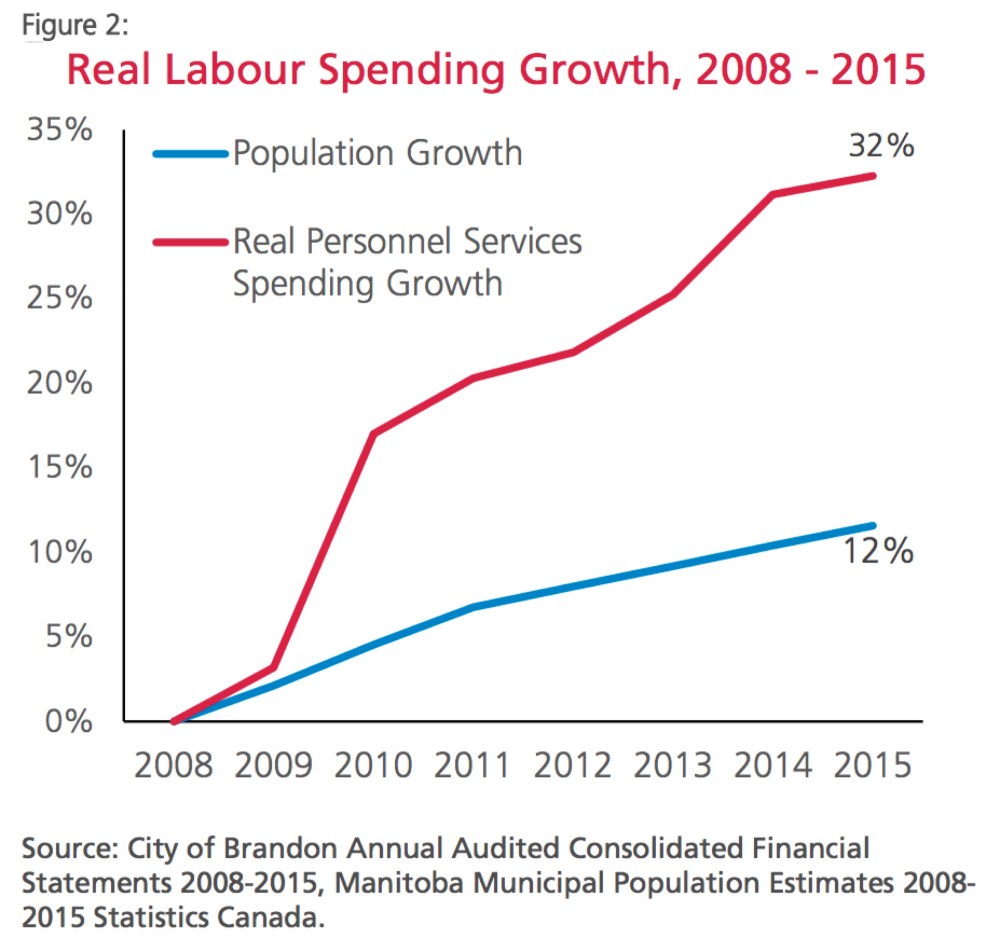
According to the report, from 2008 to 2015, Brandon grew its real operating spending (19 per cent) beyond the sustainability benchmark of population growth (12 per cent).
“They shrunk the gap to just seven per cent, which is still high and ends up costing residents in Brandon quite a bit of money over the time period, but it’s a lot better than some other communities,” Alward said.
Increasing labour costs was once again identified as a major issue in Brandon. According to the report, real labour costs in the city increased by 32 per cent above 2008 levels. In relation to population growth, this has left Brandon with a sustainability gap of about 20 per cent.
“What we’d recommend certainly is trying to really curb what they’re spending on labour. It’s not always an easy fix,” Alward said. “We find that in general, municipal employees are making more than people doing the same job in the private sector.”
Mayor Rick Chrest said city council has been concerned about rising labour costs, but their hands are often tied by the competitive pressures of collective agreements.
“This council has achieved a reasonable balance of fair contracts and longer-term labour stability,” Chrest said. “The graph, I believe, measures against population growth only, but doesn’t take into account inflation, while inflation and cost-of-living increases weigh heavily into labour settlements.”
Overall, Chrest said most municipalities seem to be taking spending control seriously, which is shown in the CFIB report.
“Brandon, in particular, was highlighted by CFIB as making improvements. It is a complex topic and there needs to be some recognition that most councils — ours included — while continuously finding efficiencies and cost savings, are at the same time responding to the needs and requests of our communities,” he said. “Citizens expect services and infrastructure to be maintained and enhanced but also need us to keep their taxes in line. It is definitely a tricky balancing act.”
Chrest said he is proud how council has been able to keep taxes in line, with a “grand total of 2.02 per cent increase in taxes in our four-year term — one-third of inflation — while continuing to enhance services and infrastructure.”
Alward said the CFIB tries to commend good policies and criticize the bad. The hope is that this report will be part of the conversation leading up to Manitoba municipal elections on Oct. 24.
“We want the candidates, both mayoral candidates and councillor candidates, to treat this as a top issue and adopt some of the CFIB’s recommendations, to get spending growth under control and be sustainable.”
» jaustin@brandonsun.com
» Twitter: @jillianaustin